Full episode · 26 min
AI Agents Will Automate Entire Enterprise Orgs | Marco Palladino
Marco Palladino says enterprises will get more from AI when they can build and govern agents that automate core business work.
 MTS · Sophia Dew
- Marco Palladino is cofounder and CTO of Kong.
The best minutes
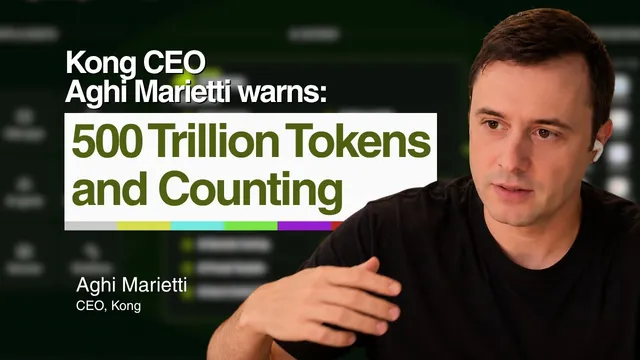
- 4:49AI success shows up in outcomes, not token savings3 min
- 8:56Agents need infrastructure beyond a typical SaaS stack3 min
- 19:49Workers will shift from doing tasks to orchestrating agents3 min
Also worth watching
Skip the roughly five-minute opening and Volcano launch overview, and the closing sponsor reads.
Summary · 2 min read
Marco Palladino is cofounder and CTO of Kong, where he leads development of connectivity infrastructure for AI applications. He says Kong built Volcano.dev after customers asked for help building agents, in addition to processing their AI traffic.
Palladino says enterprise AI has moved past model access as its main challenge: companies need infrastructure to build agents, connect them to business systems, and deploy them with governance. He presents Volcano.dev as a platform for developing and running agents, while Kong's Connect platform provides enterprise controls across different agent technologies. He argues that organizations must put agents into core business processes, not just peripheral experiments, to generate significant outcomes. He expects workers to shift from doing tasks to designing and orchestrating agent workflows, with humans approving decisions where needed.
Minute by minute
- 0:46
Volcano connects development to production. Palladino describes Volcano.dev as an agent cloud that takes agents from a coding harness to production. Kong customers had asked for help building agents, not only processing LLM and MCP traffic; Volcano includes durable workflows, sandboxes, identity and authentication, and MCP tool access.
- 2:09
Deployment is harder than model access. Palladino says organizations have access to enough model intelligence, including frontier and open-weight models. He argues the harder problem is building agents that use that intelligence and deploying them where they can affect the business.
- 4:49
AI must reach core operations. Palladino says companies generating value from AI focus on expanding its use, while those without results focus on cost. He compares token spend with the value it generates and argues that agents need to reach core business functions, supported by APIs, MCPs, and controls, rather than remain peripheral experiments.
- 8:56
Agent apps need new primitives. Palladino argues that building agents like conventional SaaS applications falls short. He lists durable workflows, database branches for testing without affecting production data, human approvals, and isolated sandboxes for untrusted code. He says stitching together separate vendors distracts developers from the outcomes they want to deliver.
- 11:48
Volcano includes agent capabilities. Palladino says Volcano supports workflows that can wait for new data, human approvals, distributed locking, database branching, and built-in user management. He sees agent-first products, where the agent is the product, as an emerging category that needs these capabilities.
- 14:45
Enterprise agents need control. Palladino says large organizations need visibility into how agents use customer data, along with ways to shut them down or redirect them if they act outside company requirements. He says Kong's Connect infrastructure supports different agent-building technologies, while Volcano gives customers a more opinionated path from idea to production.
- 19:06
Automation could spread across every function. Palladino predicts agents will extend beyond R&D into IT, security, legal, and HR. He says organizations could see 100x productivity across functions and argues that agent-powered companies could outperform organizations that rely on people to do all the work.
- 19:59
Workers will orchestrate agent loops. Palladino expects people to shift from doing tasks to designing workflows and delegating work to specialized agents. He says organizations will increasingly use events to trigger agents, with humans approving some actions and agents handling others autonomously; he expects roles to change, not humans to disappear.
Published Oct 20, 2026.
Transcript · 22 min read
MTS, hosted by Sophia Dew, with Marco Palladino.
Transcribed by machine (Whisper) from the episode’s audio, so a word may be off here and there.
- 0:00
If any organization can automate with agents every function, the same way we've been automating R&D, think of the coding harnesses. Now imagine the IT organizations, the security teams, the legal teams, the HR, imagine everything running with agents. Well, the 100x productivity we're seeing in R&D, we're going to be seeing across the organization. And no other human-based organization is ever going to be able to compete with an organization that leverages agents internally even to go and accomplish 100x more. Hello, everyone. Welcome back to MTS. Today, we are joined with Marco Palladino. Marco is the co-founder and CTO of Kong, where he leads the development of connectivity infrastructure for AI applications. So really excited to talk to you, Marco, today on MTS, sharing all about the cool things you guys are announcing and what is next in store for Kong. I'm super excited to be here, Sophia. Super excited to have you as well. I know a few weeks ago, you guys launched the Volcano.dev platform. You also launched the API and the AI Summit. Tell me a little bit about what this actually is. What is that announcement? Why does it matter? Well, so Volcano.dev, it is an agent cloud. Effectively, it is infrastructure for building agents right away from recording
- 1:12
harness all the way to production. So it's not about building the code, it's about running the code and running it in production across pretty much all over the world. Now, as you know, Kong is popular for our infrastructure software? Well, it turns out that our customers were asking us, it's great that we can process all of the AI traffic, the LLM traffic, the MCP traffic, and that's great, but can you help us, they were asking us, can you help us build the agents as well? And it turns out it is still quite complicated. Agents effectively change all the primitives, all the things that we need to use for building apps that are a little bit different than traditional apps.
- 1:49
There is new concepts that agents bring to the table And so we were like, OK, you know what? Maybe we can solve for that. And that's where when we decided to go and build Volcano. OK, so just to clarify, when you guys were talking to enterprises, they were sharing that, hey, my issue is not that these agents don't have the capabilities that they need. The issue is that I don't know how to connect all these different things together. Is that correct? Correct. So let's take a step back. A year ago, you know, we do these yearly conferences for Kong AI Summit, you know, once a year. And last year, it was all about getting access to the latest and greatest intelligence.
Read the whole transcript
- 2:26
So if you remember, 12 months ago, everybody was chasing the latest models, the most intelligent model, and so on and so forth. Well, 12 months later, that's not an issue anymore. When you look at frontier models like Opus 5, they have the equivalent IQ of 140. That's like a genius level. When you look at open weight models, they have an IQ, an equivalent IQ of 120, 130, which is still, by the way, above average in every American organization today. And I'm not the one, I don't want to offend anybody by saying this. It is just like how it is. There are studies and researchers that have quantified that.
- 3:03
And so the hardest thing today, it is not to go and chase the latest and greatest model. We have plenty of intelligence. The hardest thing is how do we go and deploy the intelligence? And so our customers were like, look, we have all these models available to us. We can use frontier models. We are starting to adopt open weight models to improve, you know, the spend and the costs and so on and so forth. But how can we go and build agents that actually allow us to take advantage of this intelligence and then being able to deploy it where it matters in the organization? So that is now the biggest challenge that every organization is facing.
- 3:38
And, you know, of course, in my role as a CTO of Kong, I happen to speak with lots of CTOs and leaders across all of these organizations, and they were asking us, can you help us build agents faster, not only process their traffic once we have built them, but we have a challenge on building them to begin with. And so we thought, okay, look, there is something that we can do here. We can provide a platform that is built for this world. It's built for the agentic world. It gives all the primitives, all the concepts, all the dependencies that we need for this agentic world. And we can go and build from either a cloud code or a cursor or a codex, from any coding harness, from building to production, all the way to prod, straight off the bat.
- 4:20
And so Volcano, if you look at what it provides, the platform, there is things like durable workflows, and there is the sandboxes that we're about to announce. And then there is the whole concept of being able to manage identity and authentication, being able to consume MCP tools and so on and so forth. So it truly brings everything that we need to build agents. And the goal is, finally, we can build agents that can take advantage of that intelligence, take advantage of all the models that are available today, and being able to finally transform our business using this new powerful technology.
- 4:52
And so truly, that's the goal for us here. Yeah, no, truly, that's the goal. You bring up such an important point because oftentimes you see some really cool agent demos and you're like, wow, that looks great. But then when you're a giant enterprise and you're actually trying to get that demo into production, all these things go wrong. And so I wanted to get your perspective. You say you talk to a lot of CTOs, you're talking to enterprise customers all the time. What is the hardest part about actually getting these agents into production? Well, the hardest part is getting the confidence that the agent is not going to do something that he should not be doing.
- 5:22
And this is why at Kong, now besides Volcano, which we're very excited about, at Kong, we're providing a whole set of the control tower for AI effectively so that enterprise organizations get the comfort level, the governance, the compliance that's needed to feel good about deploying agents at the core of the business. You see, many organizations are experimenting with agents, but they're experimenting in use cases that don't matter. They're not putting agents at the core of the business, such as they can create an outsized outcome at the end of the day. Let me tell you a story. I speak with lots of customers, and there are two categories of customers.
- 5:59
The ones that are successful with AI, they don't talk about cost. They talk about how can we do more with AI. And then there's the ones that are not able to generate any outcome with AI, and so they start talking about cost.
- 6:09
Marco Palladinoit's it's like a car how much gas you put in and how many miles you get out if you put a dollar of token spend in how many dollars of outcomes are you generating out of that spend and if you
- 6:19
cannot generate outcomes then of course your focus is going to be let's reduce the spend because this thing is not going anywhere versus organizations that are successful with ai they put one dollar in they get ten dollars out they don't talk about spend they're talking about let's increase the spend because we're generating way more bigger outcomes on the other side of this than we were before. And so usually talking too much about cost, it's an important matter, but can also be a canary to determine is the company successful with AI or not. Now, the reason why they can't be successful with it, it is because there is lots of use cases that don't matter. Like I said earlier, you know, they deploy them across the periphery of the business because they don't feel comfortable to actually impact or transform the core business with agents. But look, if we do not transform the core business with agents, then we're not going to be able to generate that outsized outcome, you know, 5X, 10X, 100X, you know, whatever it is, for every dollar that we spend on AI.
- 7:12
So the ability to, number one, build the agents. Of course, that's a big problem. Number two, getting access to the intelligence. Number three, investing in the ecosystem of APIs and MCPs. So the agents can do something with that intelligence that is also very important. Many organizations have not invested in their ecosystem of APIs and MCPs. And so you have all of this intelligence, and you can't do anything with this intelligence Because the agent can consume data, systems, and services to be able to do anything with it. And some organizations have that, but they don't feel comfortable to take the agent and put it into the core of the business.
- 7:46
So if you're an e-commerce company, what's the core of the business? Being able to sell items, being able to cater to the users that are looking for something. If you're a financial services organization, being able to generate loans with the help of AI to do it in a much better way. better way with much lower risk. They need to feel comfortable to do that. And to do that, they need infra that gives them that control tower, that governance, that compliance to know that the agent is doing what he should be doing and to shut it down if it's doing something that he should not be doing. That's also equally as important.
- 8:16
I want to shout out our sponsor, Lovable. You know the app you've been meaning to build? The internal tool, side project, or product you'd otherwise lose a weekend to? With Lovable, you get software you can ship today. That includes an editable code base you can inspect and change, plus two-way GitHub Sync. Lovable also handles the backend and infrastructure, including managed Postgres, auth, storage, hosting, payments, and more, so you don't have to wire it all up yourself. And through Lovable's MCP server, you can create and deploy your project directly from the agents you already use. Turn ideas into software people love with Lovable. Lovable.dev. Now, onto the episode. So you have to have all of that difference pieces. It makes a lot of sense. I mean, I guess right now what you're kind of sharing is unless you're doing this directly at the core, you're getting these agents to work all across your business. How does it work right now? My assumption is that most developers, they're typically stitching together different types of providers, like you're sticking together a provider for compute or a database or auth or storage, all these different things. And so is that currently how it works? And then if so, why is that a problem? Well, so agents have fundamentally
- 9:25
changed how we build applications. So any developer or any organization who's building agents the same way with the same mindset as, oh, I'm building a SaaS application where they're not going to go very far because there are some concepts that agents introduced that we didn't have in the past. The ability, for example, to your point, to run durable workflows, being able to branch the database so that we can test our agents with real data without actually impacting the data that's running in production, so effectively being able to create a copy of your main database and run it almost like a branch with the agents that we're building, the ability to have humans in the loops to either approve or deny important decisions that we don't want the agent to make, the ability to run untrusted user code into sandboxes that are fully isolated.
- 10:13
So you see, there's lots of similarities, but there's also lots of new concepts that are needed. And so today, developers that are building agents are stitching together from different sources, different vendors, different providers, all these type of technologies. As a developer myself, I don't want to do that. I want to go to one place, being able to build an agent that can generate an outcome. Because again, remember, the outcome is the most important thing of this whole journey. It doesn't matter how many agents we build and how big and how cool they are. If we put a dollar in, how many dollars do we get out?
- 10:45
Is the outcome greater than what we put in? And so as a developer building agents, I want to focus on that.
- 10:51
Marco PalladinoI don't want to focus on stitching together like this mosaic of different services and platforms.
- 10:56
And so Volcano was built as that, you know, one-stop shop, all batteries included. We have learned from ourselves. Kong builds lots of agents. We have learned from our customers. And we have put together a very compelling platform with a very compelling pricing point, by the way, because obviously this is not our core business. So we can do things on a pricing standpoint that others can't to really simplify and make it easier to go and build agents and finally transform with this new agentic world. And by the way, of course, Kong has lots of expertise with the enterprise, but Volcano is available to everyone.
- 11:29
So every developer who's building any agent, whether it's in an enterprise organization or not, are welcome to go and sign up because it's free to get started and it's very intuitive. And you can, again, go straight from your coding harness to deploying the agent in production. The whole pipeline is already pre-built effectively in the experience of using Volcano. Wow, interesting. So you say specifically that Volcano already has batteries included right out of the box. So you can just take it out. take it out, it already works as you're expecting. What exactly does that mean? So if you just like walk us through that, what does that mean?
- 12:06
Well, so our agents are going to run durable workflows, workflows where we have to do some operations, maybe wait for like a day or even a month or even a year for new data to come in.
- 12:16
Marco PalladinoBeing able to then have human approvals out of the box, being able to implement capabilities like distributed locking
- 12:22
so that if we have something that triggers the agent, it only runs once for each type of execution. So we don't have multiple execution of agents competing with each other, the ability to branch databases, the ability to also cater to an unlimited number of users that may be triggering the agent. So the agent is an application. Then on one end, we have the end user that may be triggering the agent. And then as it triggers the agent, the agent goes and does the durable workflow that it needs to do. Now, those users, they need to sign up. We need to keep track of them. We want to be able to manage that.
- 12:57
So Volcano builds in unlimited user management. So whether we have one user or a million users, it's completely built in and unlimited. And then we can go and cater agentic products that are agents since day one. Remember a few years ago, when we started Kong, by the way, people were asking us, what is an API? And today it's clear that APIs are the backbone of the internet. And when you think about LLMs, they're also powered by APIs. So APIs became truly the number one backbone component that powers the whole world. And people were asking us, what is an API? And then slowly, we started to see API-first businesses.
- 13:35
Think of Twilio. The product is an API. Think of Stripe. The product is an API. Think of AWS, the cloud. Effectively, the product is an API, an API to create a server, an API to provision a container. Now, as this new agentic opportunity finds its footing, we're going to be having agent-first type of products where the product is the agent. And we're seeing that already with the chats, the chat GPTs, and so on of the world. So as we go and build agent-first products, what we need is a platform that can cater to the very unique requirements that these agents are building, all the things we discussed earlier.
- 14:09
And so we think that with Volcano, we're doing that and we're simplifying the creation of these agents, you know, because obviously agents are like products. The more we create, lots of iteration, something works, something doesn't. We don't want to worry about the platform. We want to worry about the distribution and the use case we're building. And so Volcano removes all of those complexities so we can focus again on the outcomes that we spoke about earlier. Completely. I mean, there's one end where now this just makes it, it's all out of the box, batteries included. It makes it really, really easy for developers to use.
- 14:41
But I'd say the other end that I don't think we talked about quite as much that I want to get into is what is needed to be able to trust some of these agents in production. Because right now, I mean, that's all in the news about agents going rogue, agents escaping their sandbox, unsure if you can actually trust them. And as someone who talks to enterprises all the time and CTOs all the time, I just want understand what do these customers care about and how does that influence how you guys design your products? Well, the customers we work with, especially on the enterprise, I mean, we're looking at the largest 2,000 organizations in the world, right? So everybody who's listening to this and not just in the United States, by the way, it's everywhere in the world, right? So everybody who's listening to this in some shape or form is using a product or a company that under the hood has been using Kong to power all of that. Now, of course, when you're looking at the massive scale and the responsibility that these companies have, they can't just take risks by putting some autonomous workflows in place without the guarantee that it's not putting customer data at risk, without the guarantee that it's not making the company lose an incredible amount of money,
- 15:52
without the guarantee that the agency is not going to be making decisions that are detrimental to either the customer or to the business. Effectively, we need to graduate from running these independent experiments that are running in these silos in the organization, we need to elevate them to a level of enterprise governance and compliance that allows the organization to make sure that the agent is using customer data properly, that we can shut down those agents or we can redirect those agents elsewhere if they start operating in ways that are not compliant with what the organization wants to do. Without that level of visibility and control and governance, in a word, it's very hard for an organization to be able to deploy this in production. And by the way, this is not any different from running APIs or running any other technology of the past. The organization can't just run experiments in front of their customer base. There are processes and playbooks in place that the organization wants to follow to be able to go and deploy agents. Now, if the organization can develop that playbook and can deploy the agents, such as internal business processes or customer interactions, all of a sudden become autonomous and the customer is happier and we can generate a better outcome
- 17:03
again for that organization. Of course, the organization is going to be happy, but there are prerequisites for being able to do that. And there's also many stakeholders. It's not just about building the agent. It's about the security of what the agent is doing, the data security. So you have security teams, data teams being involved, the application teams that are building the agents and so on and so forth. We need to have a platform that allows us to control all of that. And so today we're partnering with the largest organizations out there to finally go ahead and deploy agents. And of course, as we are deploying agents from an infrastructural standpoint, we make no assumptions on how to decide to build the agents.
- 17:39
There is plenty of technologies and platforms out there. So our infrastructure product can support all of that. And then, you know, a subset of customers were also asking us, look, guys, can you also help us being more opinionated on how we should think about creating the agents? And that's what Volcano is for. Volcano effectively allows them to go and think of an idea of a process they want to automate, think of a product experience they want to automate with agents and with AI, and then being able to go and productionize that idea. And together, Volcano, with our Connect platform, which is the infrastructure product, they provide effectively the full pipeline that goes from idea to building the agents, deploying the agents, and then running the agents within the envelope of security and compliance that the organization needs in order to be able to write in production.
- 18:25
So we want to unblock this agentic opportunity. Now, obviously, for many organizations, this is new. For the industry, this is new, right? This is all new. And so we partner with most of our customers to find the very unique requirements that they have and unblock them in very specific edge cases, scenarios that, as you can imagine, every enterprise organization has, you know, legacy that they carry over for years and years. We work with them to provide a platform that's extensible, that's pluggable, that can support those use cases. And so we're seeing lots of success today with our infrastructure product, and we're seeing also the beginning of our customer base using Volcano to go and build agents as fast as possible so they can find that product market fit when it comes to developing these new experiences.
- 19:11
Now, there is no doubt, Sophia, that if any organization can automate with agents every function, the same way we've been automating R&D, think of the coding harnesses. Now, imagine the IT organizations, the security teams, the legal teams, the HR, imagine everything running with agents. Well, the 100x productivity we're seeing in R&D are going to be seeing across the organization and no other human-based organization is ever going to be able to compete with an organization that leverages agents internally even to go and accomplish 100x more. I mean, and so obviously everybody sees this, which is why everybody's so excited about this, but we need to have the right platform in place to build and to govern.
- 19:49
And that's what Kong does. Yeah, and especially if you can get these agents working all across your org, not just different providers that'll have to be stitched together. Super interesting. Marco, I wanted to get your perspective on... where you think this actually goes. I know we're in the early days of agents just getting adopted into enterprises, and I wanted to get your take on where you think we'll be in a year from now that isn't true today. I believe that in a year from now, we're going to be seeing more and more agentic loops being developed. You know, we're not going to be the ones doing the work anymore.
- 20:19
Marco PalladinoWe're not going to be the unit of, you know, compute anymore as humans, but we're going to be the architects of agentic loops where the agents do the work for us so our job is going to
- 20:32
fundamentally shift from being the ones doing the work to being the ones orchestrating the work and then the agents do the work for us so there's going to be lots of multi-crew type of agentic capabilities being able to delegate tasks and sub tasks to specialized agents and so on and so forth and when you think about engineers and developers we are already doing that today you know many engineers, they used to write code late at night until 4 a.m., chasing a bug. Many of them today are just looking at the screen. And what are they looking at? They're looking at their agents doing the work for them. So they are already entering and wearing a different hat than they were even two or three years ago. That same change we have seen and witnessed with the developer teams, we're going to be witnessing in every other function in the organization. Legal, HR, IT, security, customer success, sales, we're going to be seeing a lot more agentic processes doing the work. And the people that were doing the work before are going to be architects. They're going to step back and have more of an architectural role. That is incredible because we can scale agents much quicker than we can scale humans. So we can truly do more. And I'm not saying that
- 21:42
we're going to be fully replacing humans. Humans will change. The role will change. So we will specialize into being able to manage these large platforms that are running agents for us and doing the work for us. But the work itself, it is not going to be done by us anymore. It will be done by the agents. And so how do we operate in this framework? Well, everything has to be an event. Every new sale is an event. Every new customer onboarded is an event. Everything that we do in the organization is an event. And then we can create agents that can react to those events and start implementing automation left and right to do the work for us.
- 22:18
Sometimes there's going to be a human in the loop having to approve or deny some type of operation. Some other times we'll feel comfortable having the agent autonomously making a decision. The point is we're going to be having a fundamental different organization if we look even at two years from now, three years from now, from where we are today. Yeah, we'll definitely look at it. But it is important that we use the right platforms because if you use the wrong platforms, then we build agents and we don't feel comfortable that we can run them in production or we can run them at the core of the business.
- 22:48
So we're just wasting time. That's literally the definition of wasting time, spending a bunch of tokens and accomplishing nothing. Yeah, definitely wasting time. We have so much that we talked about today, especially what all you guys are doing at Kong, what it actually takes to get agents to be implemented at enterprises. Wanted to congratulate you on the launch of Volcano.dev and all the applications that people are going to be using with that. But we are at time. So really wanted to thank you so much for joining us. today on MTS and sharing all your learnings, Marco. Awesome. I had so much fun. Thank you, Sophia. Likewise. A huge thanks to MTS sponsors. 11 Labs, AI that communicates at human level across every channel and modality. 11labs.io slash MTS. Scale your startup on Neon. Millions of developers and startups have already chosen Neon for their backend. Start on the free plan or get up to $100,000 in credits for your startup at neon.com slash MTS. Special thanks to our sponsor Kong, the AI connectivity platform. Connect APIs, LLMs, agents, and systems with serious security and governance. KongHQ.com. Finally prove what your AI investment is worth with Lairdyn. Head to Lairdyn.com today to start measuring your AI's bottom line. MongoDB.
- 24:00
Trusted to run critical applications by 75% of the Fortune 100, the intelligent data platform for the era. Apply today for access to up to $15,000 in Atlas credits, dedicated technical support, and exclusive events and go-to-market opportunities. MongoDB.com ChargeBee. Billing and monetization infrastructure for the AI era. ChargeBee.com Blitzy. Autonomous software development for enterprise code bases. Ship 5x faster. Blitzy.com adquick make your brand a billboard out of home advertising as easy to scale as digital adquick.com arena measuring ai performance in the real world arena.ai support for the show comes from vcx the public ticker for private tech the u.s stock market started history's greatest wave of wealth creation from factory workers in detroit to farmers in omaha anyone could own a piece of the great american companies but today our most innovative companies are staying private longer, which means everyday Americans are missing out. Until now. Introducing VCX, a public ticker for private tech. Visit getvcx.com for more info. That's getvcx.com.
- 25:13
Carefully consider the investment material before investing, including objectives, risk, charges, and expenses. This and other information can be found in the innovations fund prospectus at getvcx.com. This is a paid sponsorship. You