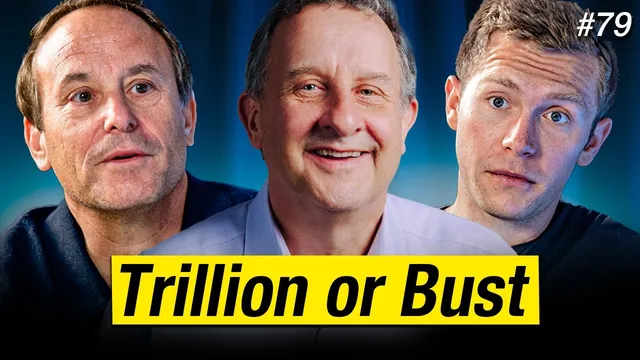
Full episode · 32 min
Demis Hassabis: Why AGI is Bigger than the Industrial Revolution & Where Are The Bottlenecks in AI
Demis Hassabis says AGI could arrive within five years and may transform science, while major technical and safety challenges remain.
 20VC · Harry Stebbings
- Demis Hassabis is co-founder and CEO of Google DeepMind.
The best minutes
- 2:43AI still lacks continual learning despite strong scaling returns4 min
- 12:18AI drug design must still clear the clinical-trial bottleneck3 min
Also worth watching
- 8:41Algorithmic breakthroughs could widen the gap between AI labs3 min
- 15:46AI safety needs global standards and independent model audits4 min
- 25:11The UK offers DeepMind talent, while Europe lacks growth capital4 min
Skip the opening intro and sponsor reads and the closing sponsor block; together they take about six minutes.
Summary · 3 min read
Demis Hassabis is the co-founder and CEO of Google DeepMind, whose breakthroughs include AlphaGo and AlphaFold. He also founded Isomorphic Labs to apply AI to drug discovery; the episode description says AlphaFold was recognized with the 2024 Nobel Prize in Chemistry.
Hassabis defines AGI as a system with all the cognitive capabilities of the human mind and says there is a good chance it will arrive within five years. He argues that compute remains essential and that leading labs will gain an advantage by developing new algorithms, while AI still lacks continual learning, long-term planning and consistency. He sees AI's greatest promise in science and medicine, including drug discovery, but says clinical trials and safety safeguards remain major challenges. He warns that AGI could bring disruption on a scale beyond the Industrial Revolution and argues that its gains should be shared broadly.
Minute by minute
- 2:43
Compute still drives progress. Hassabis says compute is needed both to scale systems and to test new ideas at a meaningful size. Scaling gains have slowed from their early pace, but he says returns remain substantial. He says video models and interactive world models are ahead of what he expected, while continual learning remains a major gap.
- 5:06
AI still lacks human-like learning. Hassabis says today’s systems do not learn well after training. He compares this with the brain’s consolidation of new memories, possibly through sleep and replay. He says DeepMind’s progress followed organizational changes that brought talent and compute together, and identifies memory, long-term planning and consistency as further challenges.
- 8:41
New algorithms may widen the gap. Hassabis expects the leading labs with the ability to invent algorithms to pull ahead as existing approaches yield fewer gains. He says open models may trail the frontier by about six months, while Google’s Gemma models are intended for small developers, academics and edge computing. He expects foundation models to remain central, with other capabilities built on top.
- 12:08
AI could accelerate drug discovery. Hassabis sees AGI as a tool for science and medicine. He says Isomorphic Labs is developing a drug-design system for chemistry, toxicity and other properties, and estimates it could be ready in five to ten years. AI could also help simulate aspects of human metabolism and match patients to drugs; Hassabis says wider changes to trials may depend on evidence from AI-designed drugs.
- 15:00
AI safety needs international checks. Hassabis worries about misuse by bad actors and about increasingly autonomous systems evading safeguards. He favors international minimum standards, benchmarks for traits such as deception, and independent audits, with governments ultimately responsible for verification. He proposes an international body similar to the Atomic Agency and says safety institutes, researchers, academia and civil society should contribute.
- 23:53
AI may help expand energy supply. Hassabis argues that AI could more than repay its energy costs over the medium to long term. He says AI could help optimize grids, potentially improving their efficiency by 30 to 40 percent, and support weather modeling. He also points to fusion, batteries and superconductors as areas where AI could help enable new energy technologies.
- 25:11
The UK can support deep tech. Hassabis says he stayed in the UK because it has strong universities, scientists and engineers, and because DeepMind could attract talent with less competition. He says being away from Silicon Valley can limit access to its networks and trends, but can also support original thinking and focus on long-term deep-tech work.
- 27:25
Europe needs more growth capital. Hassabis says Europe can build a trillion-dollar company and names Spotify, Helsing and Isomorphic Labs as possibilities. He says Europe’s smaller markets are a challenge, and argues that growth-stage companies need access to much larger rounds. He recalls that this capital was missing when he raised for DeepMind and says the problem persists.
- 29:07
Hassabis recalls meeting Elon Musk. Hassabis says he met Musk at a Founders Fund event around 2011 or 2012, when DeepMind and SpaceX were both in the fund’s portfolio. He recalls that they connected over ambitious ideas and science fiction, and says Musk invited him to visit SpaceX. Hassabis also describes Isomorphic Labs as building a drug-design platform intended to address a range of diseases.
- 30:48
AGI raises questions of meaning. Hassabis says he worries about philosophical questions as well as the technical and economic ones: what gives life meaning, what consciousness is and what it means to be human. He says society will need philosophers to help navigate those questions. He would like to be remembered for advancing science and building technologies that bring benefits such as curing disease.
Published Apr 7, 2026.
Transcript · 28 min read
20VC, hosted by Harry Stebbings, with Demis Hassabis.
Transcribed by machine (Whisper) from the episode’s audio, so a word may be off here and there. Where the podcast’s audio and the video part ways, some times are a minute or so off.
- 0:01
Our guest today is one of the greatest minds on the planet, and I consider myself incredibly lucky to have had the chance to sit down with him and discuss what we did today. This is a truly special one, and one that I'll remember for a very long time. Enjoy the episode, and I so appreciate the time we had with a very special human being. I'm thrilled to welcome Demis Osalbus at DeepMind. But before we dive into the show today, did you know the industry average for booking a business trip is 45 minutes, that's a massive waste of your team's time. Well, with Navan, your employees can book a trip in just seven on average. Navan is the AI-powered travel and expense platform designed for companies that value efficiency. It drives real business impact through high employee adoption and automated policy control. Now, the built-in AI approves in-policy bookings and blocks the rest automatically. This allows finance teams to stop chasing receipts and skip the month then chaos and you get this real-time visibility that can save your company up to 15% on your travel budget and that's why leaders like Visa, Stripe, Figma and even Anthropic rely on Navan these days. Go to navan.com forward slash 20VC today to see for yourself and
- 0:27
you'll get a chance to win two business class flights anywhere in continental US. No purchase necessary, rules apply. Head over to navan.com forward slash 20VC now. Once Navan simplifies the travel airwallet simplifies the spend behind it founders let's get real about the growth tax you've raised vc funding and you're scaling globally and it's no longer about shipping product it's about orchestrating operations across continents but suddenly your payments and finance stack is choking your growth you're logging into lots of different banking portals waiting days for transfers and reporting across entities it's operational drag and it's at your scale it's costing millions that's why i'm so excited to partner with airwallets airwallets are more than just a banking alternative to HSBC or Citi. Airwallex brings you an intelligent financial operating system that powers how global businesses operate and grow, allowing you to manage and automate banking, treasury, payments, and spend. The most exciting part for me, they're heavily investing in agentic finance. If you're scaling globally, you need a banking and finance platform that's borderless, real-time, and intelligent. Check out Airwallex today and see
- 0:51
how they're helping thousands of businesses like canva mclaren and deal scale at airwallex.com forward slash 20VC terms and conditions apply your monies are safeguarded not fscs protected see airwallex.com for more details while airwallex helps your money move globally vanter helps your security keep up security and compliance done wrong is a giant headache security and compliance done right though well that's vanter vanter helps you earn trust and speed up growth, no spreadsheets required. For startups low on time and resources, Vanta becomes your first security hire, using AI and automation to get you compliant, fast, and unblock really big deals. And if you're big enterprises, Vanta is your AI-powered hub for compliance and risk, bringing together data from across your business and automating workflows so you can prove trust at any moment. Vanta scales with you at every stage.
Read the whole transcript
- 1:11
That's why top companies, from startups like Cursor to enterprises like Snowflake, choose Vanta. Do security and compliance right. My listeners can get $1,000 off Vanta by going to vanta.com forward slash 20VC. That's vanta.com forward slash 20VC for $1,000 off Vanta. You have now arrived at your destination. Demis, I'm so excited to be doing this. Thank you so much for joining me today. Great to be here. Now, there are many places that we could start, but I was watching actually the documentary that you did, which was fantastic. And I actually wanted to start on AGI. Definitions are very varying.
- 1:32
You've been very thoughtful about what it means to you. And so I wanted to start. Can you explain to me how you think about it today so we get that as a kind of ground center? Yeah, we've been very consistent how we define AGI as basically a system that exhibits all the cognitive capabilities the human mind has. And that's important because the brain is the only existence proof we have that we know of, maybe in the universe, that general intelligence is possible. So that, for me, is the bar for what AGI should be. It's the worst question. How close are we? Everyone says different things. And it's very difficult when you have very prominent figures saying it could be as early as 2026, 2027.
- 2:11
Yeah. I mean, I think, look, I've got a probability distribution around the timings, but I would say there's a very good chance of it being within the next five years. So that's not long at all. Is that closer than you thought? Has that changed over time? Not really. I mean, actually, when you when you it's funny, my co-founder, Shane Legg, who's chief scientist here, when we started out DeepMind back in 2010, he used to write blog posts sort of predicting about when AGI would happen. And bearing in mind in 2010, when we started, almost nobody was working in AI and everyone thought AI basically didn't work.
- 2:40
And with the greatest of respect, no one was reading the blog posts. No, but they're still there on the internet for people to check. And we used to do this extrapolation of compute and algorithmic progress. And basically, we predicted around 20 years it would take from when we started out. And I think we're pretty much on track. What are the biggest bottlenecks when you look today in the documentary that you just never have enough compute? What are the biggest bottlenecks when you look at where we are today? I think compute is the big one, not just for the obvious reason of scaling up your ideas and your systems as, you know, the scaling laws, as they're called, you know, keeping on building bigger and bigger architectures with more and more parameters.
- 3:20
And as you do that, you get more intelligent systems. But the other thing you need a lot of compute for is for doing experiments. The computers, the cloud is our workbench, basically. So if you have a new idea, a new algorithmic idea, but you want to test it, you kind of got to test it at a reasonable scale. Otherwise, it won't hold when you actually put it into the main system. So you need quite a lot of compute if you have a lot of researchers with lots of new ideas. You mentioned the word scaling laws. A lot of people suggest that we're hitting scaling laws and we're starting to see that plateauing effect.
- 4:00
Yeah. Do you think that's true? No, I don't think so. I think it's a bit more nuanced than that. So, of course, when the leading companies all started building these large language models, you're getting enormous jumps with each generation of new system. You know, maybe they're almost like doubling in performance. At some point, that had to slow down. So it's not kind of continuing to be exponential. But that doesn't mean there isn't great returns still for scaling the existing, you know, systems up further. So we and the other frontier labs are getting a lot of great returns on that kind of compute expansion.
- 4:31
So I would say the returns are kind of still very substantial, although they're a bit less than they were, obviously, at the start of all of this scaling. Where are we behind where you thought we'd be? I think actually in most areas we are ahead of where I thought we would be. If you think about things like the video models or even now with our newest systems like Genie, they're interactive world models, which I think is kind of incredible if you sort of step back and think about it. I think if you'd shown me that five, 10 years ago, I would have been pretty amazed. So I think. In most domains, we are ahead of where the field thought.
- 5:15
There's still some big things missing, though, like continual learning.
- 5:18
Demis HassabisThese systems don't learn after you finish training them, after you put them out into the world.
- 5:23
You know, they're not very good at learning further things. And I think some critical capabilities are missing. Why is that? I'm sorry to ask blunt and basic questions. Why do we not have continuous learning? Well, people haven't quite figured out yet. And all the leading labs are working on this, like how to integrate new learning into the existing systems that you spent months training. Of course, the brain does this very elegantly, right? And probably through things like sleep reinforcement learning. So you just kind of get consolidation, it's called, in the brain, where your memories during the day are replayed.
- 5:50
And then some of that information is elegantly incorporated into your existing knowledge base. And perhaps we, I thought for a while, maybe we need something like that to incorporate new information along with the existing information base. You mentioned video models, you mentioned kind of media and image. It seems that DeepMind has progressed very quickly and caught up slash overtaken other providers. I think I've tweeted, I think you liked it, but I basically tweeted what I used and how it's changed over time. And DeepMind now is my number one for research for new shows. It wasn't that way before. What has led to the acceleration and progression of DeepMind in a way that it wasn't maybe there two to three years ago?
- 6:38
Yeah, well, we made some organizational changes. So I think we've always had the deepest and broadest research bench at Google and at DeepMind. I mean, if you look at the last decade or plus, you know, 15 years, I would say about 90% of the breakthroughs that underpin the modern AI industry were done by either by Google Brain or Google Research or DeepMind. So one of our groups, if you think of like AlphaGo and reinforcement learning, and of course, Transformers, you know, these are all the key breakthroughs. So I would back us to sort of make those breakthroughs in the future, if there are any missing ones. And I think we've basically helped put together all the talent from around the company sort of pushing in one direction. And then we talked earlier just about compute resources.
- 7:20
It was also about combining all of our resources together so we could build the biggest models rather than having two or three versions around the company. So I think a lot of it was assembling together all the ingredients we already had and then kind of pushing with relentless sort of focus and pace, acting almost like a startup, really, to get back to the frontier and be ahead in many areas. You say if anyone's going to do the breakthrough, it could and should be us. Yes. When you think about that, is continuous learning the next breakthrough that you're most excited by? I think there's quite a few things that are missing. There's continual learning.
- 7:54
I think there's a lot of mileage in looking at different memory systems. At the moment, we have these long context windows, which are kind of a bit brute force. You just put everything in them. I think there's a lot of interesting, probably, architectures to be invented there. And then there's stuff like long term planning, hierarchical planning. These systems are not very good at planning at long time horizons. many years into the future, which with our minds we can do. There's quite a lot of problems I think that are still left to overcome. Maybe one of the biggest is consistency. So I sometimes call these systems jagged intelligences because they're really amazing at certain things when you pose the question in a certain way. But if you pose a question in a slightly different way, they can actually still fail at quite elementary things. So a general intelligence shouldn't be that sort of jagged. When you reposition files and you set up agents to perform in certain ways, and then the files no longer configure, it completely falls over.
- 8:48
Sure, exactly. A hundred percent. That's a disaster. Yeah. Well, I mean, the general intelligence, you know, if you think about how our minds work, it shouldn't have those kinds of holes in it. We said about a plateauing of scaling rules. Everyone talks about a commoditization of models in terms of capabilities. Do you think we see that or do you think we see ones to continuously accelerate ahead of the others? Yeah, I feel like maybe, you know, the three or four leading labs now, which we're one. the gap is sort of starting to pull away because a lot of these tools also, of course, help you build the next generation. So things like coding tools, math tools, and it's getting harder and harder, I would say, to kind of eke out the same gains from just the same ideas. So I think those
- 9:45
Demis Hassabislabs that have capability to, you know, invent new algorithmic ideas are going to start having bigger advantage over the next few years as the last set of ideas are sort of, you know,
- 9:56
all the juices being wrung out of them. You were very open with a lot of your research for years and we see many very good quality open models. How do you think about the future of open? I have many portfolio companies that kind of use frontier models and then they use that to set a benchmark and then they use open models to kind of get as close as possible but with more cost effectiveness. What does that future look like? Yeah I think it's probably similar to what we're seeing today. I mean we're big supporters of open science and open models and we've done many many things obviously from the original Transformers to AlphaFold.
- 10:29
You know, these are all things we've sort of given out into the world and to help the research community. And we plan to continue to do that, especially in applied domains, you know, scientific domains, applying AI to science, which is obviously my passion. But increasingly, you know, what you're going to see is the open source models are probably one step back from the absolute frontier. You know, it usually takes about six months for the open source community to sort of reimplement and figure out what those ideas are. But we are also pushing hard on a kind of suite of open source models called Gemma, which are, you know, we're determined to kind of make best in class for their sizes.
- 11:04
So specifically for small developers or academics or, you know, the beginnings of a startup, I think they're perfect for that. And also edge computing, too. So we're very interested in open source models for certain types of applications. How do you think about a world post LLMs? You have different people with different views. You're Yalana Koons with very different views. For me, I don't think it's, you know, I kind of disagree with Jan on a few things in terms of, I think there might be, there's a 50-50 chance there's some things maybe missing that we still need to make breakthroughs in, perhaps their world models, these kinds of approaches.
- 11:50
But my betting is, pretty strongly, is we've seen how successful these foundation models have been. They can do incredibly impressive things. I don't think that's going to go away. We're still seeing, you know, gains from the returns from the scaling laws. I think the only question really is when you think about a future AGI system is, is an LLM foundation model going to be the key component only or is it the total system? Right. So I just think it's it's a question of, you know, is there anything else needed? Not is it not? I don't think it's going to get replaced. I think it's going to get built on top of these foundation models, just like the way we do with our world models.
- 12:25
When we think about that future five years out, as you said, potentially with AGI, what does that world look like? many people have different concerns if we just start generally what does that world look like well i think on the positive side and the things obviously i've i spent my whole career in life building towards agi is i think it will be the ultimate tool for science and medicine so in terms of advancing scientific discovery finding cures to diseases i think we need that kind of technology and so i hoping um in five years plus time we'll be sort of entering a new golden era our golden age of scientific discovery so my mother's got multiple cirrhosis so it's like something it's the thing that i'm always most excited about yeah the thing i worry about is actually kind of drug discovery the process of getting it through all the trials and knowing that it takes a decade before my mother will actually get any benefits from it how do we solve that yeah so i think we'll get to that point soon first of all what we're doing is you know after we did the alpha fold project to do protein folding then we spun out a company called isomorphic labs which is doing extremely well and that is supposed to you know the idea there is we're
- 13:31
focusing on solving the rest of the drug discovery process which is a lot of chemistry designing the compounds checking it's not toxic and all the different properties you need for drugs to be safe i think we'll have that whole drug design engine ready in the next five plus five to 10 years, then you're right. The next problem is the clinical trials still take many, many years. But I think AI can help there in terms of simulating parts of the human metabolism, also stratifying patients to make sure that certain patients get exactly the right type of drug that's suitable for their genomic makeup. And so I think AI can help there
- 14:07
Demis Hassabistoo. But I think the real revolution will come when a few, maybe a dozen or so AI drugs get through the whole process. And then the government and the regulatory body see that and they have
- 14:18
enough data to sort of back test the predictions of those models. And then maybe what we can do will be in the future where maybe 10 further years where we can really just trust the predictions that the models are making and actually then maybe skip out some steps, perhaps like the animal testing is not needed anymore. Maybe we can go up the dosage ladder quicker because you can rely on these models. So I think we've got to do it in two steps, solve the drug design problem first, and then look at the regulatory length of time it takes. Speaking of regulatory, AI safety is a big topic and a big concern.
- 15:12
I think it was, again, I watched it last night over dinner, which was a great watch, which is obviously the documentary. And I think it was Stephen Hawking who said we must get it right because we might not get another chance. Do you think that's right? Yeah, I do think that's right. I think that is the stakes that we have to deal with. And there's two things I worry about. One is the misuse of these systems by bad actors and they can be repurposed. these are dual-purpose technologies. They can be used for incredible good in science and health, as we just discussed, but they can also be repurposed for harmful ends by a bad actor.
- 15:43
So that's one issue. Second issue is a technical one, making sure these systems, as they get more powerful, not today's systems, but maybe in a year or two's time, when they become more agentic, more autonomous, as we get towards AGI, can they be kept on the guardrails that we want? And I think regulation, the right kind of regulation could help here in terms of making sure there's at least sort of minimum standards from all of the leading providers but it needs to ideally be a kind of international standards what is the right kind of regulation and again i'm kind of quoting yourself back from this documentary you're like i think we need more global coordination which worries me because we're getting worse at it yes which i think would be an unwavering truth yes for sure i mean that's like it's sort of crazy the timing that we're in right with this most consequential maybe technology the world's ever seen at the same time as a very fragmented sort of international system. And it's not ideal, but I think we're going to have to try and do the best we can to at least come up with a sort of set of maybe minimum standards, some
- 16:45
Demis Hassabisbenchmarks that test for undesirable properties, for example, deception. Nobody should be building systems that are capable of deception because then they could be getting around other safeguards.
- 16:57
And then I imagine, you know, if things go well, some kind of certification process that basically it's almost like a kite mark of quality that this model has certain safeguards and certain guarantees. And so therefore consumers and companies can safely sort of build on top of it. And I think that is how it should go ideally, but it does have to be international because of course these systems are cross border and they're cross territory. Who is that ultimate verification system right you know you obviously started with theme park yes uh a long time ago yes brilliant don't put the burgers down too close to the roller coaster but you know obviously as a media company i go through any media platforms and i don't know what's real or fake i'm always having to ask what's real fake who is that arbiter of verification yeah well i think there are i mean ultimately it's got to be government i think but you know the kinds of technical bodies that would be able to do the technical work would be like maybe the AI safety institutes. You know, there's a very good one in the UK that, you know, was set up under Prime Minister Sunak. And I think it's doing great work. And then there's one in the US and maybe some of the leading countries.
- 18:11
have the best research should also have an equivalent body that is staffed with high quality researchers too, that can actually evaluate and audit these kinds of systems against certain benchmarks. And I kind of like independently check whether they are meeting the right standards. If I could give you like a magic wand that was only applicable to AI safety, sadly, what would be your implementation idea program that you would put in place with this magic wand? Yeah, I think we need some kind of international body, maybe similar to the Atomic Agency, something like that, that perhaps the AI Safety Institute sort of feed into. And the research community has to also do this and be involved in like, what are the right set of benchmarks to check what types of traits, what types of capabilities? Maybe there are other safeguards too, like, you know, it wouldn't be desirable to have AI systems, output tokens that are not human readable.
- 19:17
so you know in some kind of machine language that we couldn't understand i think that would introduce a new vulnerability so there's quite a few sort of things like that which i think most of the leading labs would agree probably not best to do and then these bodies would you know these institutions would test against those things and i think that would give the public confidence and and you know academia could be involved as well as well as civil society that these systems which are going to get incredibly powerful have been independently checked and audited that's it your magic wand's done now yeah that was the one maybe i used to on the wrong thing but time will tell yes exactly you said that about science being one of the most exciting areas in five years time i have to ask it because it's one of the biggest concerns is the labor displacement problem i just had mark andreessen on the show actually and he said that i was a he said i was a marxist for i know which i thought was like it's a bit harsh for bringing yeah mark's wonderful so yeah i'm not blaming him but he was like it's completely rubbish yeah i don't agree with that at all we've always overpassed, overcome it. How do you think about the labour displacement problem when
- 20:23
you look at how truly capable these systems are? Yeah. And what that does to labour markets? Well, certainly, you know, in the past, with every new revolutionary technology, there's been a lot of jobs disruption. So that's for sure. And I think that's definitely happened. So a lot of old jobs, you know, go away or not viable anymore. But then actually, the history of it is that a whole set of new jobs arrive that maybe one can't even imagine before. And those are higher quality, higher paying. So that's the normal course. Of course, you have to be very careful to say this time is different. And I guess that's what people like Mark are claiming is like, you know, it's the same as the last sort of, you know, 10 massive breakthroughs like the internet, mobile and so on. I do think this is going to be bigger than all of those previous breakthroughs, technological breakthroughs. I mean, I sometimes quantify like AGI, the coming of AGI is like 10 times the industrial revolution at 10 times the speed. So unfolding over a decade instead of a century. I've been reading a lot about the Industrial Revolution. There's a lot of great books about it. That caused a huge amount of upheaval, as well as a lot of advances. I mean,
- 21:34
we wouldn't have modern medicine today. Child mortality was at 40% back pre-Industrial Revolution. So you wouldn't want it not to have happened. But ideally, this time around, we mitigate some of the downsides a bit better than we did during the Industrial Revolution. I often listen to amazing voices like yours. I get very excited by how fast it's coming. Yeah. And then I try and stop myself from being too useful and think I should be more wise. Yeah. And I'm told that, you know, we always overestimate what can be done in a year and underestimate what can be done in 10. Is that the truth here or is it actually coming faster than we know?
- 22:12
I think that's still the truth. I mean, maybe all the both timescales of short term and long term are nearer than other technologies. But I do think like literally today, as of today and in the next year, things are a bit overhyped in AI. I mean, there couldn't be any more hyped in some ways. But on the other hand, interestingly, I still think it's still very underappreciated how revolutionary this is going to be in the sort of timescale of about 10 years. We could call that long term. So there's still that dichotomy even today with AI. With the concern around labor markets, there's also a concern around income inequality and the concentration of wealth to few players.
- 22:53
How do you see that shaping out with the comment on the industrial revolution and what happens there? Well, I think there's different ways that could play out. So, you know, maybe pension funds should be buying into all the big AI companies and making sure that everyone has a piece of that or sovereign funds. Maybe everyone, every country should have a sovereign wealth fund that does that. That would be the investment way of doing it. I think also there needs to be thought about if there is this massive productivity gain, but it's sort of narrow where that accrues, you know, how do we redistribute and how do we distribute that so that everyone benefits from these huge gains?
- 23:34
And I can see all sorts of ways that could be done, including like providing sort of infrastructure and other things with that additional productivity gain. I mean, there could be unbelievable things happening in the five to 10 year timescale, including like a breakthrough in some kind of renewable free energy. You know, maybe we solve fusion. We're working on that, right, with our partners at Commonwealth Fusion. I think AI is going to usher in, you know, maybe we have amazing new superconductors, better batteries, you know, material science. There's all sorts of ways I could see that completely changing the nature of the economy.
- 24:10
How do we solve the energy crisis that comes with an AI revolution? What it means in terms of energy requirements is unprecedented. I know it's an incredibly hard question, which I'm delving from really hard question to really hard. But how do we solve that unprecedented need for new energy? Well, I think actually AI will in the medium to long run more than pay for itself, I think, in terms of energy costs. So, you know, we work on all these projects of like optimizing existing infrastructure, like optimizing the grid. I think we could probably get 30, 40 percent more efficiency out of our national grids.
- 24:42
and then there's like modeling the climate and weather and we have all sorts of the best kind of weather modeling systems in the world so that helps us work out where the effects are really happening to mitigate that and then finally the most exciting maybe is like these new breakthrough technologies like fusion like new batteries superconductors that i think ai will be essential for helping us reach and then i think we'll be in a completely new energy situation than we've ever been as humanity where and then that will of course help with things like the climate and environment and eventually also help us get into space much more cheaply because if you have a you know an incredible energy source like fusion then you have effectively unlimited rocket fuel because you can just distill uh catalyze seawater i'm not going to ask you to solve space don't worry then my question was on being in the uk yeah you're in london i'm in london i'm very proud to be in the UK. You have been, I'm sure, pushed to prod it at every turn to move to the US.
- 25:51
Why have you stayed? Well, I should ask you that question too. But I think I saw in London when we started DeepMind as a place, and the UK in general, and Europe to some degree, there's incredible talent here. We've always had, I don't know what it is, three or four of the top 10 universities in the world with Cambridge and Oxford, Imperial, or UCL, these kind of universities. So we're producing the envy of the world, really, these amazing graduates and PhD students. We have incredible scientists here. We've got rich heritage of that all the way from, you know, Turing and Hawking and Darwin, Newton.
- 26:26
So, you know, we have this incredible history of scientific breakthroughs and having great thinkers. So I felt we had all the ingredients and the talent and great engineers here, but it just hadn't been galvanized into an ambitious startup idea deep tech startup idea and but i felt it was possible and i felt that there was actually less competition here for that sort of talent and we could even draw in the best talent from the top european universities and that's what it was like in the early days of deep mind so i think it was a huge structural advantage for us and then the final thing is maybe being a bit away from the valley there is some disadvantage in that you're not plugged into the network and the gossip and the the latest trends and vibes and all these things. We're a little bit out of it here.
- 27:08
But I think it's very conducive to thinking deeply about things, being more original about how you think. And I think that's great for things like deep tech, where, you know, you don't want to be distracted by the latest fad. You know, it's going to be a 20 year mission, which is what we knew at the beginning of DeepMind. So I think being a little bit away from that maelstrom is quite good. I mean, Palmer Lucky and Angel often talks about being 400 miles away from the valley it's core to his kind of innovative thinking yes so a few thousand miles away but yeah terrible question will europe have a trillion dollar company you know you see the americans always bash us for our lack of large companies i ping daniel eric and be like come on dude yes exactly but we don't have a trillion dollar company not yet i mean daniel might well get there with one of his companies you know spotify helsing i think those are two good options i think there's no reason why we can't have that i'm i'm gonna try and do that with isomorphic which is headquartered here, and I think has the potential to be that. That's one of the disadvantages of Europe is obviously we're a combination of smaller markets. So that's one thing we have to kind of overcome.
- 28:16
Maybe this EU Inc. thing could be a good innovation. I'm pulling out the magic wand again. But this time applied to European technology. What would you do to implement a growth mindset, a ability to build that trillion dollar company that we don't have to say? I think in the UK, I mean, this may apply to other European countries too. I think unlocking what pension funds can invest in or just for the kind of growth stage. I think we're brilliant at doing the startup idea and getting it to a certain level like we did with DeepMind. But then if you really want to cross that sort of chasm into the trillion dollar
- 28:48
Demis Hassabisglobal player, then where are the billion dollar rounds going to come from where you can really take on the existing incumbents? And I think that certainly was missing 10 years ago when I was
- 29:00
doing fundraising for DeepMind. And I think it's still kind of missing today. Just that kind of level of ambition and the amount the capital markets can support. I read about some of your early rounds raising in the Seb Maliby book. Yes, it was quite hard work. Pitching families, kids. Yes, exactly. Exactly. Okay, we're going to do a quickfire round. So take me to meeting Elon for the first time. How was that? Oh, yeah, it was amazing. It was at a founder's fund because we were both, SpaceX and DeepMind were part of a same portfolio, kind of amazing portfolio that Peter Thiel had at Founders Fund. I think we were both invited. I think I was invited to my first portfolio kind of conference. I think it must be back in 2011 or 2012, very early days. So we were the small little upcoming thing. And I had a small speaking slot. And then Elon was the big thing in that portfolio. So he had the keynote. But then we met afterwards. I think it was in, Elon says it was like we were passing each other in the bathroom or something. We said hi. And we both hit off you know immediately like uh as sort of you know people that were almost too ambitious in their thinking perhaps and love sci-fi and and and i really wanted to visit his rocket factory so
- 30:13
i was sort of trying to get an angular invite to spacex and in la and i think i got there a couple you know he invited me at the end of that meeting and and that was our second meeting in in the space effects factory i love it now i'm speaking slots as big as his yeah i don't know about that Healthcare revolution, disease eradication that you're most excited about? Again, for me, it's specifically with multiple cirrhosis. Yeah, well, look, I want to literally cure cancer. I know people said that's the cliche, but I actually, what we're building at Isomorphic is general purpose. So we're trying to build a platform, a drug design platform that will be applicable to any therapeutic area.
- 30:50
So ideally, it will help with everything from neurodegeneration, cardiovascular, immunology, cancer. Those are the ones we're focusing first. but eventually it should be applicable to every disease error. What are you thinking about that you're not reading about or seeing anyone talk about? So I think a lot of people are worrying about the economic questions around AGI. I worry a lot about the philosophical questions around it. Like when it comes, let's assume we get the technical right. Let's assume we get the economics part of it. Right. Both of those are hard. Then there's a philosophical question of what is meaning, what is purpose? We'll find out maybe what consciousness is, what does it mean to be human? I think that's what's coming down the road. And I think we need some great new philosophers to help us navigate that. Hard final question. There are many different ways you could describe what you do. What would you most like to be remembered for your legacy to be?
- 31:53
I would like my legacy to sort of be remembered for like advancing science, building technologies that bring incredible benefits into the world, like curing terrible diseases. Damis, thank you so much for putting up with my meandering conversation. You've been fantastic. I really appreciate it. Thank you very much. But before we leave you today, did you know the industry average for booking a business trip is 45 minutes? That's a massive waste of your team's time. Well, with Navan, your employees can book a trip in just seven on average. Navan is the AI-powered travel and expense platform designed