Free with a sign-in.
The best 18 min of 51
Anthropic’s $1.5 Trillion IPO: Wall Street’s Big Bet on AI
Dharmesh Thakker says Anthropic’s IPO shows how frontier AI’s capital needs can push even high-growth companies into public markets.
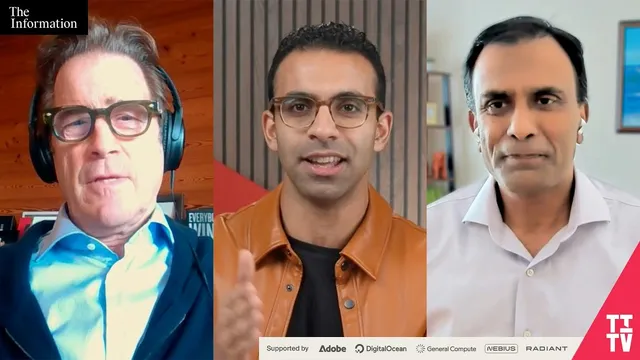
 The Information's TITV · Akash Pasricha with Dharmesh Thakker, Arjun Bhatia, Paul Meeks, Laura Bratton and Leo Schwartz
The best minutes
- 31:36Anthropic uses discounts to lock in enterprise AI budgetsPro pick 5 min
- 15:34Anthropic’s valuation depends on growth and future margins6 min
- 2:58Frontier AI needs public markets, while software can stay private6 min
Every moment plays free. PRO marks a write-up that's in Pro.
Also worth watching
- 43:37ByteDance may add $500 million in Microsoft AI spending6 min
- 22:34Anthropic’s data-center buildout may take three years4 min
- 37:26Commerce put H200 export approvals at the top of the queue6 min
- 10:19Venture returns may concentrate in a few funds5 min
Skip the repeated remote-access clarifications in the ByteDance deal discussion.
Full analysis · 6 min read
Real Alpha · Nov 20
Thakker says Anthropic’s almost $100 billion raise needs public markets
- Thakker said Anthropic is raising almost $100 billion, making public markets necessary.
- Bhatia’s favorable multiple depends on his 150% growth forecast, while profitability remains a separate test.
- Discounts may win annual commitments, but renewals and realized prices remain the test.
Free with an account
Read the rest of the analysis
7 sections, the 5 other voices it tests Thakker against, and what it means for you. Every episode we cut gets one.
Check your inbox
We sent a link to your address. Click it to finish signing up. Not there in a minute? Look in spam.
or
Signed up before? The same buttons sign you in. The episode, its moments and the transcript stay free.
Anthropic’s IPO turns compute into a public-market test
Thakker’s headline figure was Anthropic’s almost $100 billion raise. He said frontier intelligence costs more than a few billion dollars.
That scale, he said, requires access to capital markets. His next point was market appetite, citing investment in Google, Meta and other public companies.
His third point was operational. Public proceeds could strengthen Anthropic’s balance sheet for long-term chip and cloud commitments. Thakker said those commitments could help deliver future revenue growth.
But that is a capital-access case, not evidence that private fundraising has dried up. Thakker is a venture general partner, and he also described more exits as positive for the sector.
For operators, this is a financing signal, not proof that compute demand has become profitable.
Our read
The IPO is both a capital raise and a bet on securing compute. Its success depends on whether that capacity supports durable revenue.
Software margins still separate IPO candidates
Thakker’s comparison sets a different bar for software companies. Frontier labs may spend $20 billion or $30 billion on one training run.
He contrasted that with software firms generally earning 60% to 70% gross margins. Those firms may not need public capital as urgently.
Yet the choice to list also reflects employee liquidity and tolerance for quarterly volatility. That distinction matters for AI application businesses.
Thakker said those businesses pay a frontier-model tax when they use Anthropic or OpenAI behind the scenes. Even a company with $1 billion in revenue and 100% growth could have only 20% to 30% gross margins.
That may be a weak public-market story despite fast sales growth. For example, Thakker expects some firms to move toward open-weight models while revenues grow.
He said application IPOs might arrive perhaps two or three years away. But that timing depends on margin improvement, market size and predictable revenue.
Our read
The listing does not make every AI company a public-market candidate. Application firms still need to show they can keep more of each revenue dollar.
Bhatia’s valuation case depends on growth staying fast
Bhatia called nine times 2027 revenue attractive, based on his forecasts. His estimate assumes 150% growth next year.
At six times his 2028 revenue estimate, the multiple compresses. But he warned that forecasts become less certain further out.
That makes growth durability the premise, not a result. Bhatia said a 15 to 20 times revenue multiple might prompt concerns about too much growth being priced in.
That is a caution band, not a precise valuation rule. Sarah Frier said on Bloomberg Businessweek in November 2026 that Anthropic is young.
Frier said enterprise adoption had only recently begun to pop, leaving its business model to prove itself. Her point tests the long forecasts behind Bhatia’s multiple.
Still, founders selling AI software should notice the gap between model adoption and durable economics. A valuation tied to rapid growth leaves little room for slowing usage or weak customer economics.

Our read
Bhatia’s bullish view depends on his forecast holding, not on the multiple being cheap by itself. Anthropic still has to demonstrate growth across products.
Profitability, not revenue alone, sets the underwriting bar
Meeks said profitability belongs beside sales growth in underwriting. He said Anthropic believes it can reach a 35% adjusted operating margin, perhaps in 2028 or 2029.
His model ties that target to about $190 billion to $200 billion in revenue beyond 2028. Meeks compared the target with mature cloud businesses.
But he noted those earlier cloud businesses were not GPU-based. That difference makes the comparison useful, but not a direct forecast for Anthropic.
Michael Regan said on Balance of Power in November 2026 that future commitments were about $900 billion. He cited $71 billion due next year.
Ed Elson said on Prof G Markets in November 2026 that Anthropic was not close to profitability. These outside assessments make the distance between target margins and current cash needs explicit.
For example, sales can grow before new capacity contributes revenue. Investors should track cash requirements alongside operating margins, rather than substitute revenue growth.
Neither outside view proves Meeks’s forecast wrong. But both sharpen the execution risk.
- MRMichael Regan · Balance of Power · Nov 19Anthropic’s growth comes with steep spending commitments
 Ed Elson · Prof G Markets · Nov 16Anthropic’s growth must outrun a steep compute bill
Our read
Meeks offers a possible destination, not proof that the route is funded or on schedule. Margin disclosure and cash commitments will test the valuation.
Three-year buildouts complicate margin promises
The buildout timeline complicates Meeks’s margin forecast. He said a data center typically takes about three years to build out.
Meeks also cited $120 billion in promised commitments to SpaceX. Either side can exit that agreement on 90 days’ notice.
That offers an exit right, but not immediate replacement capacity. Paisley Nardini said on Bloomberg Tech in November 2026 that $250 billion in Anthropic compute deals were tied to Nvidia.
She said $150 billion could be ended on short notice within 12 months. Those figures do not establish that every commitment will be spent.
They do make contract value, cash due and delivered capacity distinct questions. So finance teams should compare booked compute with demand and construction timing.
A three-year buildout can leave spending ahead of usable capacity. This timing matters if margins are supposed to improve soon.

Our read
Compute access can protect growth, but long lead times and exit rights make the cost path uneven. Anthropic needs to explain what it must pay, and when.
Discounts can buy contracts without proving loyalty
Bratton reported discounts up to 30% or higher, alongside usage credits. Some offers came as customers shifted toward annual enterprise plans.
She said one Fortune 50 customer received an offer well above 30%. In some cases, customers were asked to direct a share of their AI budgets to Anthropic.
Bratton said that, in some cases, Anthropic requested invoices or documents to verify those promises. She described this as a share-of-wallet provision and said OpenAI also uses it.
That could lock in annual spending while Anthropic expands beyond Claude Code. Bratton described Cowork, cybersecurity and managed agents as growth areas.
Consultants told her spending was roughly 60% engineering and 40% Cowork. Those figures reflect the consultants she interviewed, not Anthropic’s entire customer base.
For example, her reporting found some cybersecurity customers use their own software with Anthropic models. They were not necessarily buying Anthropic’s own security application.
But customer wins are more persuasive if buyers renew at sustainable prices and use Anthropic products directly. Discounts can introduce products and establish contracts, but they cannot prove loyalty.
Our read
The discounts may help build enterprise usage, but renewals, realized prices and direct product adoption matter more than signed budget promises.
IPO liquidity may concentrate venture returns
Thakker said venture returns had concentrated in a small group of companies and funds. He described annual venture investment rising from $100 billion to almost $250 billion or $300 billion.
Meanwhile, the sector had seen little DPI or returns in recent years, he said. He named SpaceX and Anthropic, and hoped OpenAI, Databricks and others would also go out.
He hoped those IPOs might return three to five times the recent venture dollars to LPs. That remains his expectation, not a realized distribution.
Jason Lemkin said on 20VC in November 2026 that Q3 deal counts fell 21% while invested dollars rose. That pattern fits a market placing larger sums into fewer companies.
And liquidity could free some employees to start companies. Thakker said employees with life-changing proceeds may pursue their ambitions.
He also said departing talent could hurt employers, while new ventures may help the wider ecosystem. His position carries a venture-sector interest.
More exits can return capital to LPs, yet gains may remain concentrated among a few funds. Founders should not treat a landmark IPO as evidence of broad venture liquidity.

Our read
The IPO could broaden the startup pipeline while concentrating returns among a small set of investors. A large exit does not mean venture liquidity is widely distributed.
What it means for you
- Model margin scenarios. Test operating margins against slower growth and compute costs. Compare the results with Meeks’s 2028 or 2029 target.
- Separate booked from usable compute. Track committed capacity, exit windows, delivery timing and cash due. Meeks said data-center buildout typically takes about three years.
- Measure discount payback. Compare enterprise renewals and realized prices with credits and discounts. Track whether customers use Anthropic applications directly or access its models through their own tools.
- Review AI budget clauses. Ask procurement and legal teams whether share-of-wallet commitments or invoice requests are acceptable before signing enterprise contracts.
What to watch
- Whether Anthropic sustains annualized revenue additions, which Bhatia said investors would track.
- How Anthropic explains capital spending, future financing needs and its path toward operating margins.
- Whether enterprise discounts convert into repeat usage and direct adoption of Cowork, cybersecurity products and managed agents.
Send this to finance and infrastructure leaders setting AI budgets and compute plans.
Watch where Bhatia gives his 150% growth estimate
Written by Real Alpha from the episode's transcript and the other moments it links, then checked against the transcript. Quotes are the speaker's exact words.
Minute by minute
A Pro write-up, open to you here. Try Pro free for 7 days
A Pro write-up. The minute by minute is in Real Alpha Pro; the episode, its moments and the transcript stay free.
Read it with Pro, 7 days free- 2:58IPO timing depends on capital needs
Thakker says Anthropic’s nearly $100 billion raise reflects frontier AI’s capital needs and its push to secure long-term chip and cloud capacity. He contrasts that with firms such as Stripe and Databricks, which he says have 60% to 70% gross margins and less need for capital. He says application companies may need two to three years to improve margins before going public.
- 9:13Venture returns will concentrate
Thakker says venture returns and liquidity are concentrating in 20 to 30 very large companies, leaving much of the long tail unlikely to share the gains. He expects major exits to return three to five times capital to LPs, but says a few funds could generate 90% to 95% of asset-class returns. He also argues IPO wealth could free employees to start companies, even as incumbents lose some talent.
- 16:12Valuation depends on durable growth
Bhatia says Anthropic is valued at about nine times 2027 revenue estimates, alongside projected 150% growth, and six times his 2028 estimate. He says 15 to 20 times revenue could make the stock less attractive. Meeks says investors should also weigh profitability: he sees a chance of a 35% adjusted operating margin in 2028 or 2029, with $190 billion to $200 billion in revenue beyond 2028.
- 21:43Compute spending shapes the risk
Bhatia says investors will focus on whether Anthropic can sustain growth, how much it spends on data centers and whether it can stay at the frontier. Meeks says low switching costs are a concern, but Anthropic’s enterprise focus helps differentiate it. He cites a $120 billion SpaceX contract that either side can end with 90 days’ notice as Anthropic builds capacity.
- 27:09Products extend beyond Claude Code
Bratton says Anthropic’s S-1 reported that Cowork had higher adoption in its first nine months than Claude Code had at a similar point. Consultants she spoke with estimated customer spending was roughly 60% engineering uses and 40% Cowork; some customers direct up to 20% of Anthropic spending to cybersecurity, often using their own software with Anthropic models. She describes Managed Agents as a service for building and running customized agents.
- 31:31Discounts secure enterprise commitments
Bratton says Anthropic has offered discounts of 30% or more and usage credits to encourage customers to try products or move to enterprise plans. Some customers were asked to commit a share of their AI budget to Anthropic and provide invoices to demonstrate it. She says many discounts support a shift to usage-based annual contracts, and that current AI-provider discounts are modest compared with hyperscalers’ discounts.
- 36:57Commerce fast-tracked chip approvals
Schwartz reports that after Trump approved H200 exports to China, some Bureau of Industry and Security staff felt rushed and lacked time for ample due diligence. His story identifies two approved end customers with ties to the Chinese military or state-owned enterprises, or to chip smuggling. Schwartz says the applications were prioritized; Nvidia said they went through the normal process.
- 43:37ByteDance deal raises access concerns
Schwartz reports that Microsoft is nearing an additional $500 million Azure deal with ByteDance, mostly for access to OpenAI services. OpenAI has raised concerns that its models could be used for distillation, but ByteDance denies this and Microsoft said it found no evidence of a specific type. Schwartz says lawmakers have sought a briefing, while Microsoft’s OpenAI contract runs through 2032.
Published Nov 19, 2026.
Transcript · 37 min read
The Information's TITV, hosted by Akash Pasricha, with Dharmesh Thakker, Arjun Bhatia, Paul Meeks, Laura Bratton and Leo Schwartz.
Transcribed by machine (Whisper) from the episode’s audio, so a word may be off here and there.
welcome everyone to the information's ti tv my name is akash bashrisha it is thursday november 19th and it is anthropic ipo day we have got a lot of coverage for you all day long A quick reminder, right after this stream, we have our big Anthropic IPO live video summit starting at 11.30 a.m. Pacific, 2.30 p.m. Eastern. It will be available to subscribers of the information on our website. Anthropic priced its IPO at $83 a share above its marketed range of $70 to $78. dollars today at the summit we're going to be talking through the market reaction in real time how it will affect the ipo market at large the company's cyber security playbook and even its playbook in drug discovery if you are a subscriber you can register at the information.com slash events if you're not yet a subscriber check out our website for more details on today's show we are going to be talking about the impact that this ipo will have on the venture capital sector We're going to once again revisit the fundamentals of the business as well.
We also have exclusive reporting for you on how Anthropic is working to justify its massive valuation with the help of some discounts. And to close out the show, we have more exclusive reporting for you on the Commerce Department expediting approvals for certain chips from NVIDIA that it has been selling to China. It's going to be a great show and a busy day, so let's get right on into it. anthropics ipo is bound to have ripple effects throughout silicon valley and the venture capital sector i want to bring on dharmesh taker general partner at battery ventures for a conversation about that dharmesh welcome to the show it's great to have you here thank you for having me
“Companies like OpenAI Anthropic that spend $20, $30 billion for a training run need real capital”
Read the whole transcript
right right i want to ask you about you know the the power law and venture capital being at work here in magnificent uh scale i guess you could say i mean with spacex anthropic opening i will come up i mean these are big winners for many of these funds but at the same time i mean you know when we think about dpi and about exits and stuff like that i mean it's really concentrated in a few of these big names. And so I wondered what impact you think that concentration will have on the structure of the venture capital sector going forward. True. You are right. The private capital markets have also followed the trajectory of the magnificent seven in public markets. You look at the S&P 500 and the top seven companies have generated almost 80, 90% of the returns. And in the private markets, you have two phenomena going on. You have the number of companies that have exploded to 40, 50,000. It's up 4, 5x. And the number of winners has concentrated in the top 20, 30 names that are now worth 100 billion plus in
“The number of venture firms has exploded to over 5,000 in the last couple of years.”
And the ones that want to pursue their ambition will do better for society and is great for us overall. Right, well, I guess I should know better than to ask venture capitalist about people defecting from tech companies to start their own businesses. Well, it does make our job harder because we now have to pick, you know, 20 companies from 20,000 of them. But it's great overall. It's good to have a bigger pie and a lot more innovation to fund and be a part of. Great. Okay. Well, Darmesh, I want to thank you for coming on. That is Darmesh Thakker, general partner at Battery Ventures here on TITV.
for more anthropic coverage i want to bring on two more guests who have been following this story very closely arjun batia is partner and co-head of tech equity research at william blair and paul meeks is head of technology research at freedom capital markets welcome to you both it is great to have you here arjun i want to start this discussion not so much on how the stock is going
“as they mature, they seem to have been driving their operating margins to about 35% to 40% handle.”
I'm much more bullish on Antropic than I was on SpaceX, which I wrote and appeared a lot on television, bad enough in that IPO.
I'm actually pretty optimistic about this one, even though it looks like it's going to come out at $1.05 instead of the $83 price. And I'm a tech contrarian most of the time. Okay, so Arjun, look, Dario's going to have his first earnings call in a couple months. and analysts like yourself are going to have the opportunity to ask questions. I mean, what do you think are the top questions he's going to have to answer on that call? Yeah, I think, you know, some of the biggest topics that we've been talking to investors about on the IPO is durability of growth, right? You know, they're growing 12x this year.
Certainly that growth rate is not going to sustain. But when you look at the October ARR disclosure, they are adding $120 billion in ARR on a run rate basis annually, right? You still want that dollar figure to at least sustain, right? So I think that's one thing that investors will pay a lot of attention to.
“a data center from announcement to full build out is typically around three years.”
Well, and I got to tell you that, I mean, that's why the, I mean, you suggested that they get to that margin profile quicker than I would have anticipated. And so it was the timeline there that sort of concerned me. but I know that these are all questions that Dario will have to answer on his first call, which I know we're eagerly awaiting. Can't come soon enough in a couple months. In the meantime, I want to thank you both for joining us.
That is Paul Meeks and Arjun Bhatia here on TI TV. The information published exclusive reporting on the discounts Anthropic is making to try to gain traction in many of its products outside of Cloud Code. My colleagues Kevin McLaughlin and Laura Bratton wrote a story about that this week. I want to bring on Laura to share more about what they learned. Laura, welcome back to the show. It's great to have you here. Good to be here. Okay, so we know that Cloud Code has been a huge success for Anthropic. What you and Kevin really got into in your story were the other products that it's going to have to make as stunning a success to really diversify its business a bit.
And, you know, I want to go through each of these bets they're making. I mean, Cowork is, I think, maybe the other well-known product that people know very well. There's been a lot of competition since Cowork first came out from other companies. So you've talked to customers. How do they find Cowork compared to the other options? Yeah, Cowork appears to be really popular. Amthropic itself said in its S1 filing ahead of its IPO that, um you know co-work has seen a higher level of adoption in its first nine months since being released in research preview than clawed code saw at a similar point following its debut so i think that's a clear sign of co-work success and then you know among the consultants that i talked to they said that their customer spending was roughly split probably about 60 percent to engineering use cases you know cloud code and then 40 to co-work for knowledge workers to use cloud code work essentially as a personal ai agent to help them build slide decks conduct research search, build out dashboards that can help them with things like accounting, recruit new folks.
So it seems to be catching on. Okay. So coworkers catching on. Cyber is another application they're pushing into. I mean, this was an interesting point in the story. You said that customers are shifting up to 20% of their entropic spending, in some cases, to cyber. That sounds pretty good. Are there caveats here? Yeah, definitely. I mean, the consultant I spoke to who told me that said that, you know, they're using the underlying models with their own harnesses for cyber use cases. And that's what he sees as the next biggest use case beyond coding. And I think especially what we saw with the capabilities of Mythos and Fable, that definitely seems like something I think could be true. One thing that I'll note that I found interesting is that customers are using their own software to use the models for cyber capabilities rather than using Anthropik's own tool called Cloud Security. And I think it just speaks to the tension in which customers are developing their own software that can call Anthropik's models for different use cases rather than going to the applications that Anthropik is developing. And I think that whether Anthropik can get customers to use those applications directly, as it has with Cowork, will be a key
tell of whether it can succeed beyond coding use cases. And the last product category I want to ask you about are Claude Managed Agents. What are these managed agents? How big of a business is that for Anthropic right now? Totally. So my colleague Kevin got a lot of the reporting on cloud managed agents. He really loved the church there. But what I can say is that cloud managed agents is essentially a service for building and running AI agents. And that seems to be another massive use case for customers that are trying to expand beyond cloud code. So really, I think that you can think of cloud managed agents as more personalized than cloud co-work, which is more of a generalized agent. And, you know, Anthropic's biggest use case is going to be agents and providing agents, personalized agents, whether that's to knowledge workers through Cloud Cowork or specific customized agents through Cloud Managed Agents to its customers. And that's really what we see as its next biggest use case beyond coding.
Okay. So these are three categories of products that, you know, they're growing quickly, they're a big focus for the company. I want to talk about now how Anthropic is incentivizing
“they can only get that discount if they promise that a certain percentage of their AI budget will go toward anthropics products rather than rivals”
Right. Okay. Well, Laura, I want to thank you for coming on. That is Laura Bratton, author of our...
Applied AI newsletter here at The Information. More details have emerged about NVIDIA's interactions with the U.S. government as it relates to China chip sales. My colleagues Chen Liu and Leo Schwartz have exclusive reporting that the Commerce Department fast-tracked approval of NVIDIA's H200 chip exports to China. I want to bring on Leo for a conversation about that. Leo, welcome back to the show. It's great to have you here. Thanks for having me. So what happened inside the Commerce Department in getting these
“they made this a priority to basically expedite the approval process.”
“they're actually nearing a contract for an additional $500 million in spend, again, mostly to access OpenAI through Azure on Microsoft.”
our tech and politics reporter here at the information that does it for today's show a reminder we have our live video somewhat in about 45 minutes starting if you loved these conversations you are going to love our real-time coverage of anthropic trading on the nasdaq again it starts at 11 30 a.m pacific 2 30 p.m eastern if you're a subscriber to the information the registration is at theinformation.com slash events.
And if you're not a subscriber yet, subscribe to The Information. It is well worth it. A reminder, we are on this stream Monday through Friday at 10 a.m. Pacific, 1 p.m. Eastern. And if you can't make it then, episodes are available on theinformation.com, on our YouTube channel, or wherever you get your podcasts. Make sure to follow us on social media on X, on Instagram, on TikTok, and on LinkedIn. I am already excited for our next show tomorrow. Have a great rest of your Thursday. I'll see you on the live stream. Bye-bye for now.