Free with a sign-in.
The best 17 min of 49
Jensen Huang Resigns as Nvidia CEO: What's Next for the AI Industry?
Doug O’Laughlin says Huang’s exit could slow Nvidia’s execution and weaken its influence across the AI ecosystem.
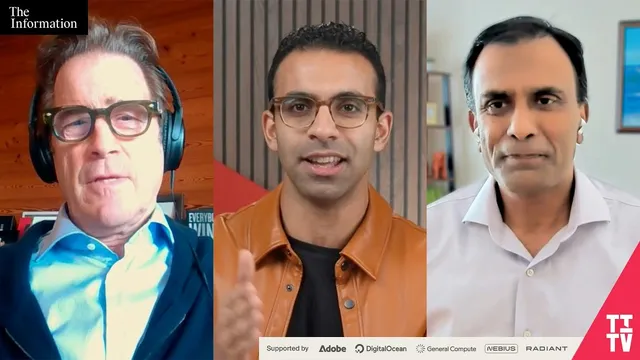
 The Information's TITV · Akash Pasricha with Nancy Tengler, Matt Bryson, Doug O’Laughlin, Bing Gordon, Leo Schwartz and Jean-Denis Greze
The best minutes
- 19:35Nvidia may need an insider to keep its supply-chain edge6 min
- 29:25Nvidia’s moat is shifting from CUDA toward supply and networkingPro pick 4 min
- 35:07Chip access rules could push Chinese firms to other countries6 min
Also worth watching
- 13:25Jensen personally secured Nvidia’s supply-chain commitments3 min
- 6:57Nvidia’s roadmap gives a successor several quarters of runway4 min
- 43:34Town is building AI agents for teams, not just individuals5 min
Skip the opening recap, the CEO-name speculation after Matt’s outlook, the broader AI froth discussion, and the show outro.
Full analysis · 6 min read
Real Alpha · Nov 20
Doug O’Laughlin thinks Nvidia’s 2020 commitment was like $40 billion
- O’Laughlin thought Nvidia’s 2020 supply commitment was like $40 billion.
- That example shows supply-chain aggressiveness, not demand, which Bryson said exceeded supply.
- The next CEO must preserve supplier confidence while directing product choices beyond the scheduled runway.
Free with an account
Read the rest of the analysis
6 sections, the 7 other voices it tests Tengler against, and what it means for you. Every episode we cut gets one.
Check your inbox
We sent a link to your address. Click it to finish signing up. Not there in a minute? Look in spam.
or
Signed up before? The same buttons sign you in. The episode, its moments and the transcript stay free.
Nvidia has several quarters to absorb the shock
Host Akash Pasricha opened with Huang’s resignation after relationship reports and a board review. The cause remained uncertain, while supply and execution were easier to assess.
At 8:10, Matt Bryson said demand exceeded supply, next year’s supply chain was set, and the technology roadmap reached 2028. He said a successor should have three or four quarters of strong financials to get things in order.
That buys time, but a schedule cannot guarantee future product decisions arrive unchanged. Bryson said outsiders could not see how much Huang personally facilitated those decisions.
Tengler valued shares at 10 times next year’s earnings, while warning investors need not believe those earnings. She said her growth portfolio held Nvidia long term, her value portfolio short term, and she would likely add after earnings.
That is a disclosed investor position, not independent operating evidence. Ryan Vlastelica on Bloomberg Tech in November 2026 likewise reported chips sold through 2027, while noting later uncertainty.
Together, the two segments support an order runway, not confidence in leadership beyond it.
Our read
Nvidia appears buffered against an immediate sales shock, but the product and leadership test starts beyond that buffer. Scheduled supply is not a completed succession.
Huang’s supply commitments made succession operational
Doug O’Laughlin, SemiAnalysis president, gave the clearest example of why succession is operational, not just symbolic. At 24:17, he said he thought Nvidia’s 2020 commitment was like $40 billion.
He compared that with peers’ $5 billion commitments during the original chip shortage. This was one historical example, not an audited peer comparison or a recurring commitment target.
O’Laughlin’s point was that Huang made large supply bets before rivals, then benefited when others lacked chips. Earlier, he said suppliers across Taiwan and the wider ecosystem rallied around Huang’s roadmap.
He said Huang pushed partners toward faster technical timelines through persuasion, pressure and spending. The inference is that supplier confidence may depend on credibility as well as purchasing power.
Bing Gordon, Electronic Arts cofounder and former Amazon board member, favored an internal successor for authority, speed and the ability to rally peers. For example, an insider might secure a faster first week than an outsider still learning the company.
Sarah Fryer on Bloomberg Surveillance in November 2026 also described Huang’s dealmaking as unusually personal. That comparison reinforces concentration risk, but neither discussion identifies a specific deal at risk.

Our read
The $40 billion figure is a hedged example of scale and credibility, not a forecast of lost supply. A successor’s test is whether suppliers accept the next set of commitments.
O’Laughlin says CUDA’s advantage has flattened somewhat
O’Laughlin said CUDA’s advantage had gotten a little flatter over time, as language models eased programming. He identified Google’s TPU ecosystem as a leading inference competitor, alongside AMD.
The point is not that CUDA stopped mattering. Easier programming may soften its relative protection, while Nvidia’s scale, supply-chain strength and networking remain differentiators.
So a successor inherits durable assets alongside a software advantage O’Laughlin said had flattened a little. Stacy Rasgon on Odd Lots in November 2026 tied Huang’s direct control to Nvidia’s speed and early CUDA bets.
Rasgon explains how those software choices accumulated over time. O’Laughlin asks how far they still separate Nvidia, and both views can hold at once.
Take a workload test across CUDA, TPU and AMD, recording performance and the effort needed to move. Do not budget around CUDA alone. O’Laughlin also emphasized networking and supply-chain scale.
Our read
In O’Laughlin’s account, Nvidia’s advantage is becoming more operational as CUDA’s relative edge softens slightly. The next roadmap must defend more than software adoption.
Internal candidates may move faster, but inherit peer tensions
O’Laughlin described Nvidia’s management as unusually flat, with 35 direct reports to Huang. He said decisions often followed Huang’s call, leaving questions about whether a peer could rally the organization.
That speed may have relied on founder authority, leaving former peers to negotiate a new hierarchy. The board’s choice therefore has to address how decisions will get made, not just who gets the title.
Gordon said outside hires often fail and favored promoting from within before trying an outsider. That path keeps a second step available, but works only if the new leader gains authority quickly.
Gordon also said there were probably three direct reports who would not enjoy reporting to a peer. He cited Andy Jassy’s adjustment after becoming boss to former peers as a warning.
The host raised Rene at Arm among possible outside candidates. O’Laughlin said Rene was probably the most credible external candidate because he had worked at Nvidia.
Mandeep Singh on Bloomberg Daybreak in November 2026 said the next CEO must manage supply chains, partnerships and strategy. Emad Mostaque on Moonshots in November 2026 stressed CUDA and TSMC credibility.
Those tests make the job broader than technical pedigree alone. An outsider could bring perspective, but would need working authority quickly.
- MSMandeep Singh · Bloomberg Daybreak: US Edition · Nov 13Nvidia needs a CEO who can manage more than product
 Emad Mostaque · Moonshots · Nov 13NVIDIA’s next CEO needs CUDA and TSMC credibility
Our read
The board should be judged on whether the new leader can move decisions through former peers and suppliers. A candidate’s name is not a transition plan.
Transition could unsettle Nvidia’s wider ecosystem role
At 26:04, O’Laughlin called Huang one of the strongest AI advocates in the United States. He said he expected most Nvidia neocloud backstops to continue, noting Colette Kress’s earlier involvement.
His warning concerned less-established neoclouds, which might receive less support during the transition. He framed the risk as management distraction, with delays compounding into quarters.
That separates possible execution delays from a confirmed financing cutoff. Gordon framed Nvidia’s position as important to American national security and AI leadership.
That was Gordon’s judgment, not evidence in the episode that defense capabilities had changed. Rohan Goswami on Prof G Markets in November 2026 also described Nvidia’s role in funding AI companies.
Goswami’s comparison makes financing links relevant, but identifies no canceled backstop. For finance teams, separate announced commitments from discretionary support and delivered compute.
Those categories carry different timing risks, especially when the people making commitments are changing.

Our read
The transition may leave formal commitments intact while making marginal support less certain. Treat that as a diligence question, not a prediction of an AI spending collapse.
Proposed chip controls may move access rather than close it
Leo Schwartz, The Information’s tech and politics reporter, said Commerce was nearing a rule extending controls to seven more countries. He said it could be announced as soon as this month.
Schwartz said US-owned data centers could get a licensing carveout but face added reporting requirements. China hawks warned firms could shift to other countries, creating a whack-a-mole enforcement problem.
That is a warning about enforcement boundaries, not proof the proposal has no effect. Some routes may become harder even if alternative jurisdictions remain open.
The episode leaves Nvidia’s China posture under a question mark after Huang’s departure. Schwartz said policymakers might find the transition makes controls easier to advance.
Bradley Tusk on Bloomberg Tech in November 2026 said remote access should have been covered from the start. That point shows the cloud-access concern predates this particular proposal.
Procurement and compliance teams should map provider ownership, locations, reporting duties and licensing exposure. Watch for publication this month, but do not treat a reported draft as final policy.
Our read
The reported rule could narrow one route to chips without closing every route. Its reach, and Nvidia’s position on China, remain open questions.
What it means for you
- Supplier capacity. Ask suppliers what capacity is contracted through 2027 and which commitments still depend on executive relationships. Track reserved supply separately from delivered product.
- Succession decision rights. Map who owns supplier commitments, roadmap decisions and cross-functional approvals. The episode tied those responsibilities closely to Huang.
- CUDA workload tests. Compare workload performance and migration effort across CUDA, Google TPU and AMD systems. O’Laughlin said competition is broadening beyond CUDA.
- Compute support exposure. Separate announced backstops from discretionary support for less-established neoclouds. O’Laughlin said those providers could face more uncertainty during the transition.
What to watch
- Whether Nvidia names an internal CEO or an outsider, and whether former peers support that choice.
- Whether Commerce announces the proposed rule this month, as Schwartz said it could.
- Whether less-established neoclouds receive support as the leadership transition consumes management attention.
Send this to the CFO and operations lead overseeing AI compute commitments.
Watch the minute where O’Laughlin gives his hedged $40 billion example
Written by Real Alpha from the episode's transcript and the other moments it links, then checked against the transcript. Quotes are the speaker's exact words.
Minute by minute
A Pro write-up, open to you here. Try Pro free for 7 days
A Pro write-up. The minute by minute is in Real Alpha Pro; the episode, its moments and the transcript stay free.
Read it with Pro, 7 days free- 3:04Investors separate leadership from demand
Tengler says the reasons for Huang’s resignation remain unclear and estimates his contribution to Nvidia’s valuation at 20-25%. She argues that AI capital spending, CUDA and the company’s $230 billion buyback support holding the stock and potentially adding after earnings.
- 7:06The near-term roadmap is set
Bryson says demand exceeds supply, Nvidia’s supply chain is set for next year, and the product roadmap extends through 2028. He expects the incoming CEO to have three or four quarters of strong financials to get organized, but says it is hard to know how much Huang drove future innovation.
- 10:22The board faces an inside-or-outside choice
Tengler mentions Ian Buck as an internal candidate and floats Lisa Su and Alex Karp as possible external names. Bryson says the board could promote internally, hire externally or pair leaders, but should make a choice that quickly clarifies the company’s direction.
- 13:37Huang’s role extended beyond product decisions
O’Laughlin says Nvidia’s 35-direct-report structure makes a quick succession difficult. He credits Huang with rallying suppliers and manufacturers, securing large supply commitments and pushing the ecosystem to meet technical timelines.
- 17:04Boards must balance speed and care
Gordon says moving too quickly is among the biggest risks when a board investigates a CEO. He expects Nvidia’s board to have succession plans and possible successors already identified, and says board members will live with the consequences of their decision.
- 19:45Internal candidates face a peer test
O’Laughlin names Ian Buck and Nvidia GPU engineering leader Jonah as possible internal candidates, but says the next CEO must rally former peers and manage a flat organization. Gordon favors promoting internally before looking outside; O’Laughlin says Rene, a former Nvidia deputy who became a CEO, could be a credible external option.
- 25:16Leadership change could slow Nvidia’s ecosystem
O’Laughlin says Huang was one of the strongest advocates for AI in the U.S. and expects Nvidia to continue most neocloud backstops, noting that Colette Kress has been involved. He worries that less-established providers may receive less support while Nvidia’s leadership team focuses on the transition. Gordon says Nvidia’s position also matters to U.S. competition with China.
- 29:25Nvidia’s moat faces new competition
O’Laughlin identifies Google’s TPU ecosystem as a key competitor in inference and says CUDA’s advantage has flattened as LLMs make programming easier. He points to Nvidia’s scale, supply-chain position and networking as strengths, while warning that Huang’s long-term decision-making will be difficult to replace.
- 33:05Gordon expects AI investment to continue
Gordon says data-center construction and the backlog for Nvidia chips will continue because he sees the buildout as important and profitable. He says data-center companies need a formula that benefits local communities, but does not expect the current turmoil to become a tipping point for the AI sector.
- 35:07A proposed rule targets remote chip access
Schwartz says Chinese AI firms can rent restricted chips from data centers in countries such as Thailand and Singapore. A Commerce Department rule under review could extend controls to seven more countries beyond 46 already covered; U.S.-owned centers may get a licensing carve-out but face more reporting. China hawks argue firms could simply shift to unlisted countries.
- 41:20Town bets on model-neutral work agents
Greze says Town targets everyday work tasks for a broad range of workers and will use whichever model best fits each task. He argues the market is still early and says Town’s focus is helping teams work with AI together, with agents coordinating across employees rather than serving only one person.
Published Nov 12, 2026.
Transcript · 36 min read
The Information's TITV, hosted by Akash Pasricha, with Nancy Tengler, Matt Bryson, Doug O’Laughlin, Bing Gordon, Leo Schwartz and Jean-Denis Greze.
Transcribed by machine (Whisper) from the episode’s audio, so a word may be off here and there.
welcome everyone to the information it's ti tv my name is akash bashricha it is thursday november 12th jensen huang has resigned as president and ceo of NVIDIA colette crest the company's evp and CFO will be the interim chief executive. This all comes after the New York Times reported last night that Jensen had a second affair with an executive that works on NVIDIA's healthcare technology initiatives. That, of course, followed an already crazy week with several reports of Jensen having a close relationship with a woman believed to be affiliated with the foreign intelligence efforts in China. Of course, NVIDIA's board said on Sunday that it would launch a review looking into some of this reporting. We are going to unpack every angle of this story with a stacked roster of guests looking at the drama, the valuation, the ripple effects for AI, and the policy elements of this story. We're also going to try to figure out who could be a permanent replacement. After we get through all that, we have some exclusive reporting on a related story about how the US government is seeking to further its crackdown on foreign countries using its advanced chips. It is very much related to the Jensen and Megaspeed story. And to close out the
show, we're going to switch gears and get to the information's list of the 50 most promising startups out this week that we are watching. I'm going to be talking to the founders. Our reporters have spotlighted over the course of the next few days. It's going to be a great show. So let's get right on into it. Jensen Huang is out at NVIDIA. What comes next is the big question for the company. I want to bring on Nancy Tengler from Laffer Tengler Investments and Matt Bryson at Wedbush for their perspectives on all of this. Welcome to you both. It is great to have you here. Nancy, I want to start with you because you are the NVIDIA shareholder here. What's been your reaction to the last 12 hours? Yeah, Akash, I think at some point it became inevitable, And that was probably last night or middle of day yesterday that Jensen was out.
And I think, you know, what's interesting is we don't actually know why he resigned. I mean, we all know why he resigned, but we don't know what the specific reasons are and how deep this goes. But I will say that I was on the air when the news broke initially, and I drew an analog to Apple when Tim Cook took over and he was no Steve Jobs was the news. And the stock's up 27% during his tenure, so much more than it was during jobs. So it is possible to replace an iconic CEO with a different kind of CEO. And I think the vision is in place at NVIDIA. We will be using weakness at 10 times next year's earnings.
Read the whole transcript
You don't have to believe the earnings. The company is going to defend the stock. They have a $230 billion buyback hanging out there. So we're going to wait for earnings to be reported and then likely add to it. And we've been long-term shareholders in our growth portfolio, very short-term in our value because it is basically a value stock now, and long-term holders in AMD and Broadcom, which we used to refer to as the poor man's NVIDIA. Okay. I'm going to come back to you. We're going to talk about the valuation, but Matt, what do you think here of how quickly this all unfolded and what do you think of the decision here? Again, as Nancy said, it's really hard to know what was Jensen's primary motivation in resigning. Was it personal? Was it at the board's bequest?
Um, and the suddenness is it is kind of crazy um at the same time we've seen instances like this before right you you saw something uh similar with marvell back in i want to say 2016 uh when sahar was pushed out for um it it was moving sales around um but it was sudden um as nancy pointed out with Steve Jobs. There was a successful plan in place, but his resignation happened relatively quickly. So we've seen it before, but I think everyone's surprised and still trying to figure out what the ramifications are. Right. Okay. So Nancy, I mean, you say that you're almost ready to buy more, sounds like, depending on how the earnings go. So how much of the valuation do you think was Jensen? Yeah, that's probably a better question for Matt because he lives in Brees, the company. But you're buying it. No, right. But it's down 25, 30%. And so it's probably 20 to 25% would be my guess. But that's now because of the shock factor. I think once, you know, Colette Kress is a great interim selection, having Harvey Jones at the ready as the first chair of the board. He's been on the board since 1993. I think the board has acted quickly and smartly, if that's a word. And so what we're buying is the long-term CapEx
spend on AI and the fact that NVIDIA sits at the center of that. And it's not just the chips, It's CUDA. They've got a deep bench. I think you want to own this stock at this valuation level. I just want to get through earnings and then let the company be prepared, you know, out of their blackout and let them come in and put a floor under the stock by buying back shares.
“NVIDIA has their supply chain set for next year barrel rubin is shipping so you've got your technology set through 2028”
So, Nancy, who do you think should be the permanent CEO?
I think there's a really wide... There's some internal candidates, I think, that... And is it Buck? I just forgot his name because, you know, there's so much going on. But the gentleman in charge of building out CUDA, I think that's interesting. Ian Buck, I think, is his name? Ian Buck, yeah. Okay. And I think out externally, I mean, there's a number of outstanding tech CEOs. I've heard the same names you've heard mentioned, Alex Karp being one, Elisa Sue being another. I haven't heard Alex Karp. Okay, that's a new one. I didn't hear that one. Matt, did you hear that one? I doubt it. But Lisa Su, I hope not, because we have a big position in AMD, and she's been amazing.
But I'm going to leave that to the board. They're interviewing candidates, I'm sure, as we speak. You probably heard Elon offered Jensen a spot at Tesla slash SpaceX. So we'll see what happens. Matt, do you think he goes to join Elon? on? I think that is a lot of people who like to make decisions in the same room. It's kind of like in a soccer game, you can only have, there's only one ball in the field. So it's hard to have two guys who always want to be in the ball. Right. But Matt, do you think it would be better to look externally or internally for the next CEO? I mean, it's hard to say. You can do things like we see at TSM with co-CEO roles.
um so you have someone who understands the company uh and someone coming from outside with a different perspective um it you could just promote internally um again you look at the the how steve jobs managed things versus how tim cook seemingly managed things um and there there's different ways to skin a cat if you will um and so i i just think it depends Again, Matt Murphy came in, you know, not from a CEO level position to run Marvell and he did a great job. So, you know, I think it's more important at this point that the board feels confident that they're making the right decision and then that things get kind of set relatively quickly so we understand where the company's going and then we'll see from there.
Great. Okay, well, I want to thank you both for coming. That is Nancy Tengler from Lafford Tengler Investments and Matt Bryson from Wedbush here on TIA-TV. For more coverage of the Jensen resignation, I want to bring on Doug McLaughlin, president of Semi-Analysis, and also Bing Gordon, the co-founder of Electronic Arts, who has significant board experience across the tech sector. He has been on the board of Amazon, among other big-name companies. Welcome to the both of you. It is great to have you here.
“Jensen was a deals guy at the end of the day. The large supply commitments from TSMC”
valuation but bing so i want to come to you now because uh you've uh i mean you're the board guy you've been on the biggest boards in the world uh you've seen all these silicon valley stories play out uh throughout your career uh you've studied them what what do you make of the way the board handled this well we don't know exactly how they handled it but uh you know in general general, if you're a good board member, you remember the rest of your career, bad board outcomes, and there's nothing harder to do than investigate a CEO, either for performance or for malfeasance.
And that's a time when you look around the room to the other board members and you have to breathe deeply and then do the right thing. I think the biggest mistakes I've seen is when the board moves too quickly. As Colin Powell said, the first question always is, how much time do we have? and um you know the biggest regret is is uh starting a process that gets out of control um basically by trying to move too fast so being i mean do you think this all happened too fast then and and again i i say this we don't have a lot of information here uh we do know that jensen did not have a quote in the press release which some folks was sort of read as maybe the board sort of suggested he should resign and it maybe wasn't as voluntary as a resignation might seem.
We don't know a lot, so we'll put the facts aside, but do you think this all went too quickly in your mind? We'll know a year from now. You know, what I'm saying is that the board members who are all substantial you know they you're on the board it's kind of a privilege you know it's this they made a lot of money they've been in the middle of the center of the universe for quite a while and you know if if they feel that they screwed up this this is a lot worse than hiring the wrong person because you have this duty of care and uh by the time you get on a board like this you are generous of spirit because you already have taken care of your own life and uh if you do it wrong um it haunts you forever so did they move too quickly i suspect what happened is in the end one of the one of of the board members took Jensen aside and said, dude, this is going to get ugly.
And how ugly? You know, the other thing to remember is the board, at least once a year, has to do a succession plan from the CEO all the way down. And it's not credible that the board would say if Jensen gets in a car accident, we don't have anybody inside to take the place. So I'm sure that the board already has three names that, you know, an immediate successor and then maybe a one-year successor.
“My experience is big outside hires have a high failure rate.”
ai ecosystem at large here so i mean look there was this whole discussion around well uh NVIDIA's investing in all these companies. They're backstopping some of these deals.
Some people argued that, well, Jensen doesn't necessarily want to be Hank Paulson if stuff doesn't go according to plan. I would argue that he already was a Hank Paulson type of figure. He was just being proactive with things. So I guess my question for you, Doug, is do you think the AI sector lost their central bank here? What do you think happens to the deals machine? Yeah, I think it's been very clear Jensen has been the biggest AI advocate in the United States. You lost probably one of the strongest advocates and there is a cult of personality around the man, right? In terms of the NeoCloud backstop financing portion, I think that he clearly, or rather, the company clearly will continue.
Colette actually has been deeply involved with this since the beginning. So I imagine if Colette was to be the successor, for example, we would expect most of the backstops. And I do still expect most of the backstops to continue. But there is definitely a longer tail of less established neoclouds that I think might not be as aggressive or might not have as much support as they once did. And maybe that reason isn't because NVIDIA doesn't care. I think when you have these big moments of change and transition, it's about lack of focus, right? Right. NVIDIA has been pushing itself very hard for a very long time at a very fast pace.
And when something like this happens, the entire senior management team has to, you know, stop doing what they're doing and figure out, hey, what's the new situation here? Right. Let's say one of the internal peers were was elevated to become CEO. What's that working relationship like? Like, oh, how are you going to kind of do this differently? i know blah blah all that kind of stuff you know each week of of delayed uh delays add up to months add up to quarters and i think that that's what's what the real risk is is that yeah maybe maybe this all happens but it just compounds the the timeline yeah thing what do you think i was gonna say if this were a video game um you you would have thought that uh an enemy force has just decapitated an important foreign leader and so if this really is kind of an international relations story uh one of the worst things that could happen to the u.s tech sector and probably the u.s economy and the u.s military is to decapitate NVIDIA and um you know so the gamesmanship here It's, you know, it's a bold stroke that in the game of civilization by Sid Meier, if you would have done it, you would be exalting because you would have just made a significant stride forward.
Okay, so Bing, push that a little further then. I mean, what do you think this means then for the international relations story between U.S. and China specifically? you know it i'd say it's uh we we need to make sure that the the u.s elected officials stay ai forward uh it you know i think i i said before when i was here before that um on monday the number one the number one industry for ai is war and we need to make sure in the the u.s for kind of the freedom of the world, that we have mutually assured destruction. We can't afford to get way behind. And here, Jensen is clearly one of the prime movers in our domestic and global leadership.
So, Bing, do you think that that's at risk, though? Do you think this puts that at risk? In gaming terms, you know, absolutely. So, you know, it's actually important to the U.S. as a whole that NVIDIA gets Mojo back.
“One of the big rises in LLM makes programmability of everything a lot easier.”
Bing, I mean, if you just look at the AI story at large, I mean, we have been waiting to see when some of the hot air comes out of the ecosystem a little bit. There's a lot of frothiness going on. We had the election, right? People thought that was going to be the thing to take it out. uh now we have this i mean i i guess the question i have you broadly being is um do you see the sort of the last two weeks taking out any kind of the froth in the ecosystem um or how do you see the story playing out at large i i don't think the um uh the build out of data centers is going to slow down i think it's just it it's too important too profitable um i do think kind of in the everybody wins mentality that the data center uh manufacturers if you will are going to have to um um create a winning formula for the local communities uh but i think the the data center build out is going to continue uh i think the uh the backlog for video chips is going to continue um so you know so the answer is is no is no basically okay the the answer is no is this going to be is this going to be a tipping point you know like an assassination of an archduke in austria you know maybe but unlikely okay all right well i want to thank you both for a great discussion
That is Bing Gordon, a former longtime board member at Amazon, Doug McLaughlin from Semi Analysis here on TITV. The Commerce Department within the U.S. government is nearing the completion of a rule change that would make it much more difficult for AI companies in China to remotely access powerful chips. That is according to new reporting from the Information's Tech and Politics reporter Leo Schwartz. I want to bring him on to share more about what he has learned. Leo, welcome back to the show. It's great to have you here. Thanks for having me. Okay.
“it's basically a game of whack-a-mole unless you make this a worldwide system”
some great reporting. I want to thank you for coming on. We're going to let you get back to it.
That is Leo Schwartz, our tech and politics reporter here at The Information. Okay, we're going to switch gears here now. Every year, The Information puts out a new list of the 50 most promising startups that our reporters are closely watching. These are companies that are not yet unicorns and have sub $100 million in revenue at the moment. Past companies on the list have included Hugging Face, Perplexity, and Polymarket, all of which have gone on to grow to giants in their own fields. Today, I want to bring on one founder from this year's edition of The List out this week. Leading our enterprise apps and B2B category is Town.
a company founded in 2024 and valued at $892 million. Joining us now is Town's CEO and co-founder, Jean-Denis Crez. Jean-Denis, welcome to the show. It's great to have you here. Yeah, thanks for having me, Akash. Excited to be here and super honored to be on the list. All right, so tell us about what Town does. Yeah, so we're an AI assistant before work. So we try to make it easy for people to leverage AI in their day-to-day work to make their jobs better, to be more effective at what they do. And, you know, our market is really mainstream users. So we wake up every day thinking about how do we get just everybody to benefit from AI, not just people in Silicon Valley or people who are very technical.
Okay, so I'm looking here at what we've written. I mean, these are all what we call white collar professional worker, knowledge worker tasks, I guess, Slack, CRM, stuff like that. Yeah, you know, I tend to think that in some way, shape or form, everyone's a knowledge worker. You just don't ever call yourself a knowledge worker. So we have users, for example, that are electricians or plumbers, because even though like the core part of the role is being in a home and doing work or like doing construction, you still have to deal with suppliers. And how do you do that? You email them back and forth to get your supplies. You still need to find clients. You need to do billing and invoices.
So there's a lot of that work that involves a calendar scheduling, involves email, involves documents. And that's really where town excels. So even if you're not, you know, what you call a typical white collar worker, you can get tremendous amount of benefit from from the product. And, you know, one way I view AI is there's a lot of toil that we all do on computers day to day for work. And AI has, I think, a huge opportunity to remove the toil from everybody's lives.
“our whole focus is not on how you make one human really good at leveraging AI, but how you get a whole team of humans”
thank you for coming on and congrats on making the list uh that is jean denis grez the ceo and co-founder of town here on ti tv cool thanks for having me on board thanks that does it for today's
show a reminder we are on this stream monday through friday at 10 a.m pacific 1 p.m eastern if you can't make it then episodes are available on the information.com on our youtube channel or