Free with a sign-in.
The best 9 min of 20
The AI Economy Runs on Nvidia. Can It Survive the CEO’s Affair? | Big Take
Sarah Frier and Michael Shepard say the allegations around Jensen Huang could unsettle Nvidia’s central role in AI and complicate U.S.-China ties.
BTBig Take · Sarah Holder
- Sarah Frier · Managing Editor, Bloomberg
- Michael Shepard · Tech Policy Editor, Bloomberg
The best minutes
- 5:48Nvidia's dependence on Huang puts the wider AI industry at risk3 min
- 10:58The scandal could complicate the US-China trade trucePro pick 2 min
- 16:27AI's market optimism may be giving way to realityPro pick 3 min
Also worth watching
- 1:25US investigators examined possible diversion of Megaspeed’s chips4 min
- 13:31Nvidia’s funding role could push AI firms to diversify2 min
Skip the opening show setup and the discussion of Trump’s ties to Huang and AI infrastructure’s role in GDP.
Full analysis · 6 min read
Real Alpha · Nov 21
Sarah Frier says Nvidia has no clear successor as AI depends on Huang
- Megaspeed bought billions of dollars in Nvidia chips while a U.S. diversion inquiry remained unresolved.
- That does not prove diversion, but Nvidia's reliance on Huang makes the uncertainty wider than one customer.
- Founders should track investigation findings, overlapping financing ties and the market's next test of AI funding.
Free with an account
Read the rest of the analysis
6 sections, the 8 other voices it tests Frier against, and what it means for you. Every episode we cut gets one.
Check your inbox
We sent a link to your address. Click it to finish signing up. Not there in a minute? Look in spam.
or
Signed up before? The same buttons sign you in. The episode, its moments and the transcript stay free.
The unresolved inquiry keeps the chip question open
Shepard said Megaspeed launched in 2023 and quickly became a major Southeast Asian Nvidia customer. It bought billions of dollars in AI chips while U.S. officials investigated possible diversion to China. The inquiry had no conclusion at the time of the episode.
Shepard distinguished legal offshore rentals from illegal diversion under U.S. export controls. Chinese companies could rent computing space outside China under the controls he described. But direct diversion to China would violate those controls.
For example, legal offshore rentals do not settle whether chips were diverted to China. The distinction is about use and destination, not simply where a data center sits.
Megaspeed said its conduct was legal and above board. Nvidia described its dealings with Megaspeed as normal and within export rules. Its board said it had no reason to believe national security or Nvidia secrets were compromised.
But those statements are defenses, not findings from the unresolved U.S. inquiry. The episode gives no conclusion, investigation timetable or detailed evidence from the inquiry. It also does not establish diversion, access to secrets or intelligence direction of Alice Wang.
Nvidia sells the chips, so its account of ordinary business is an interested company's account. That is different from independent clearance, which neither the board's statement nor this episode supplies.
Our read
The affair intensifies scrutiny, but it does not prove wrongdoing. Until investigators report findings, compliance exposure remains a question rather than a settled fact.
Huang concentrates roles Nvidia has not shown how to replace
The host said Huang reportedly had something like 60 direct reports. Frier's warning centered on succession, not that reported headcount. She described Nvidia as top-down, without a clear number two or a replacement for Huang.
Her reason was personal relationships and ideas shaping how the company operates. The distinction matters because this is not just a question of who manages chip production. Frier linked Nvidia's position to chips, financing, deal-making and relationships in Washington.
She said large AI companies depend on that bundle. Chamath Palihapitiya on All-In in November said Nvidia's financing ran through Huang.
Emily Chang on Bloomberg Tech in November said Huang was the only person ever to run Nvidia. She cited the company's 33-year history. Those reports reinforce the concentration concern, but do not identify a successor or explain a handoff.
Frier also said Nvidia's chip alternatives were scarce, so customers cannot assume an easy hardware switch. That leaves succession tied to customer access as well as internal leadership.
The reported headcount signals managerial concentration, while Frier's sharper concern is the absence of a clear substitute. The AI trade inherits that dependency because Nvidia's role extends beyond chips.
 Chamath Palihapitiya · All-In · Nov 14Nvidia's financing role could stall without Jensen
 Emily Chang · Bloomberg Tech · Nov 12Huang’s centralized leadership leaves Nvidia without an obvious successor
Our read
The reported headcount signals managerial concentration, while Frier's sharper concern is the absence of a clear substitute. The AI trade inherits that dependency because Nvidia's role extends beyond chips.
Nvidia's financing ties widen the risk beyond chip supply
Frier said Nvidia had seeded companies it wanted to succeed with capital, resources and chips. That makes the potential disruption broader than hardware shipments. It could touch funding rounds, infrastructure plans and commercial deals that depend on Nvidia's support.
But Frier described a risk if uncertainty dragged on, not a funding freeze already underway. Take an AI company that gets both compute and capital from one supplier. A rival chip might reduce its compute dependence, but would not automatically replace financing or deal support.
That is why a supplier map alone can understate exposure. Kunjan Sabani on Bloomberg Tech in November said Nvidia's relationships and balance sheet helped finance the wider AI buildout.
Mandeep Singh on Bloomberg Daybreak Asia Edition in November said Nvidia cash recipients may face more risk than chip suppliers. That comparison points to a different exposure than ordinary chip supply.
The episode does not quantify Nvidia's support at risk or give a timeline for any change. Budgets should therefore separate committed compute from financing still contingent on a relationship.
- KSKunjan Sabani · Bloomberg Tech · Nov 13Nvidia's balance sheet helped finance the wider AI buildout
- MSMandeep Singh · Bloomberg Daybreak: Asia Edition · Nov 12Nvidia's cash recipients face more risk than its chip suppliers
Our read
Nvidia's balance sheet and deal role can make funding recipients more exposed than customers buying chips alone. The episode offers a risk channel, not evidence that financing has already stopped.
The affair could weaken Huang's policy voice
Frier said Huang had been a prominent advocate for allowing China to use Nvidia chips. She said the affair had made that voice less credible. That is a reputational effect on policy advocacy, not a finding about export violations.
Shepard said the United States might raise the allegations with China, but consequences remained unclear. The episode said a trade truce was set to last until January 10. It linked U.S. restraint on some penalties to China's continued rare-earth supplies.
An extension therefore joined chip tensions to another concrete trade commitment. Julian Goebbels on Bloomberg Tech in November linked limited transparency around discussions to weaker confidence in U.S. AI export controls. He also connected enforcement doubts with that loss of confidence.
Tyler Kendall on Bloomberg Tech in November said chip restrictions affected Southeast Asian countries and drew Chinese countermeasures. He linked the controls to leverage before Trump and Xi's talks.
Those moments show a complicated policy backdrop, not evidence the affair will change negotiations. The distinction protects against treating a possible diplomatic complication as an enacted policy shift.
- JGJulian Goebbels · Bloomberg Tech · Nov 20Export-control rules matter only if the US enforces them
 Tyler Kendall · Bloomberg Tech · Nov 17US chip controls give Trump leverage ahead of Xi talks
Our read
Huang's reduced credibility may weaken his ability to advocate for chip sales to China. The episode cannot show whether officials will change export rules or trade terms.
A market decline cannot isolate the scandal's impact
At about noon Eastern during taping, Holder said Nvidia shares were down around 6%. That figure captures one moment, not a clean estimate of the allegations' cost.
Holder also said investors were jittery about AI companies' spending and debt. So the share move sat against pressure already affecting the sector.
Shepard said investors lacked answers and would wait for board and government investigations. He named board, law enforcement, intelligence and congressional inquiries as possible sources of findings.
Until those inquiries produce results, the share decline cannot tell whether customers will cancel deals or funding will slow. Frier said the incident added uncertainty where cracks were already forming.
She did not present the decline as a measure of those cracks. For instance, a company can track supplier commitments separately from stock performance. Contract delays, financing changes and customer diversification would test operating exposure more directly.
Our read
The share decline is a signal to watch, not a clean measure of damage. Investigation outcomes and changes to customer or funding commitments will be more informative.
Anthropic's IPO and data centers test AI demand
Frier said market sentiment might hinge on demand for Anthropic's IPO. She said an offering that proceeded as planned could be positive, while delay or reduced ambitions could read negatively.
She said companies often try to list before Thanksgiving, when markets become less receptive to IPOs. Ed Elson on Prof G Markets in November also said Anthropic's IPO would test AI financing appetite.
Rohan Goswami on Prof G Markets in November said the industry may be in a right-sizing or reckoning moment. Those comparisons make the IPO a funding signal, not a proxy for every AI business.
Shepard's forecast went beyond the listing. He said observers might later see this period as a moment when reality tempered AI optimism. He pointed to local resistance to data centers, investor financing doubts and political pressure on company positions.
For example, strong demand for one IPO would show appetite for that offering, not financing for every data center. Weak demand would raise concern, but would not identify why other projects are stalled.
Teams planning expansion should measure customer demand, financing availability and local constraints separately.
 Ed Elson · Prof G Markets · Nov 16Anthropic's IPO will test appetite for AI financing
 Rohan Goswami · Prof G Markets · Nov 17AI infrastructure needs financial discipline to keep growing
Our read
The episode depicts a concentrated Nvidia dependency meeting doubts across the AI buildout. Founders can test each exposure separately rather than treating a single IPO as proof of sector health.
What it means for you
- Map funding exposure. List which critical suppliers provide chips, capital or deal support. Mark where one relationship covers several dependencies.
- Set diversification tests. Measure how quickly teams could shift compute if needed. Do not assume alternatives match Nvidia's chips or support.
- Define inquiry triggers. Agree what board or government findings would change your compliance review, supplier plans or financing assumptions.
- Track IPO signals. Record Anthropic's timing, scale and investor demand. Compare that signal with your own infrastructure financing needs.
What to watch
- Whether investigators reach a conclusion about Megaspeed and possible chip diversion.
- Whether the U.S.-China trade truce is extended before its stated January 10 end date.
- Whether Anthropic's IPO proceeds, is delayed or reduces its ambitions.
Send this to finance and infrastructure leads mapping AI dependencies.
Watch the minute Frier explains why Nvidia has no clear replacement for Huang.
Written by Real Alpha from the episode's transcript and the other moments it links, then checked against the transcript. Quotes are the speaker's exact words.
Minute by minute
A Pro write-up, open to you here. Try Pro free for 7 days
A Pro write-up. The minute by minute is in Real Alpha Pro; the episode, its moments and the transcript stay free.
Read it with Pro, 7 days free- 1:25US scrutiny focuses on Megaspeed
Shepard says Alice Wang, a suspected Chinese spy, moved from television in China into business and helped launch Megaspeed in 2023. The company became one of Nvidia’s biggest Southeast Asian customers, buying billions of dollars in chips. Shepard says renting computing space offshore is permitted under U.S. export controls, but diverting chips to China would violate them; the U.S. inquiry has not concluded.
- 5:48Nvidia's dependence on Huang raises risk
Frier describes Nvidia as top-down, with no clear second-in-command to replace Huang’s personal relationships and dealmaking. She says AI companies depend on Nvidia for capital, chips and Washington relationships, and that uncertainty could reshape the market. Frier also argues the affair may weaken Huang’s credibility as an advocate for selling more advanced chips to China.
- 9:13Trump's ties to Huang may matter
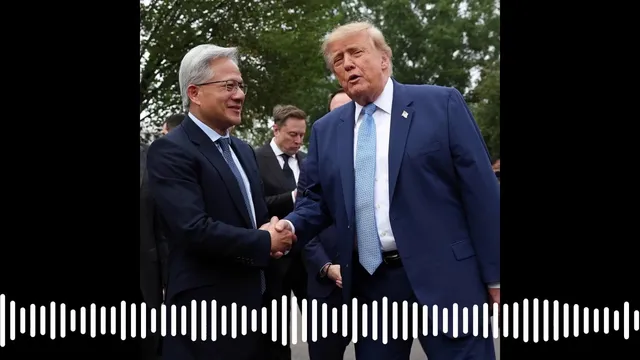
Shepard says Trump has built a close relationship with Huang, who has joined him on foreign trips and appeared at White House AI events. He argues the administration’s view of any fallout may be shaped by its reliance on AI infrastructure growth as part of its economic agenda.
- 10:58The affair could complicate China talks
Shepard says the scandal could add strain ahead of Trump’s expected meeting with Xi Jinping in China, though any U.S. response is unclear. He notes that the recent trade truce lasts until January 10 and tied U.S. restraint on penalties, including tariffs, to China continuing to allow rare-earth exports to U.S. companies.
- 13:00Nvidia uncertainty could slow AI deals
Frier says Nvidia supplies capital, chips and resources to companies it backs, so prolonged uncertainty could slow deals, complicate the AI trade and prompt buyers to diversify. Shepard says investors are waiting on board and government investigations for answers; Nvidia shares were down around 6% at noon Eastern. Frier says the episode adds uncertainty amid existing doubts about AI spending and debt.
- 16:27Anthropic's IPO may sway sentiment
Frier says market sentiment could hinge on Anthropic’s IPO plans: an offering before Thanksgiving that goes to plan could be a positive signal, while a delay or scaled-back ambitions could weigh on the industry. Holder notes that $2.3 trillion in Nasdaq 100 value was erased in one day the previous Thursday, before markets partly rebounded.
- 18:02AI optimism faces broader tests
Shepard says the episode could become part of a broader shift from AI optimism toward greater scrutiny. He points to local pushback against data centers, investor doubts about financing the AI trade and political resistance to companies’ positions, including questions about whether their interests align with those of the U.S.
Published Nov 9, 2026.
Transcript · 13 min read
Big Take, hosted by Sarah Holder, with Sarah Frier and Michael Shepard.
From the transcript Big Take publishes with the episode.
Bloomberg Audio Studios. Podcasts. Radio. News. This is like something out of a soapy TV show.
It really is. And it's something that came out of nowhere and really could not have come at a worse time for this moment that we're in with the artificial intelligence boom, considering all the pressure it's under.
Chen Sen-Wang is probably the person who responsible for the AI boom? If you could pin it on any one person, like he is at the center of it all. He is the hype man. He is the financier. He is building the chips that go into these data centers and has really driven this moment in our economy. And without him, what would it look like? I don't think anyone has a good answer.
Read the whole transcript
I'm Sarah Holder, and this is The Big Take from Bloomberg News. Today on the show, the CEO and the suspected spy. Bloomberg Big Tech editor Sarah Frier and tech policy editor Mike Shepard on what Jensen Wang's affair means for the future of NVIDIA, the U.S.-China relationship, and the AI boom. On Sunday, Jensen Wang, the CEO of the
“But if any of those chips were diverted to China, that would be a problem and a violation.”
“there's nobody who is a replacement for what he does, which so much of it is his own personal relationships”
Trump have on whatever comes next, Mike?
Well, his influence over his administration is significant and more so than in past administrations where presidents really would leave it to their subordinates and cabinet members to make difficult decisions and choices and then have it presented to the commander-in-chief. The president in this case really does take a top-down approach and a very interpersonal one as well. And he has formed this bond with Jensen, Wong, Over the past nearly two years, Jensen has accompanied the president to the Middle East, to the UK, and even to China on global trips. And he has been a regular, a real fixture, Sarah, at all of these White House events on artificial intelligence. intelligence, where the president has named Jensen in the audience. And where's Jensen? Is Jensen here? And then singled him out for praise for being such a leader in the space of artificial intelligence. And remember, the president is depending on the AI boom as a centerpiece of his economic agenda.
And if you look at the role that the infrastructure buildout has had in GDP growth, it's really pivotal. And if you take that away, you really see, you know, a much softer version of the economy. And the president and his advisors are also aware of that as well.
Coming up, how the scandal may impact U.S.-China relations and the AI trade. Mike, looking ahead, I am curious what
“this will be an irritant and a complication to talks about extending it.”
AI stocks late last week after the U.S. midterms, where Democrats won control of both Now there's a scandal at one of, if not the most foundational companies in the AI infrastructure space. Is this an NVIDIA problem or could this become a problem for the whole industry? And how soon?
“If you were thinking about diversifying away from NVIDIA's chips, this may be a factor in your decision to do it sooner.”
So much of the AI industry and the growth of the AI industry is pinned on hypotheticals, on uncertainty. And the way that the market has priced it in over the last few years, it includes a lot of the hope that AI will be a dramatic success. And I think that this incident adds just this extra layer of uncertainty to the future of the industry at a time when there were already cracks beginning to form, already a lot of uncertainty bubbling.
“We're seeing doubts even among investors about the health and viability of the financing of the AI trade.”
This is The Big Take from Bloomberg News. I'm Sarah Holder. To get more from The Big Take and unlimited access to all of Bloomberg.com, subscribe today at Bloomberg.com slash podcast offer. If you liked this episode, make sure to subscribe and review The Big Take wherever you listen to podcasts.
It helps people find the show. Thanks for listening. We'll be back tomorrow.