Free with a sign-in.
The best 17 min of 61
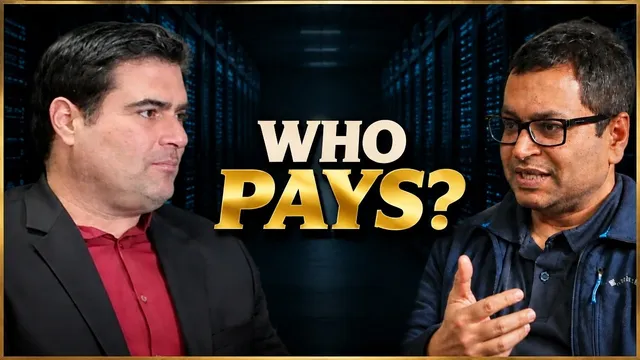
Fields Medalist: AI Can Do Every PhD Problem in a Weekend
Alessio Figalli argues that AI can solve basic PhD problems quickly, but mathematicians must preserve the training and understanding behind research.
 Into the Impossible With Brian Keating · Brian Keating
- Alessio Figalli is a Fields Medalist and professor at ETH Zurich.
The best minutes
- 39:49AI risks removing the training that future mathematicians need8 min
- 50:26AI can prove a conjecture without preserving its deeper connection5 min
- 35:48AI agents can finish the last step faster than researchers can4 min
Also worth watching
- 5:17The first minimal-surface singularity appears in dimension eight6 min
- 15:43A minimal-surface technique unlocked the melting-ice problem4 min
- 20:01Singular points are where ice-melting simulations struggle4 min
- 24:00Entropy selects the physically relevant solution after a singularity4 min
Skip the sponsor reads and the extended philosophical discussion of whether mathematical objects must correspond to physical phenomena.
Full analysis · 5 min read
Real Alpha · Nov 19
Alessio Figalli says AI can do PhD basics in probably hours or days
- Figalli says AI can do basic PhD problems in probably hours or days.
- The concern holds up as a training risk, but the estimate is not benchmarked here.
- Universities must protect practice, explanation and review as AI output grows.
Free with an account
Read the rest of the analysis
6 sections, the 4 other voices it tests Figalli against, and what it means for you. Every episode we cut gets one.
Check your inbox
We sent a link to your address. Click it to finish signing up. Not there in a minute? Look in spam.
or
Signed up before? The same buttons sign you in. The episode, its moments and the transcript stay free.
AI can compress years of proof work into hours
The striking change is not that AI solves every major research problem. Figalli says large agent runs can finish work researchers had approached, while human teams face months or years of effort.
That speed threatens more than credit. Figalli says researchers may lose the reward of reaching a result after sustained frustration and failure.
For example, he said humans might have needed five to ten more years on Navier-Stokes, partly for verification and computation. His point concerns compression, not proof that researchers have nothing left to contribute.
Figalli said a company solving a problem to demonstrate model power could be acceptable. But he worries those demonstrations leave researchers asking why they should persist.
On All-In in October 2026, David Friedberg said computers can test OpenAI proof guesses quickly and in parallel. That helps explain where speed compounds, without showing every research problem has the same fast test loop.
The episode offers no benchmark for success rate, computing cost or time across a broad problem set.
“Essentially, once you launch it, it will do the last part of the proof once all the building blocks are there in a matter of hours.”
 David Friedberg · All-In · Oct 10Math proofs fall fastest where the whole test loop runs in software
Our read
The episode makes a credible case for faster proof production, but not a measured forecast for all mathematics. The value at risk includes the work that trains researchers, not just the final theorem.
Basic PhD problems train the next generation
Figalli’s clearest figure is carefully scoped. He says AI can do every basic PhD problem in probably hours or days. He does not say it replaces all mathematical research.
That difference matters for universities. A beginner’s problem is not valuable only because nobody has solved it before. It gives a student practice in finding a route, checking a step and learning how hard problems behave.
For example, Figalli compares research training to going to the gym. Students start with small weights before attempting larger ones, so removing elementary exercises can also remove the progression that builds skill.
Take his intern comparison. Figalli asks what happens decades later if firms stop hiring interns after automating basic work. The episode offers no curriculum or hiring data to quantify that risk.
He also frames university as training people to think critically, not simply teaching operations they will later use at work. That makes the basic exercises part of a longer preparation.
Our read
The estimate is a warning about the training pipeline, not a labor-market forecast. Education and research leaders should measure whether AI assistance leaves learners able to work independently.
A correct proof can miss its motivating connection
Figalli’s strongest test of AI mathematics is not whether a proof reaches the stated answer. It is whether the proof preserves the ideas that made the question worth asking.
OpenAI’s proof solved the De Giorgi conjecture for Allen-Cahn, Figalli said, but did not carry over to minimal surfaces. The conjecture’s motivation came from a connection between those areas, which the proof did not expose.
That distinction does not make the result wrong. It means a solution to a stated problem may not explain the larger relationship that mathematicians hoped to understand.
Scott Aaronson said on MTS in October 2026 that experts need to digest AI results and produce humanly comprehensible explanations. Ryan Williams said on MTS in November 2026 that AI proofs can combine earlier work with apparently novel components.
Near the end, Figalli said that for most mathematics, the proof matters more than the theorem itself. Both Aaronson’s and Williams’s points make expert inspection more valuable than a simple solved label.
 Scott Aaronson · MTS · Oct 17Mathematicians need to understand AI proofs, not dismiss them
- RWRyan Williams · MTS · Nov 16AI proofs synthesize prior work and sometimes add a novel step
Our read
Figalli’s example makes mathematical context a separate output from correctness. Evaluators should ask what a proof establishes and which connections it leaves unexplained.
Figalli cannot assess the unseen Yang-Mills proof
The host described demands for immediate release and asked whether withholding the proof conflicted with mathematical practice. Figalli said he had not seen the proof and did not know OpenAI’s rationale.
On Lex Fridman Podcast in October 2026, Alex Kontorovich described a Lean-verified AI proof of Fermat’s Last Theorem. He said it arrived in 13 million lines and still needed substantial work to become clean and reusable.
On MTS in November 2026, Ryan Williams said coordinated reviews can help the public understand major proof releases. These examples support review and interpretation, but establish nothing about the unseen Yang-Mills proof.
 Alex Kontorovich · Lex Fridman Podcast · Oct 26AI formalized Fermat’s Last Theorem in 13 million lines
- RWRyan Williams · MTS · Nov 18Coordinated reviews can make major proofs easier to understand
Our read
Figalli could not assess Yang-Mills from a proof he had not seen. The episode supports scrutiny of the release process, not a verdict on the result.
Connections between fields can produce practical tools
Figalli’s own work shows why a theorem’s surrounding ideas can matter beyond its statement. Techniques developed for understanding minimal-surface singularities unexpectedly helped his team study melting ice.
The transfer was not automatic. Figalli says his team expected the method to fail, then checked the successful calculation several more times.
At an ice boundary, melting can split one piece into two and change the shape’s topology. Those singular points are also where numerical simulations struggle, because irregular geometry is difficult to approximate.
After a singularity, Figalli says, equations can allow infinitely many continuations. An entropy condition selects the physically relevant solution, helping connect mathematical proof to reliable modeling.
Our read
These examples support Figalli’s concern about proofs that answer a prompt but miss a connection. Mathematical understanding can guide simulations and help identify which solution represents the physical process.
Universities must preserve a path to understanding
Figalli’s response is not to reject AI. He says the tools can accelerate research, while universities must still train students to think independently and understand mathematics.
He expects mathematical production to keep increasing, and would expect a steadier state in a couple of years. Those are his expectations, not measured forecasts in this interview.
If output grows while training shrinks, fewer people may be equipped to interpret the results. Figalli worries a vast collection of proofs becomes difficult to use when nobody can explain what follows from them.
His practical proposal is to choose problems researchers care about, work on them for understanding, and give students time to learn. That fits his examples better than a blanket rule to use or avoid AI.
Our read
The decision for universities is not whether AI can solve some exercises. It is whether students still learn to check, explain and extend the work AI produces.
What it means for you
- Test independent work. For a sample of basic problems, compare what students can solve before and after AI assistance. Track whether they can reproduce the reasoning without the tool.
- Measure review time. For AI-generated proofs, record how long experts need to verify, explain and make each result reusable. Keep those measures separate.
- Price the full run. Track compute, elapsed time and human checking effort per accepted result in agent-based research. The episode gives no cost or success-rate data for its hours-or-days estimate.
- Keep context attached. Ask authors to document a conjecture’s motivation and links to neighboring theories alongside the proof. Check whether those connections survive the solution.
What to watch
- Whether OpenAI releases the Yang-Mills proof for broad independent review.
- Whether AI proofs preserve connections to neighboring theories, not only answers to stated problems.
- Whether universities adapt PhD training to retain foundational work and independent reasoning.
Send this to university leaders and research directors responsible for math training.
Watch the minute where Figalli gives his estimate
Written by Real Alpha from the episode's transcript and the other moments it links, then checked against the transcript. Quotes are the speaker's exact words.
Minute by minute
- 0:00OpenAI's proof needs expert review
Asked about OpenAI's Yang-Mills announcement, Figalli says he has not seen the tools or proof and does not know the rationale for restricted access. He says the pace of new AI results also makes it hard to know what comes next.
- 2:57Jim Simons asked for checks
Figalli recalls a 2019 fundraising dinner where Jim Simons asked guests to write $100,000 checks for a mathematics institute, then told Figalli he did not need to contribute because he was a mathematician. The story leads Keating into Simons's work on minimal surfaces.
- 5:17Dimension eight allows singularities
Figalli describes minimal surfaces through soap films and the shapes that minimize area. He says Simons proved that minimal surfaces remain smooth through dimension seven, while the Simons cone showed that a singular minimal surface can occur in dimension eight.
- 11:38Higher dimensions reveal thresholds
Figalli says higher dimensions matter in questions connected to physics and in mathematics more broadly; the relevant threshold is not always known in advance. He says Simons's calculation worked in arbitrary dimension until an integral diverged at dimension eight. Figalli describes himself as more interested in proving theorems than constructing counterexamples.
- 15:43Minimal-surface tools helped study melting ice
Figalli says techniques developed to understand singularities in minimal surfaces later proved useful for studying the moving boundary between ice and water. He describes the connection as unexpected and says it gave the team a key first step.
- 20:06Melting creates boundary singularities
Figalli explains that a thin part of an ice shape can melt through before thicker parts, splitting one piece into two and changing its topology. He says understanding these singularities can improve numerical simulations. He adds that ice-water boundaries are not fractal and that different problems need different theories.
- 24:00Proofs help select physical solutions
Figalli says equations can have multiple mathematical solutions after singularities appear, even when physics points to one observed outcome. In conservation laws, an entropy condition can select the physically relevant solution and restore uniqueness.
- 29:51Math draws on the physical world
Figalli says mathematics was initially shaped by human attempts to understand the physical world, but that does not mean every mathematical theory must have a physical application. He argues that general theories can be useful because later discoveries may fit within them.
- 31:59AI puts pressure on mathematicians
Figalli says AI models can combine prior mathematical knowledge and try many strategies at once. He cites a 10,000-agent effort and argues that if companies can finish problems in hours while humans need months or years, researchers may lose the reward of completing work as part of a community.
- 39:54AI could weaken the PhD pipeline
Figalli says AI can be a useful research tool, but delegating intellectual work risks weakening learning and independent thought. He says AI can solve basic PhD problems in hours or days, making it harder to motivate students, and argues universities must keep training future mathematicians to understand growing research output.
- 47:34Creativity depends on the problem
Figalli says creativity is difficult to define and that unexpected results can seem creative because they surprise people. He says models can work from stated problems and existing mathematical knowledge, but may not know the rationale that led mathematicians to ask a particular question.
- 50:37AI's proof missed a connection
Figalli says OpenAI completed the missing dimensions of the De Giorgi conjecture for the Allen-Cahn equation. He says the proof was specific to that equation and did not retain its connection to minimal surfaces, so it solved the stated problem without recovering the broader motivation.
- 55:31Mathematicians need access to proofs
Asked again about OpenAI's Yang-Mills announcement, Figalli says he has not seen the proof and does not know why access has been limited. He says mathematicians should choose problems they want to understand and ensure students get the time and training to do that work.
- 58:27Understanding can matter more than proof
Figalli says an opaque proof may be useful if its goal is simply to provide a formula for an application. But if the goal is to understand a theory, he considers an ununderstood proof useless or even detrimental, because it can discourage further work without showing how to build on the result.
Published Nov 18, 2026.
Transcript · 46 min read
Into the Impossible With Brian Keating, hosted by Brian Keating, with Alessio Figalli.
Transcribed by machine (Whisper) from the episode’s audio, so a word may be off here and there.
My last questions have to do with this announcement. Two days ago, OpenAI announced that its model had constructed a rigorous mathematical existence proof for four-dimensional Yang-Mills theory, and that's one half of a millennium problem. and David Gross, who won the Nobel Prize for work with QCD. My question is twofold. You just mentioned that there needs to be follow-up by experts, but my question is there's not much transparency going on. So your fellow mathematicians are demanding that OpenAI release the proofs immediately rather than giving privileged access to people like David Gross just because he has a Nobel Prize or fields medalists like you, etc.
Is withholding this claim breakthrough fundamentally incompatible with the way that you think mathematics should actually work? Yeah, that's another good question. i think i don't know what is the rationale behind that i haven't seen the tools nobody has besides these four people yeah exactly so i haven't seen the tools i haven't seen anything i mean there have been i think consultations also with the advisory board that they have now which is made of some mathematician i don't know if there was an idea i mean i haven't i don't know what was the status there right so if they wanted to what was the rationale i mean that's the part that perhaps one should ask open ai for me anyhow giving up i mean there was also a bit of that when they try to to do with the end of the problem to have people check i think the problem now is more like you don't know what comes next right so it's like every if every month and if from pounds i don't know every week new problems comes and so solved there is a lot of uncertainty yeah to be honest i don't know perhaps it's a moment in the sense that once the model has reached this superhuman capability and essentially already reached i don't know until when open ai will
have a motivation to keep solving just math problems i mean i don't even see a clear purpose there to keep using these models just to solve more math i mean the production anyhow is increasing exponentially overall just because people have added this i would expect that in a couple of years we will reach more of a steady states where you know we will know more how things evolve i think on our side what we can do is just to say okay we choose the problem that really matter to us we work on them because we want to understand them in our way we go on and we make sure that our students you know get the training and get everything they need to keep going to be supported they see the value of understanding they're not damaged by spending time to understand you know that's i think the most important thing so we don't want them to feel that they need necessarily to use the eye themselves to speed up we want them to have the time to learn at their pace because that's the only way to train the future generation so alessio thank you so much for joining me all the way from einstein's home home institution isn't that right yeah einstein was actually a student here in zurich so we have still a cabinet in the you know in the main
Read the whole transcript
building people come every day to take pictures of oh yeah where he was putting his stuff so yes he's a he's a probably good alumni to have on the uh on the record well i i met you at a A tribute to my late, great mentor and friend, Jim Simons, in 2025 at the Simons Foundation. You and Nobel laureates and other luminaries were there to discuss the life and work of Jim Simons. But also your own work and the things that you do and the intersections between them. And you told a funny story about how he asked you for $100,000. Do you want to recap that story, Alessio? It was a funny one. It was in 2019, I was invited for a dinner at this place in New York.
And essentially, we're all billionaires present at the dinner. he was raising money for what was called an sri now is sl math and so i was you know there as one of the mathematicians we were just two and uh essentially the speech was great because it just said you know i want to raise money for msri it's a great place the math is very important and but i don't want to waste time you know doing you know waste time to raise this money i have too much too many things on my plate so the easiest way to raise money is just that before you leave the door after dinner you just write a check for a hundred thousand dollars and that's going to be so it was very you know easy and convincing argument of course then i panicked for a second i was like wait i'm also sitting on this table am i supposed to write a check for a hundred thousand but then immediately look at me you know it didn't even give me the time to think about it and say oh don't worry you don't have to write anything you're just a mathematician so i'm not checking for you and i was like thank you you know just about my change you don't have to melt down your fields metal you know for the gold and um yeah once he wouldn't be enough
he ran a charity called uh math for america and i used to host a benefit for a fundraiser here in san diego um once a year or something for west coast people to get involved and once i remember I invited him and he was the keynote speaker and then we had some other remarks and some students and everything. It was very nice. I want to start off with the story that you told about his work and the reason is because we'll get to Eugene Wigner's famous saying about the unreasonable effectiveness of mathematics and physical sciences.
“which means that in dimension 8, it's more efficient to pass through the origin and create this singularity.”
Now, you know, to me, again, I would have stopped at dimension three. I mean, you know, but what makes a mathematician keep going? I mean, what if it wasn't eight? Would he kept going till, you know, the reach the Feynman point, which I think is, you know, where there are six nines at 762 digits into pi or something like what makes a mathematician keep going where a physicist would have stopped? Well, that's a good question, right? So I think as a mathematician, you still want to understand geometry of the space and whatever, I mean, whatever problem, independently of the dimension. And there is a reason. So, okay, you could think, okay, if I'm in dimension two, dimension three, I'm fine. So you have a very clear reason why maybe on the plane there is something happening or dimension three happens something happens but then you know once you say i'm willing to go to higher dimension and there are very good reasons to go to dimension resistance four if you think about space time or you can naturally go to dimension seven if you think that you think in physics right you have time three variables for positions and for instance three variables for velocity naturally you are in dimension seven so there are situations where you naturally want
to go to higher dimension and so as a mathematician you know adding variables is just something that then becomes more like algebra you just start coordinates so and then you independent of the the situation you say ask yourself okay but will the dimension play a role in this problem and if yes how and of course you don't know when you start right you don't know okay i never asked how the history was because this history started already in the 50s but I can believe that at the beginning many people were convinced that MIMAS would have been smooth in every dimension so there was no sign that something would happen and then 8 just came out it could have been 23, it could have been 88 it could have been a number some number had come out 8 came for this and there are other problems in Math where 6 come out or 24 comes out so I don't think we have a clear explanation then you know as a physicist you could also say well i mean there is there are theories like string theories right where you are not naturally in three dimensions anymore so mathematicians can't think okay whatever you want to do let's if we can get something that works for every dimension why not doing it and then why you as you try to do it i mean i'm sure that when jim tried to do this
he was just trying to he didn't do it in dimension seven he was doing a dimension n and arbitrary and was doing computation that were like valid in every dimension, in fact. But just then he had an integral and Vizitra diverged from dimension eight and higher. And so that was just the moment where he saw, oh, something is happening in dimension eight. So, you know, that's how he goes sometimes. And we'll talk about more singularities when we talk about the Navier-Stokes finite time blowups, and then that will lead us into artificial intelligence and the threat to your career. Actually, I think you're going to be fine, Alessio.
I think you've got a nice stable position. I'm not worried about you. I'm worried about your students. But before we get there, I guess my father was a mathematician, as I told you. I could never tell with him if it was more important to discover a counterexample or falsify a theory. you know, a claim or prove the original theorem. What's more important to you? Having a counterexample that you come up with or proving the original theorem? That's a good question. You know, there are some mathematicians that love counterexamples and others who like to prove theorems. I'm a theorem person, I think.
I always try to see what's the, yeah. I try to look at the positive side. What can we prove works? And let's look at which assumption something works. and then other people are less I don't know I think the brain almost works differently we are very different I mean I have colleagues that are brilliant in building up counter examples and they just have this mindset where they try to see the mechanism which breaks down and for me I've always been more on the constructive side I think everyone has done differently which is good very exact of course it's always fun to prove your colleagues wrong you know it's like you know Which is more painful, when bad people succeed or when good people fail?
“And to be honest, it was kind of a miracle. It was really the kind of thing that you hope is true”
“These are exactly the points where usually every numerical methods will have issues because the geometry is not regular.”
And perhaps the terms are different. You cannot prove the same theorem because different things are true.
“because math tells you there are infinitely many solutions and then physics will tell you, wait, there is only one way to evolve”
And I would say mathematicians and physicists have been so successful in the last centuries in understanding so many things by just pushing each other. If I was going to rewrite Wigner's essay, and I heard Sergio Kleinerman recently talking about these issues, but he wrote about the unreasonable effectiveness of math. And I look at all these objects.
For example, in classical mechanics, we have this notion of a commutation relation, Poisson bracket, observables commute. And that's all fine and good and you can measure momentum and position. And then you can get a completely new branch of physics by just adding in the square root of negative 1. You make the quantum commutator relationships and that looks identical mathematically. I mean it even has the same symbols almost. And it involves just this constant h bar and this new other constant, you know, square root of negative 1. It makes me wonder. And then we can go into, you know, use SU2 and talk about now we have matrices, which are kind of like square roots of higher dimensional objects.
And then we can go quaternions from quaternions, octonions, and then it stops again. My question is, you know, does every mathematical object have some physical relationship? Maybe we'll never know it, but are all mathematical entities instantiated somehow or somewhere potentially in a physical context? that's a good question and kind of philosophical there right um there is also the people who ask themselves that is the math uh you know what comes first i mean is the matter the math we have because that's how the world is done or is the math independent of where we live everyone at this theory i have my theory which doesn't mean that it's the correct one, it's just mine.
I mean, for me, I think, so we developed mathematics because as humans, because we wanted to understand the world and the world in which we live. So then at the beginning, you know, there was a lot of math was developed just with a lot of intuition coming from the physical world. Eventually at some moment, mathematician had to say, wait, we have to stop a moment because this is getting out of control. We need to put down the axioms before, you know, it's not clear what is a proof anymore. And then we started over. Now, for me, it's clear that, you know, math has been inspired by the physical world. So it's not surprising that so many things come into place. At the same time, I mean, I don't see a reason either on the other end that every mathematical theory should be connected to the necessity of the physical world, right?
I mean, you could start to build new things. I mean, as you say, SU2 is one where you can find a physics related to it, but probably you can take other groups and then suddenly maybe there is no physics there. So of course, the point is also that mathematicians usually like to generalize a lot, right? And then so they try to find theories which are independent of the particular choice of the group or whatever the objects they're studying. And then inside that, perhaps there is also the physical theory, but they do it in a more general situation and more general way for a reason, because then they can even say, well, you know, you're not using that much of the specific choice, which means that if something comes out later that, you know, there is a new theory that you need to build and the group changes, actually everything works and you don't even have to worry about that.
So there is this idea. We like generality because sometimes it's fun, but there's also this idea that this can be efficient and sometimes can lead to some new discoveries as well. I think we're living in an extraordinary time. And I want to start off by talking about this letter that you co-signed, but some of your fellow colleagues did not co-sign. And that was a statement about concern of the misalignment between artificial intelligence companies like OpenAI and Anthropic and mathematicians, not mathematics, but mathematicians. But I found that extraordinary, maybe unprecedented. So my first question is, you know, what do you feel is most misaligned between these AI companies producing mathematical results?
I mean, they have to be verified. We'll talk about that. And things like Lean and so forth. But what is being misaligned between your sort of proposal with Terry and many other fields, Metalis? Well, I think there are many aspects here, right? So let's try to put things into context. So we have these AI models. which now are extremely powerful. This is something that's also very recent. Of course, AI models have been improving a lot in the last two, three years. But I think for us as professional mathematicians, until a year ago, they were really supporting, so they could be of support in research, but they were not yet at a level where they could do breakthroughs in mathematics.
Which, in some sense, it was very nice. I mean, you had a tool that will help you in doing things, but at the same time, you were not threatened by it, especially young people. But okay, we can come to that. Now, let's say these models improve to, and they could improve further, right? I mean, there is no reason why they reached the maximum. And so let's say they reach a superhuman level. So what does it mean? So these are models that are trained on previous mathematics, which means that anyhow, their knowledge is what the mathematical community has developed in the last say 100 years. And they're trained on that, they're trained on these ideas, on these techniques and so on.
And they have a computational capability which is beyond imagination for us. So they're able at the same time to do computation that you will never do, they're able at the same time to attempt multiple strategies. that maybe will take decades to one of us to try. And they can try to combine tools from different areas that maybe we are not familiar with, because as humans, we know one part of math. We don't know everything in the same way. So let's say they have, sometimes the current situation is that you have models which have clearly superhuman capabilities. At the same time, they're still models that, But as I say, they're built on previous knowledge, which means that it's unlikely, maybe I'm wrong, but it's unlikely that they could come up with a completely original idea out of the box as a human could, just because the way they're built.
Now, what was happening, I think, so what triggered everything was the following, right? So the millennium problems have been put there by the mathematical community, the Crain Institute, as an idea to, okay, these are directions that should kind of guide some areas of mathematics. So not every mathematician works on a millennium problem, nor in an area which is connected to a millennium problem. So for instance, me personally, I never worked on fluid or on negative stocks, let's say. I never worked on negative stocks. So for me, and still, that's the millennium problem I'm the closest to. So it's not that everyone should work on something which is connected to one millennium problem.
Still, these are important problems that have been put there to kind of guide a bit of some areas of research.
“Essentially, once you launch it, it will do the last part of the proof once all the building blocks are there in a matter of hours.”
“AI can do every basic PhD problem in a matter of probably hours of days”
And especially as a professor myself, I've proposed something I call the Einstein test, which was echoed by Demis Hassabis recently and others, not my name. But it's this idea that Einstein had a happy thought and that was based on his visceral bodied sensation of what freefall feels like. And so you brought this up earlier.
They're trained on what previous mathematicians have done, these AIs. But Einstein wasn't – he was trained as a human being or since he was a child and he went over roller coasters and things like that. But he didn't have to wait until some huge corpus of knowledge, some of which has nothing to do with mathematics, much of which has nothing to do with mathematics, came out. So I use that as a counterexample. Maybe I'm in the counterexample, not theorem proving side of things. But I don't know that an AI can A, have a happy thought or B, visualize visceral sensations like free fall. What do you think about this?
Could an AI come up with the Simon's cone? Could it – without playing around with soap bubbles, could it come up with Einstein field equations and the Einstein equivalence principle without – we take some silicon and we drop it? I mean what's the point of that, Alessio? So what is your feeling on this? is it too reliant on human beings to ever be truly independent and generate what you do and generate genuine mathematical creativity? At Edward Jones, we believe rich is more than Yeah, I think here the tricky part is to define what creativity means, right? So, of course, there are... thinks that we feel creative just because still they were unexpected.
But unexpected to most of us doesn't mean that they're expected to everyone. I think also the perception of creativity is very subjective. I think AI at this moment in life is at this kind of best moment of creativity for a simple reason because it just reached a level where it can use all the knowledge that it's available and at the same time you know the rules of the games i mean now there are mathematicians have produced a lot but at the same time they left around a lot of problems listed on papers to say this is what is important for us so this is where the model exists, right? There is a problem, it's clear what it is, the statement is there, they can essentially, they start prompting, and then from there they move around, and the agents move around to try to find a way to solve it.
So the model is a very good way to understand what is a problem because you stated, but the model doesn't necessarily know
“it doesn't solve the full picture, doesn't give you the full picture, it only solves the problem.”
and his colleague Frank Wilczek has been on the podcast my question is twofold you just mentioned that there needs to be follow-up by experts but my question is there's not much transparency going on so your fellow mathematicians are demanding that open ai release the proofs immediately rather than giving privilege access to people like david gross just because he has a nobel prize or fields medalists like you etc is withholding this claim breakthrough fundamentally incompatible with the way that
you think mathematics should actually work yeah that's a good question i think uh i mean i don't know what is the rational bit behind that i haven't seen the proofs nobody has i mean besides these four people yeah exactly so i haven't seen the proofs i haven't seen anything uh i mean there have been i think consultations also with the advisory board that they have now which is made of some mathematician uh i guess i mean i don't know if there was an idea i mean i haven't i don't know what was the status there right so if they wanted to what was the rationale i mean that's the part that perhaps one should ask open ai for me you know anyhow giving up i mean there was also a bit of that when they tried to to do with endos problem to have people check i mean so i think the problem now is more like you don't know what comes next right so it's like every if every month every two months i don't know every week's new problems comes and are solved you know there A lot of uncertainty going on.
To be honest, I don't know. Perhaps it's a moment, in the sense that once the model has reached this superhuman capability and essentially already reached, I don't know until when OpenAI will have a motivation to keep solving just math problems. I mean, I don't even see a clear purpose there to keep using these models just to solve more math. I mean, the production, anyhow, is increasing exponentially actually, overall, just because people have AI at their disposal, I would expect that in a couple of years, we will reach more of our steady states where we will know more how things evolve. I think on our side, what we can do is just to say, okay, we choose the problem that really matters to us.
We work on them because we want to understand them in our way. We go on and we make sure that our students get the training and get everything they need to keep going to be supported uh they see the value of understanding they're not damaged by by spending time to understand you know that's i think the most important thing so we don't want them to feel that they need necessarily to uh use the eye themselves to speed up some ai system can verify both proof but no mathematician can explain and regenerate the central idea so formally we get it, would that be an achievement or would it be evidence that we as human beings confuse proof for understanding?
Does it matter if something is proven that we don't understand it? Is that a necessary and sufficient condition or is it OK to just have a proof that even no human can understand? I mean, sometimes it depends. I mean, for me, it depends on what the goal is, right? So if the theorem tells you, you don't understand it, but it gives you the formula, pure cancer, who cares? I mean, and then we just apply it and we build all the molecules we want, right? So I think the goal is there. But if it's about understanding a theory, then no, it's totally useless. Actually, I would say that case is detrimental, right?
Because you know that the proof is there. So, you know, maybe, I don't know, sometimes you know that this has been done. So people lose motivation to what may be on some problems because they say, oh, I don't know, there is already the proof. At the same time, if you don't understand, you don't know how to go on, how to build new theories. The proof, sometimes it's the core. I mean, much more than the theorem by itself. I mean, usually it really depends on what your goal is. But I would say for most mathematics, the proof matters more than the theorem itself. And so that's why it's so important.
Very good. And it's important to get this right. I mean we're living in a most rapidly, dynamically changing period in human history and it seems like it's only going to get worse. Well, Alessio, I want to thank you so much for spending so much time with me. I hope we get to meet up again and I have many more questions and my audience loves the work that you do. We'll put links to it in your talks at the Simons Foundation, your technical talks and your tribute talks as well. Thank you so much for joining it and for your courage to do, you know, what a lot of your colleagues, you know, will not say and will not do.
And I just want to say molto grazie. Grazie mille. It was really great. Thank you, Brian. Thank you, Alessio.