Free with a sign-in.
The best 14 min of 41
The Growing Challenges Facing Jensen Huang at Nvidia, McKinsey CTO on AI ROI Gap
Phoebe Liu, Leo Schwartz and Mark Weinberger say Nvidia faces political and succession risks; Kate Smaje says enterprises have yet to capture AI's full returns.
 The Information's TITV · Akash Pasricha
- Phoebe Liu
- Leo Schwartz
- Mark Weinberger · Board member, JPMorgan Chase
- Kate Smaje
The best minutes
- 16:04Nvidia needs a real succession plan, not just a strong stock pricePro pick 8 min
- 34:21Few companies can show AI investments are producing real returns3 min
- 2:40Nvidia faces customer chip diversification and financing risks3 min
Every moment plays free. PRO marks a write-up that's in Pro.
Also worth watching
Skip the hearing logistics, the employee-reaction discussion and the closing show reminders.
Full analysis · 6 min read
Real Alpha · Nov 25
Kate Smaje says 6% of organizations meet her true ROI bar
- About 80% of executives report personal AI productivity gains, but only 6% of organizations meet Smaje’s true-ROI bar.
- The survey is a useful warning, but this conversation gives no sample size or operational definition for that bar.
- Budget against measured workflow outcomes, not personal enthusiasm or an agent vendor’s promised savings.
Free with an account
Read the rest of the analysis
6 sections, the 4 other voices it tests Liu against, and what it means for you. Every episode we cut gets one.
Check your inbox
We sent a link to your address. Click it to finish signing up. Not there in a minute? Look in spam.
or
Signed up before? The same buttons sign you in. The episode, its moments and the transcript stay free.
Organizations capture less AI value than employees feel
Smaje’s figures put a number on the AI return gap. About 80% of executives say they get personal productivity from AI. About 37% see value showing up somewhere in the organization, and 6% of organizations meet her bar for true ROI.
That progression matters because personal time savings are not company returns. A faster draft or completed task does not automatically become lower costs, added revenue, or durable capacity. Boards need the distinction before another funding round.
Smaje is McKinsey’s CTO, and the figures come from its annual survey. McKinsey advises companies on the same organizational questions discussed here, so the source has a professional-services perspective. The conversation supplies no sample size or operational definition for true ROI.
For example, a team may finish drafts faster while finance cannot trace savings or growth to the tool. Christopher Smart said on Balance of Power in November that the AI buildout is real. He questioned its pace and payback.

Our read
The survey supports caution about treating employee enthusiasm as proof of returns. It does not show that AI investment cannot pay off.
Custom chips put future market share at risk
Liu described Nvidia as the market leader in AI server chips, with two pressures already present before Huang’s brief absence. Major customers were exploring other chips and developing their own. Investors were questioning whether AI financing could last.
For example, OpenAI had announced heavy investment in making its own chips. Liu said a successful effort could hurt Nvidia’s market share over time. She had not seen signs of market share necessarily shifting yet.
The financing issue was already visible in specific places. Liu said she thought yields on certain bonds tied to data-center debt were spiking. Some data-center companies could not go public, and some chip buyers struggled to raise financing on helpful terms.
Nvidia was exploring use of its balance sheet and large Wall Street firms to plug funding gaps. The transcript does not establish whether that financing sustained chip orders. Nor does it quantify how much demand depended on customers securing more capital.
Our read
These are risks from major customers diversifying and buyers needing capital, not proof of current market-share loss. Neither point establishes a broad customer-concentration figure.
Huang’s absence made succession risk concrete
Liu said some customers briefly wondered whether they should diversify after Huang resigned. She did not describe actual order changes. Still, leadership uncertainty brought an existing strategic question back into view.
Weinberger widened the issue from customer confidence to operating continuity. He cited 60 people reporting individually to Huang, no succession process, and contracts described in reporting as handshakes. He said he did not know what occurred in the boardroom.
Neil Campling said on Bloomberg Daybreak Europe Edition in November that Huang is unusually difficult to replace. He linked that difficulty to Huang’s role in building Nvidia and its flat structure. That value makes continuity planning more important, not less.
The exposure is not only who gets the CEO title. It includes who can make decisions, maintain customer relationships, and carry deals forward if the central figure is unavailable.
Our read
The episode does not show customers leaving or operations stalling. It does show why the company needs a documented continuity plan beyond naming a successor.
Board independence depends on how directors act
Weinberger’s governance test was functional, not cosmetic. A chair or lead director matters only when independent directors meet and decide without management present. They must also evaluate the CEO. But titles alone cannot establish real independence.
He said good boards should use independent directors to run important processes, even when the CEO also chairs the board. Nvidia’s board had independent directors on paper, he said, but how they acted mattered more than their labels.
Weinberger said the board should retain Huang’s product and dealmaking strengths while adding controls. He named a compliance officer and independent review. He also said a COO or president could improve management and create succession options. That is not a call for Huang’s removal.
Patrick McHenry on Balance of Power in November urged a corporate-structure change to reduce key-person risk. Their proposals converge on distributing risk, though Weinberger focused more on board practice and executive roles.
Weinberger is a former EY CEO and serves on several boards. He speaks from governance experience, not inside knowledge of Nvidia.

Our read
The choice is not simply founder control or founder removal. Boards can retain a leader’s contribution while putting succession, compliance, and independent review into operation.
Political scrutiny can compound business uncertainty
Schwartz said Nvidia already faced a congressional fight over export controls before the leadership turmoil. He described bipartisan skepticism and expected more hearings and investigations. Huang’s return did not settle the policy debate.
Liu said Huang was expected at a closed-door House meeting on December 1. A public appearance was also expected December 3. Questions could cover export-control compliance, chip smuggling, and the circumstances of his return.
Schwartz said hearings might produce embarrassing headlines without materially changing Nvidia’s operations. He saw possible SEC and DOJ investigations as more consequential. That distinction matters because political attention is not a new rule, while export restrictions could affect sales.
Joanne Feeney said on Bloomberg Tech in November that she saw no short-term threat to Nvidia’s sales and profits. She warned that investigations and possible restrictions remained. Her split is a useful counterweight to reading a short market move as a complete risk measure.

Our read
Nvidia now carries policy uncertainty alongside demand and financing questions. The transcript cannot say whether hearings, investigations, or rule changes will materially alter its business.
AI capability compounds, but workload still needs measuring
Smaje challenged the assumption that more AI use automatically means less work. She said people using AI most prolifically can be exhausted and face higher cognitive load. More output may bring more review, choices, and responsibility rather than a shorter day.
Take AI-generated code. Smaje said it can be more or less secure depending on how it is written and what checks follow. That makes review and deployment procedures part of the investment, not cleanup after rollout.
Smaje expects tools to depreciate while organizational capabilities compound. A company can build reusable skills in workflow redesign, evaluation, security, and measurement across model changes. But that explains how future returns might improve, not whether today’s pilots have produced them.
The conversation offers no quantified result from McKinsey’s own AI use and no measure of cognitive load. Smaje’s remarks provide a framework to test, not proof that every intensive user is worse off.
Our read
Measure whether AI changes work and outcomes, not just adoption or individual sentiment. Build repeatable operating capabilities, then continue checking whether they produce value.
What it means for you
- Measure workflow returns. For each AI pilot, set a baseline for cost, time, quality, or revenue before expanding it. Report realized organizational outcomes separately from employee-reported productivity.
- Map chip dependencies. Identify critical workloads tied to Nvidia and track whether customers’ custom-chip exploration becomes actual deployment. Keep financing assumptions visible in demand forecasts.
- Test succession readiness. Document who can make executive decisions, manage key relationships, and oversee compliance if a founder is unavailable. Review whether independent directors can act without management present.
- Add checks to AI code. Include human review, security testing, and remediation ownership in AI-assisted development workflows. Track whether faster production changes defect rates or review workload.
What to watch
- What Jensen Huang says at the December 1 closed-door meeting and December 3 public appearance.
- Whether Nvidia documents succession, compliance, and independent review processes.
- Whether organizations move from personal productivity reports to measured organizational value.
Send this to CFOs and COOs approving AI budgets without workflow-level return measures.
Watch the minutes where Smaje gives the 80%, 37% and 6% figures.
Written by Real Alpha from the episode's transcript and the other moments it links, then checked against the transcript. Quotes are the speaker's exact words.
Minute by minute
A Pro write-up, open to you here. Try Pro free for 7 days
A Pro write-up. The minute by minute is in Real Alpha Pro; the episode, its moments and the transcript stay free.
Read it with Pro, 7 days free- 2:40Nvidia faces two business pressures
Phoebe Liu says Nvidia's largest customers are also developing their own chips, with OpenAI a notable example; a successful in-house chip could threaten Nvidia's long-term share, though she says there are no signs of a shift yet. She also says investors worry about circular AI financing, including rising yields on data-center debt and companies struggling to finance chip purchases. Nvidia was exploring its balance sheet and Wall Street firms to help fill the gaps.
- 20:56Succession planning is a key risk
Weinberger warns that investors should weigh Nvidia's key-person risk, unwritten contracts and lack of a succession process alongside short-term stock gains. He says founder-led companies often lack succession plans, but still need one. He suggests a founder could focus on products while a COO or president manages operations.
- 23:52Nvidia must rebuild trust
Weinberger says the board could have kept Huang at Nvidia in a non-CEO role while an investigation proceeded, then reassessed his leadership afterward. He argues the company needs a compliance officer and independent oversight, but says changes depend on the investigation's findings. He also says tighter export rules could redirect chip buyers toward the United States and reshape supply and demand.
- 34:21Enterprise AI returns remain elusive
Smaje says AI adoption remains early: in McKinsey's annual survey, about 80% of executives reported personal productivity gains, but 37% could identify value in a business domain and 6% met a higher bar for captured ROI. She says measuring saved time and linking it to growth can be difficult.
- 36:13AI can increase cognitive load
Smaje says frequent AI users can feel exhausted, facing more cognitive load and difficult judgment calls rather than simply getting time back. She compares AI with earlier technologies that eventually receded into the background, and says companies can capture future value by building organizational capabilities that compound across tools.
Published Nov 25, 2026.
Transcript · 31 min read
The Information's TITV, hosted by Akash Pasricha, with Phoebe Liu, Leo Schwartz, Mark Weinberger and Kate Smaje.
Transcribed by machine (Whisper) from the episode’s audio, so a word may be off here and there. Where the podcast’s audio and the video part ways, some times are a minute or so off.
welcome everyone to the information it's ti tv my name is akash pasrecha it is wednesday november 25th today on the show we are going to break down the business challenges jensen huang has ahead for him now that he is back as CEO. We'll also speak with the former CEO of EY about what he thinks is next for the NVIDIA board. And to close out the show, we are having a conversation with the Chief Technology Officer at McKinsey. It's going to be a great show, so let's get right on into it. Jensen Huang's return by no means has returned NVIDIA to a state of business as usual. Our NVIDIA reporter Phoebe Liu and our tech and politics reporter Leo Schwartz reported on how the company's operations on the ground might need to change going forward in this new era for the company.
I want to bring them on both for a conversation. Welcome to you both. It's great to have you here. Phoebe, I want to start with you because I want you to take us back to three and a half weeks ago, maybe, before any of this kerfuffle began. And I want you to remind us of some of the business challenges that NVIDIA was facing on the ground, because this is a company that it's still growing many multiple times over. But I mean, it wasn't all rosy over there, right?
“So if their own chip is very successful, that could spell trouble for NVIDIA's market share long term, though we haven't seen signs of that necessarily shifting yet”
Read the whole transcript
Right, okay. Leo, I want to come to you now to talk about some of the DC questions here around NVIDIA. So walk us through maybe what the big DC questions were before the Jensen ouster and then reinstatement, and then also which of those questions are now magnified, or maybe the new questions now that have sort of taken place because of all this.
Yeah, I mean, as we reported during the buildup of this story, even before this scandal erupted, NVIDIA had already had shaky footing, especially in Congress on the Hill, uh where right now congress is debating a trio of very impactful export control bills at least one of which NVIDIA was opposed to and could hurt its business especially in asia its ability to basically sell chips outside the u.s and likely be accessed by chinese customers through remote access so NVIDIA had more of a scorched earth approach in the past couple of years when it came to lobbying both in the administration as well as on the Hill. And I think a lot of lawmakers have been fed up with that. So they were already gearing up for this tough fight. And then obviously what happened the past few weeks has only increased skepticism. Now, even though Jensen's back, they're going to be facing weeks, if not months, of investigations and hearings. And the bills are currently being debated as part of this year-end defense package that is likely to pass. And whatever lobbying resources NVIDIA would likely have mounted against it if they were going to uh now will probably be more spent trying to save their reputation in dc and deal with this
onslaught of oversight hearings right and leo i mean let's talk about the reaction acutely that each lawmaker or or maybe uh both sides of the government have had to this because we obviously you've heard so much about how involved president trump was but walk us through how senators representatives on both sides what have they been saying about the the jensen reinstatement i know for most of our listeners in silicon valley it might seem like jensen has overwhelming support for his return that's certainly true among the tech crew but i would say that's that's not the case in dc at all in fact it's the opposite from a bipartisan perspective where pretty much any person in Congress who's made a public statement has either outright condemned Jensen or said, just because he's back doesn't mean that we don't need oversight or doesn't mean that these export control bills that we're debating aren't incredibly valuable and should pass. And again, that's coming from both Democrats and Republicans. If anything, his only real supporters in D.C. are Trump and J.D. Vance, the vice president, who played a key role in his return. As we reported, J.D. Vance, of course, has ties to Silicon Valley. He was a past
venture investor. So he does still have those two very powerful allies. But now that Trump is entering his last two years in the presidency, he's lost the House and the Senate, his political capital is rapidly decreasing. And I think you can see that with the number of very influential Republican lawmakers who basically spoke out against Jensen and in opposition to what Trump was saying right leo and one of the things i was just thinking about as you were talking was i wonder what would have happened if this had all broke before the election and i think you know as as tech reporters you know we probably like to make a big deal of the fact that oh my god you you know it would have it could have really turned or tipped the scales you know one way or the other But then I remember that Silicon Valley is a bubble and You know, the average American, I think, probably is not caring about NVIDIA leadership the way that many voters are.
But I don't know. I'm not a political reporter. Every single American cares about export controls. It's the number one issue to everybody. Right. Phoebe, I want to talk about the hearings that are coming up. I think next week is the soonest that we can hear from Jensen. And I believe I saw that it's going to be broadcast, actually, on C-SPAN. The December 3rd one will be, yes. December 3rd, okay. So what is it? That's next week, right? Yeah, that's next week. Yeah, so there are two main appearances that we're looking forward to, I guess, for Jensen on Capitol Hill next week. The first is closed door, so we can't see it.
It's going to be with, I think, three House committees, foreign affairs, intelligence, and China Select. Leo, correct me if I'm wrong there, on December 1st, and I think we're expecting lots of questions about NVIDIA's role in compliance or non-compliance or turning a blind eye to US export controls, complying with those, and chip smuggling. Obviously, that ties into questions around national security and Jensen's relationship with Alice Wong, which was, I would say, the instigating factor that broke all of this open. She's a former chip exec who my colleagues reported was involved in chip smuggling and also that U.S. officials suspect that she may have been a Chinese spy. So I think we will see a lot of questions around that. I'm very curious what Jensen will say. I'm sure he's preparing a lot for the various questions that he's going to get from congresspeople who are, it seems like, pretty angry with him right now and who want to see justice done in whatever shape that may take. And it's also possible that he is asked about President Trump and J.D. Vance's role in getting him back, because very notably the press release that said Jensen was coming back. So NVIDIA and its board had consulted senior members of
the government, the administration. So very curious kind of what happened behind the scenes there and maybe get some answers at those hearings as well right and leo i guess one question i have for you is i mean how much of these hearings matter or don't matter given how involved the president has been in all this i mean i guess what i'm wondering is um how much power beyond reinstating jensen which just seems to have very directly been his doing i mean how much more power Or do you think he has versus what could come of these hearings that maybe lawmakers could try to impact in terms of a tangible difference?
Well, I think there's a couple of questions here. One is hearings in general, oversight hearings in general, which we're going to have endless of over the next couple of years. I mean, besides creating embarrassing headlines for executives and companies, they don't really achieve that much. Maybe they can change public sentiment. But as you said earlier, it's not like NVIDIA necessarily is a bread and butter voting issue for most Americans. I think corruption is, and that can certainly play a role here. But it's not like that will necessarily impact NVIDIA's functioning that much. And then when it comes to Trump, I mean, as I said, his political capital is decreasing, but a much more material issue that NVIDIA is facing is there were a number of investigations that were either reported or announced from the Securities and Exchange Commission, the Department of Justice, the FBI was looking to them.
That is something that Trump theoretically could have influence on. Of course, the SEC and the DOJ are supposed to act independently. We haven't really seen that happening. For the past couple of years, already we had the attorney general yesterday in a sort of bizarre press conference almost walk back earlier statements that they had been there had been active investigations into NVIDIA and Jensen. So that is a place where Trump could theoretically put pressure and maybe put an end to the SEC or DOJ investigations. And that that would help NVIDIA a lot more than these hearings will likely hurt NVIDIA.
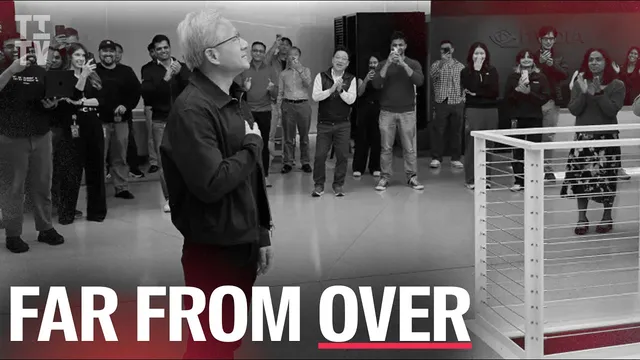
right right and phoebe before we let you go you know we've seen all the videos of jensen's uh speech i guess in the auditorium of of what seems like the NVIDIA office and you know you've got all the employees applauding for him taking videos you got the one employee that went up and gave him a big hug i guess so yeah yeah i mean it was it looked more like a concert than a than a meeting I don't even know if it was a meeting. It just seemed like he just turned up and, you know, people were applauding. Yeah, I think so. But I am curious from what you're hearing, what is the vibe among employees right now?
I mean, is it excitement? Is it nervousness? Sure, you have divide on the Jensen issue himself. I'm sure, you know, you have 20% of employees that they say sign the petition. I'm sure there are employees also that feel the opposite way about this. But how is the vibe? Yeah, I think the vibe among the rank and file per se is pretty positive. People are excited that he's back just because even though Jensen can yell at people and be kind of a very aggressive boss, he brings a certain level of culture to the company that I think a lot of employees associate him with. So some of them were pretty happy to have him back.
Same thing with customers. Jensen supports us. We know he has our back. So that vibe, I think, is good. A few of the analysts and NVIDIA people that I spoke with said Jensen will probably need to rebuild some trust with his senior executives because he lied to them about the affairs, as we reported. So that will be a little bit tougher, and we might see some turnover there. No evidence that that's going to happen yet, but I think people are suspecting not everyone will stay this time around. Great. Okay. Okay, well, Phoebe and Leo, I want to thank you for coming on. That is Phoebe Leo, who covers NVIDIA, and Leo Schwartz, who covers all things tech and politics here at The Information.
Yesterday on the show, we heard from a former Amazon board member and a Harvard governance professor about their view on what's next for NVIDIA's board. To continue that conversation, I want to bring on Mark Weinberger, who serves on the board of JPMorgan, MetLife, Johnson & Johnson, and Aramco. He is the former CEO and global chairman of Ernst & Young. Mark, welcome to the show. It's great to have you here. Thank you. Great to be here. So, Mark, I mean, high level, this story has been covered from every angle here. And I guess I'm just wondering, you know, you've served executive positions, you've served on boards.
Is there anything you think people are not talking about enough here? Anything you think people are missing with this story? well it's it's been covered in every direction as you said i mean it's got politics it's got intrigue it's got sex it's got um governance it's got a stock market valuation so i think everything has been covered generally i think the one thing that i would continue to think about is we can't judge outcomes by short-term day movement in the stock and so what's the longer term trust in the structure after all this information has come out in the board, in the governance, in the contracts that were handshakes and not written? And how do we rebuild that trust for the longer term in the market? I think it's going to be a real question we'll have to see unfold as the investigations continue and we hear more. Right. Okay. So you've served on a number of these boards of...
“The question, though, goes to your earlier point, I think, is longer term, if you have this key man risk.”
balance this short-term price movement with the reality of the reputational questions around NVIDIA that seem to have come up now. Because in some cases, you could argue, maybe you could totally say that Jensen is the best entrepreneur to run the company. At the same time, the company was a bit better off, I think, before having brought him back in the sense of there were less questions around what was going on within the company. I don't know. That's just how I'm piecing it together so you know my thought was honestly when this happened right he's still important to
the company right now and that's that's a risk it's a key man risk is what they call it so i think the board has to think about how do we diversify that okay whatever that means we have to figure it out but the other thing when they decided initially to re you know he resigned right so he resigned initially. Another option could have been And to take away the CEO role and have him, while they did the investigation, continue to be at the company outside of being the CEO and continue to do all the great things he's doing, inventing the next chip in his head and making these great deals. And then when the investigation's over, you can make a conclusion as to whether he should be there or not.
There are ways for founders to play hugely key roles. It doesn't mean they're all great organizational leaders in the terms of administratively CEO. And, you know, I think good companies would figure out ways to use the talents, but have a chief operating officer or a president come in maybe and deal with some of those direct reports in a better way so that there is succession opportunities.
“But I think there would be a huge dereliction of duty if the board didn't reassess the current structure and say, we cannot have this potential happen again.”
Right. And I will say, I mean, just before I let you go, Mark, I mean, your comment on the long-term impact of this, I think, hits because it you know NVIDIA was up 30 34 i think the day the jensen came back uh and yet you know it still it didn't save the ai trade uh anthropics ipo didn't and so it does feel a little bit like you know if you take into account the market you take into the account that i don't think jensen's gonna be on as many podcasts anymore or showing up to as many conferences it does feel like the euphoric area of all era of all this is maybe coming to a bit of a of a dip i don't know that that's my read on it i think it's a great observation looking before this uh the company was doing fabulously well and no one knew any of these things or at least they didn't focus on it or most people didn't know. You can't now unknow.
what you know. You can't unsee what you've seen. So now it has to be addressed. And I think it will be. I think that the company will figure a way to do it, but we still have to get more information before you know exactly how they're going to do it. Great. Okay. Well, Mark, I want to thank you for coming on. It was a great conversation. That is Mark Weinberger, the member of the board of JPMorgan Chase, J&J, Aramco, and MetLife here on TITV. All the big IPOs in AI are likely to rely on businesses adopting AI and finding ways to justify the dramatic investment. That has been hard to do so far, although coding and cybersecurity are certainly two popular applications that companies are certainly doubling down on.
For more on that, I want to bring on Kate Smaje, Chief Technology Officer at McKinsey, for a conversation. Kate, welcome to the show. It's great to have you here. Thanks so much. Lovely to be here. So I want to start with all these cybersecurity vulnerabilities that companies have been finding in their tech stacks. I mean, it started with what people call Black October. I don't know that it's really slowed down in November, and I think there's more to come. Tell me, I mean, among your clients right now, you advise them on a whole host of issues. Is there panic with all these vulnerabilities, or what's the story right now?
Yeah, I think it's a great question. I think panic is probably too strong a word. A lot of that depends on the person or the organization. But I think there is a real realization that we're at a new norm, right? That this is now a time and a place where it's not just, can I make sure that I am secure by design, but can I also make sure that I'm resilient by design as well? And I think the level and extent of shocks, whether external, whether internally driven, is just higher. It's running at a higher rate. And I think it's pushing people to re-evaluate how they're actually going to deal with that on an ongoing basis.
So panic may be a little strong, but certainly new realization that this is a different way of operating. Okay. And so when you say different way of operating, I mean, one thing I've sort of been wondering is as people find these vulnerabilities in their tech stacks, I mean, is this sort of a moment in time where they find these issues over the next six to eight months maybe? and then it's fine? We go back to sort of, you know, being more secure or are we going to see people hiring bigger cybersecurity teams into perpetuity? Like, what does this mean? Yeah, so I think there is both a stock and a flow issue, right?
There is an element here where we just need to be able to fix for the sort of legacy challenges that people have had within their tech stack and so on. And that's going to take a little bit of time to just work through and make sure it's right. But at the same time, there's also a flow issue in that we're all in a world now where you've got citizen developers and we're innovating further and faster and putting new technology onto this state. And every time that that happens, you're creating new vulnerabilities or things that were not a vulnerability six months ago suddenly are with the next drop of the new model. And so I think this is going to be, that's why I say sort of new reality, a new reality of, you know, the operating model needs to change. And, you know, your times of remediation goes up, the importance of how you fix these issues in the backlog of things that you do goes up. And maybe that does mean that we will have maybe more people, maybe also just more technology to help you identify, remediate, patch faster on an ongoing basis but it's stock and flow and and when you think about ai generated code and we've heard all these stats about what percent of companies code now is generated using these
coding agents do you see that code as more or less secure than code that people would have otherwise deployed and i'm talking about you know more susceptible to attacks and stuff like that. What's your experience there with the clients that you're seeing? Yeah, I mean, there isn't a kind of bore or less secure. I mean, in many ways, some of that code that is now being written by the models and so on can be more secure, right? A lot of it depends on how the parameters are actually defined and, importantly, what checks are done afterwards, right? Whether the code quality is good enough and whether the procedures are in place to make that work.
So there isn't a blanket kind of it's either better or it's worse. A lot of it really depends on the way in which that code is actually written and deployed, which is still largely a human choice. Right. And so at McKinsey, are you guys planning to beef up your own cybersecurity practice or the I was a I was a consultant at Deloitte back in the day. I'm sure that the cyber team must be growing fast at McKinsey right now. Yeah, I mean, this is a real moment, actually, where the challenge goes well beyond the technology. if you think about what people are really grappling with is how do we think about where to draw the line in terms of what we need to remediate and on what time scale how do we change the operating model to make sure that we're equipped to being able to do that you know all of that kind of human wear right not just the software and the hardware choices around it but the human wear choices of you know how the organization needs to change to be ready for that you know very very much kind of mckinsey uh you know mckinsey type problems so yeah this is an area that we're spending a lot of time on we have done for a for a long a long while anyway and we're seeing a huge amount of demand from right okay so let's talk about the roi side of all this um ai agents we
“And if you ask and set the bar at the level that I think it needs to be at in terms of true ROI capture, it drops to 6”
saying it's it's creating more work for people because people have to figure out how to implement
it the question i'm sort of wondering is if you sort of look at the transformational technologies that we've seen of the past 15 years, let's say. We had cloud, we have mobile, now we have AI, et cetera. I mean, I'm sort of wondering to what extent we actually get AI to work for us in a way that saves us time before the next big technology comes. Because this seems sort of like a repeating story, which is that we try to save time. It drives us nuts. And we get home late in the evening because of it. And then the next one comes along. I mean, it seems like this is just sort of a hamster on a wheel right now.
I mean, in some ways, maybe the reassuring thing in that is that, yeah, we have been here before, right? Whether it's cloud, mobile, big data, the internet. And what you see is these technologies arrive and are declared the thing of the moment, and it's going to change everything. And over time, it sort of dulls down into the background hum of how an organization works. And I think we will start to see that with AI as well. But that doesn't have to mean that we're not going to get value from it in the process. And I think if you look at any of those previous technologies and look at it objectively, of course, we're getting value from them right now.
And the demand is still there, et cetera, et cetera. But the really important thing, I think, in all of this is the tools themselves will depreciate over time. We'll use different things. We'll talk about different technologies. But the capabilities that organizations build, they compound. And so the thing that tends to set folks apart is, are they building that organizational muscle to be ready for whatever technology comes next? Because you're absolutely right. It's going to change. We're going to see something new, something we possibly don't have an aim for yet. But having that underlying capability set means you're ready to move faster and capture value when it comes.
Great. Okay. Well, Kate, I want to thank you for coming on. That is Kate Smaje, the CTO of McKinsey, here on TIT. that does it for today's show a reminder we are on this stream monday through friday at 10 a.m pacific 1 p.m easter but we are off tomorrow and friday for the thanksgiving long weekend so we will see you on the monday after of course if you can't make it then episodes are available on the information.com on our youtube channel or wherever you get your podcasts make sure to follow us on social media on x on instagram on tiktok and on linkedin i am already excited for our next show on Monday. Have a great holiday weekend. Bye-bye for now.