Full episode · 27 min
Why Americans are so worried about AI
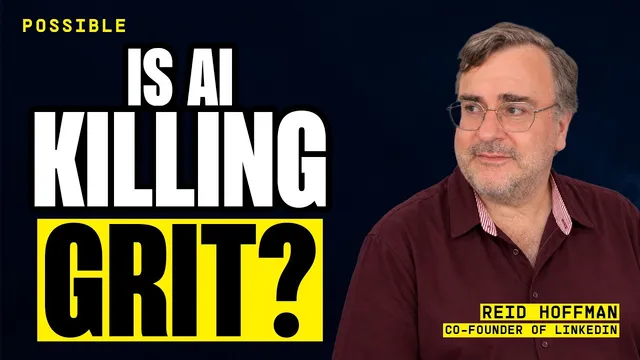
Reid Hoffman argues that the U.S. should compete in AI while making its gains reach more workers and industries.
PPossible · Ari Finger & Reid Hoffman
- Reid Hoffman is cohost of Possible.
The best minutes
- 1:15AI anxiety reflects fear of loss and disputes over who benefits7 min
- 9:56AI interviews can widen the pool beyond degree filters5 min
- 20:11AI ads need a hard boundary from answers4 min
Also worth watching
Summary · 2 min read
Hoffman cohosts Possible with Ari Finger. He argues for a dual mandate: competing in AI and spreading its economic benefits.
Finger cites survey findings that 74% of AI-aware Americans feel worried and 36% expect AI to mostly help their country, compared with 93% in China. Hoffman attributes U.S. concern to doubts that the future will improve for most people, an instinct to protect existing gains, and disputes over who will benefit. He argues the U.S. should compete in AI and use its gains to support workers and industries, including through AI-enabled manufacturing. On hiring, he sees AI interviews as a way to assess skills and widen access but says teams should retain a human role; on advertising, he calls for clear separation from answers, accountable commitments, and third-party audits.
Minute by minute
- 0:28
U.S. AI anxiety has three roots. Finger cites survey findings that 74% of AI-aware Americans feel worried and 36% expect AI to mostly help their country, while 93% of people in China expect it to help. Hoffman attributes U.S. unease to fears that the future will be worse than the present, a desire to protect what the country already has, and disputes over who will share in AI’s gains.
- 6:22
AI leadership should spread prosperity. Hoffman argues for a dual mandate: win at AI and use the resulting prosperity to benefit more workers and industries. He points to AI assistants in health, law, education, and government services, and says AI and robotics could help restore U.S. manufacturing strength; he notes the U.S. is behind China on robotics.
- 8:32
AI interviews can test AI judgment. Finger describes HackerRank’s Chakra AI interviewer, which has candidates work through practical problems with AI and then explain their choices, reasoning, and whether they checked the AI’s work. She says the approach reflects a shift toward assessing how developers direct and evaluate AI, not just how they code.
- 10:06
AI could widen hiring access. Hoffman says human interviews can be expensive, encouraging employers to narrow the pool with degree requirements. He argues that lower-cost AI interviews could support two-hour or even four-hour assessments of candidates’ skills, helping employers consider people without degrees for roles that do not require them.
- 13:24
AI may improve candidate feedback. Hoffman expects candidates to get more responses and possibly feedback through AI-supported hiring. He says AI could also help applicants judge whether a job, company culture, or career path suits them, and predicts the process could become more transparent.
- 15:22
Hiring should remain a team decision. Hoffman says AI can assess competence and capabilities, while humans assess team and cultural fit and cross-check the results. He argues that hiring should remain a team process; he sees a narrow exception for contractors hired solely to deliver a specific task.
- 19:05
Ads must stay separate from answers. Finger describes OpenAI’s planned test of labeled visual ads in ChatGPT for free and Go users in the U.S., with the company saying ads will not influence answers. Hoffman says paid, non-advertising options can coexist with free services, but argues that advertising and non-advertising content must remain clearly distinct.
- 23:58
Trust needs enforceable commitments. Hoffman says AI companies should make public commitments about how they operate and be held accountable by customers, the press, and potentially government inquiry. If those measures are inadequate, he favors stronger regulation, including third-party audits that can be reviewed and challenged.
Published Oct 14, 2026.
Transcript · 20 min read
Possible, hosted by Ari Finger and Reid Hoffman, with Reid Hoffman.
Transcribed by machine (Whisper) from the episode’s audio, so a word may be off here and there.
- 0:00
America is helping to build this technology, and yet Americans are among the most worried about it. So I actually think AI inclusion in the hiring process will broadly be much better. You want to return to manufacturing strength in the U.S.? AI and robotics is your only hope. What do you think changes when the advertising platform is also this assistant that you're supposed to trust and use to make really important decisions in your life? Reid, so thrilled to be chatting with you today as always. And likewise. So let's get right into it. AI optimism, do people like it? Do they not? We saw that last month, Gallup and Microsoft released findings from a survey of adults in 37 countries, and this was about their awareness, use, and views of AI.
- 0:45
And one of their major findings was among people aware of AI, positive feelings outweighed negative ones in 34 of those countries. That was a big surprise to me, but was not a surprise, was that the U.S. is an exception. 74% of AI-aware Americans feel worried, and only 36% expect AI to mostly help their country. And that's compared to 93% of people in China who think AI is mostly going to help them. And so across countries, the median share who had never used AI is also 57%. So, Reid, America is helping to build this technology, and yet Americans are among the most worried about it. What do you think explains this gap?
- 1:29
We're the ones who build it. We have high adoption and yet we are not excited about it.
Read the whole transcript
- 1:34
Reid HoffmanI think there's three things. One, I think there's a general, call it, concern, fear, worry that the future is going to be less good than the now and that AI is just an amplification of that.
- 1:50
Like, I think even before AI, there was that worry, partially because I think that, you know, we've done a not great job as a country of bringing, call it the majority of the country along on our economic prosperity and, and how to make sure that that, you know, kind of maybe the simplest way of putting it is make sure we get the middle class a raise in the work and jobs and opportunities they're doing. I think the second thing is that, generally speaking, when you have technological waves, the people who already in their own minds feel like challengers versus incumbents are benefited from that.
- 2:29
So it's kind of not surprising that when you go to China, which is, you know, viewing its growing its economics and feels that it's, you know, kind of coming on strong to create, you know, a whole number of industries, some of which already very successfully. But even, for example, when you get to the global south, the primary thing that they request is run AI is make sure we're included. We don't want to have this be economic prosperity for other people and not for us. So make sure we're included. But, you know, since, you know, the U.S. has been the richest country in the world, it tends to have more of an incumbent perspective, even though historically, you know, we psychologically identify more with the challenger in terms of, you know, growing our industries, growing a new country, et cetera, et cetera.
- 3:18
But we're like, I think people are like, well, we don't want to lose what we have. So I think that's the second part of the kind of the American psychology. And then the third is that we have, and this is kind of classic when you get to the kind of shadow ages of empires, whether it's Rome or England or now, for us Americans, there's a lot more internal dispute. It's like, well, if there's going to be an AI boon, who is it going to benefit? Is it going to benefit me or benefit you? And you're not focused on the U.S. as a kind of defining country within the world. It's more like, you know, my political tribe versus your political tribe, my region versus your region, my, you know, racial identity versus your racial identity, you know, da-da-da-da-da.
- 4:06
And so I think there's a lot of internal. And so I think all of that sets the stage for most people being inherently somewhat skeptical. So, for example, a lot of people are, you know, kind of anti big tech companies and big tech, you know, CEOs and creators anyway. And they're like, this is just another reason to be anti. And even when you say, well, wait a minute, this could create a medical assistant that could essentially create high quality health care across the entire scope of the world, but also 340 million Americans, of which only something substantially less than 100 million have really good high quality health care.
- 4:50
Yeah. Right. And even you could do that and say, well, no, but that doesn't matter because it matters because it'll be benefiting, you know, the tech companies and the and the owners of the tech companies more than it is us. And you're like, well, that's the wrong place to be. You should be thinking about what are the things that kind of raise the capabilities for everyone. And that's, I think, the reason why, since the other countries don't have these internal divisions, they're clear-headed about the fact that this is going to create the next generation of globally relevant prosperity that they want to be bought in.
- 5:27
And so, for example, the most surprising part of these findings is, you know, only 36% AI to mostly help their country. It's like, well, that's an obvious thing in terms of economic productivity. productivity. To say, hey, I worry about the reshuffle of power economics within the country is, I think, something to say, how do we navigate that? But the creation of prosperity for the countries that adopt is actually, in fact, really straightforward. And that's the reason why you see the 93% in China. And I think there's a number of other factors that come into it. I think the Chinese government, you know, kind of understands just as they've been trying to raise their farm industry and the car industry and a bunch of other things, they understand this is an economic multiplier. It's part of the reason why a number of years ago, they said they want to be the leader globally in AI by 2030. That's just around the corner in terms of what they're trying to target. And so I think, you know, for us, that's part of the reason why, I kind of, as you know, a couple of weeks ago came out kind of arguing for a dual mandate, which is we both need to win at AI because that will give us as a society, the economic
- 6:46
prosperity to do everything from trying to fund the fact that we are massively in debt. We're like a society that's maxed out all our credit cards and most of our taxes, a huge percentage of our taxes are going to paying off the debt. And this gives us the growth to navigate that and create economics. And then the second is to use that, to earn the money by being first in AI to then benefit the bulk of the country, to say, how is it that in building AI, it isn't only going to be a beneficiary to one industry or to a small number of companies, but to many of the industries, to many of the workers. And some of that you can do through creating assistance, medical assistant, legal assistant, educational assistant, government services. And some of it you do by supporting the industries. To close off this opening monologue, sorry for the length, is to say, look, you want a return to manufacturing as a strength in the US?
- 7:55
AI and robotics is your only hope. And the question would be, is how do we deploy our strengths in AI? We're actually behind the Chinese on robotics. So, and increase robotics to return us to a manufacturing powerhouse, or at least in contention with China, Japan, Germany, et cetera. And I think that would be obviously very good for the middle class if we succeed in doing so. So it's very clear that there is a lot of work to be done, both by the companies themselves, but also the American people on using AI to help make their own lives better, but also understanding how it can sort of keep the U.S. as an economic powerhouse as we head into the future.
- 8:37
I'd say one of the places where people are worried is jobs. And specifically, I see headlines like AI is writing resumes and cover letters, you know, thousands a day, and AI agents are rejecting thousands of people a day. Like it adds to sort of both the nervousness, but also the dehumanization that people are feeling like, I'm putting myself out there. I'm trying to get this job, but, you know, I just have a robot on the other side or I have a machine telling me no. And so HackerRank is a technical hiring platform, and it's used by thousands of companies. And it's expanding its AI interviewer chakra.
- 9:12
And so this is actually an AI that is doing the interviewing. I think the interesting thing here, though, is what it tests. Candidates can work through practical problems with AI, and then they face questions about their choices, their reasoning, whether they checked the AI's work. This company had been known for straight coding assessments, but this signals a broader change in how developers prove their ability. Employees increasingly need to assess how someone directs and evaluates AI. Like we've said so many times in the future or maybe the present, everyone is gonna be a manager because you're gonna be managing AI and employers need to know how are their potential employees gonna do that.
- 9:49
And so you and I both have told young people, including my children, that being AI native is gonna be part of their opportunity. How do you think hiring should change so that employers can actually recognize that talent. But at the same time, we need to make sure we're not sort of dehumanizing the entire experience. Well, I mean, the hiring experience is already somewhat less than ideal already. So it's not, you know, this kind of perfection experience. And actually there's various ways in which I hope that the transformation of the hiring experience through AI will actually, in fact, elevate the various elements of humanity.
- 10:32
Now, one of them is a project you and I work together, along with Byron Aguiz and all the people at Opportunity at Work, which is this notion of tear the paper ceiling and the fact that just having a piece of sheepskin is not actually, in fact, the right credential. And so it creates a differentiation and also this dependency on going massively in a debt to going to some colleges in order to do it, whereas actually, in fact, you could just use the skills and capabilities. And I think one of the things that you get in an AI interviewer is currently, the use of a human interviewer is very expensive off the things that they're doing. And so they tend to go, well, let's just narrow the channel as much as possible. So do you have a bachelor?
- 11:14
Like we're interviewing you to become a janitor. Do you have a bachelor's degree? Right. You know, like, you know, kind of, you know, in the absurdity of it. But even like, for example, you don't need a bachelor's degree to necessarily be a software developer. You don't need a bachelor's degree to necessarily be any number of other kind of white collar jobs. Sure, you should be certified if you're an accountant because you have to understand that kind of thing.
- 11:37
Reid HoffmanBut part of kind of an AI interviewer is you go, well, so-and-so looks interesting. It's not that expensive to run a two-hour AI interview process with them. And you could get a really interesting
- 11:53
assessment. And what's more, you'll get a better assessment necessarily than simply a, oh, look, does the chemistry feel right in a hour interview where you're kind of going through stuff? Because you could also do four hours with AI and you could do it in chunks and follow up and all the rest. So I think there's a lot of things you could do there that enable a much broader range of talent that you can potentially find, you know, the kind of the diamonds that are out there in the field, not just in the rough. I think there's also, you know, kind of questions around AI where, you know, like I think that you will still have human interviewing, but I think that, you know, the thing you'll do is say, okay, the AI will do a bunch of stuff on competence and capabilities and learning curves and other things. And then the human will assess, you know, kind of cultural fit, team fit, you know, other kinds of things, and then cross-checking some of the stuff.
- 12:55
And I think that will make a good experience. And then, of course, also, you know, one of the things that an AI can also then spend time doing is saying, like, helping the candidate know whether or not this particular job or company culture or path is right for them. Because it could also spend time answering and selling as a way of doing it because it's a better, it's a batch. So I actually think AI inclusion in the hiring process will broadly be much better. Now I think people will kind of go, whoa, I'm worried that the, like before I was completely, Like, could I get an interview or an information interview?
- 13:39
And could I use, you know, a really clever cover letter or a college opportunity or a network connection to make those happen? And I worry about getting further away. I think those connections will still exist. So I think those are there. But I think that the question around, as opposed to I just can't get anyone to respond to me, you can now get some response and possibly some feedback. So I'm overall very bullish and not a surprise to you are the people who know Reading Super Agency. But when I think this becomes more common, a little bit like when cars became more common, I think it'll elevate the capabilities all around the ecosystem, both on the job seeker and on the hiring side, and will make it more transparent, engaged, closer to the truth or a tout-wise.
- 14:36
So overall, very positive. to spark ideas that transform your business. You'll see people you know from possible. Reed Hastings, Amjad Masad, Kara Swisher. Take the summit stage live alongside leaders like Nobel laureate, Maria Ressa, Walmart's John Furner, and Cloudflare's Matthew Prince. Be in the room this year and walk away feeling it's possible to scale your next great idea. Join us. Visit mastersofscale.com slash summit to learn more. I mean, we've talked about this before. There's already so much bias, discrimination, whatever built into the hiring process. To your point, do you have chemistry with the person you're interviewing?
- 15:37
There are certain jobs that are much better suited for in-person interviews because those are the skills you need for the job, whereas others, those aren't the skills that you need for the job. So how could this be the job? I mean, it was funny. Last week, I was talking to someone who's sort of in the job search process, and they had been on 20 first-round interviews, and they were kicking themselves because we were like, oh, wait, obviously you recorded them and asked AI for feedback after each interview. And she was like, ah, no. And so to your point, like there are definitely ways that AI can help you do this.
- 16:07
But on the other hand, I was talking to someone who said, you know, forget AI. I would never hire someone that I hadn't seen face to face. Like we do, you know, Zoom interviews or whatever for the first rounds. But before hiring them, like I have to see them in person. I have to have that. Is there any job today, Reid, that you would say the AI can do it all? like we don't need a human in the loop, like these are the jobs that we can just hire with AI and we should be good to go? Maybe a really fast scaling startup. Like, is there a world where that could happen now or like what would we need for it to be true in the future?
- 16:37
Well, I don't think I mean, obviously these, you know, there's some already incredibly amazing capabilities with the AIs, which are very helpful and therefore an unabridged positive. I think there's a lot of context awareness and there's still a little bit of a, you know, kind of almost like, you know, as you know, one of my favorite expressions is in theory. There is no difference in theory and practice. It's almost like an evocation of the theory. Like it's kind of like what would I expect the hiring practices to be? you know the kind of thing that a mid-level MBA course would have as kind of a checklist which is not bad but by no means what you really want to be doing and I and I you know you're not just hiring for an individual and their capability most often but for a kind of part of a team and and so and you know part of interviewing is not just that cultural fit but also it's kind of that set of agreements of oh yeah we as a team think that this person is good and we as a team want to see them be successful and we as a team are buying into co-owning this process and so it isn't just like you know when you have a company as you know you know do something and
- 18:03
Reid Hoffmanall the other things you've done is when you have a company, you want the hiring process to be a team process. Totally. You don't just bring in Sarah or Bob and say, hey, everybody, meet your new
- 18:14
colleague. You know, it's like, you know, even if you say, well, we really think Sarah or Bob will be really good. And, you know, we're cross-checking with you. You don't need to do a full interview. Sometimes you do that, but you still do that. And so I don't think there's any place yet where you would hand it completely to the AI, except maybe, and this is a very limited case, say you're doing something kind of the equivalent of a project work and you're hiring essentially a contractor for a particular task, and it's just literally all you want is the task output back. You might have AI hiring, deploying, integrating only with that. But as an ongoing team relationship, I don't think, You know, it may be never, not just a question of AI capability, just on these kind of principles of forming the cultures of teams.
- 19:06
I love it. Human in the loop, perhaps forever. All right. So we already touched on jobs, which is making people fearful. Now we're going to move to advertising and trust, which I think is another place where people have a lot of differing opinions. So some people say that advertising is the greatest. It creates the greatest business models the world's had ever seen. It allows many consumers to use something and not pay. Other people say, you know, this is why social media became so predatory because it wanted eyeballs and we can no longer trust it. And so OpenAI announced it'll begin testing visual ads during ChatGPT image generation later this month.
- 19:44
And they're going to be starting in the U.S. with users on its free and go plans. And these ads, they say, are going to be clearly labeled. It's going to be separate from the image being created. The advertising, they say, won't influence the chat chat GPT's answers. And they also argue that this will make it more accessible. Obviously, a lot of people are worried that if you have this trusted AI assistant that you're asking important, intimate questions, that all of a sudden it has sort of a vested interest to give you different answers based on advertising interests. What do you think changes when the advertising platform is also this assistant that you're supposed to trust and use to make really important decisions in your life? So a couple of things.
- 20:25
One is I do think that there will be some paid non-advertising things. And if you have a particular worry about that, you'll be able to do that, whether it's from OpenAI or from others. And so I think there's a range of choice that gets there. The second thing is, you know, I think one of the reasons why, you know, Google so far has created the best, you know, call it business model yet invented in human history, or at least the best medium, so forth, is the part of what it did with AdWords was it said, this is where, this is the advertising thing. This is the non-advertising thing, right? And so, and then made the advertising thing quality enough that people would also treat it most often as an alternative class of search result.
- 21:16
Like I actually know people who on certain kinds of searches specifically do the search and then look at AdWords thinking that this is the, I'm looking for a commercial answer to this particular query and the intersection of the dollars and the click-through ads actually makes that a good search result. So I think that the key principle here will be to keep that like this is advertising, this is not advertising, and that it's not the non-advertising isn't being influenced the way that you see in other things. Like, for example, you know, when you're searching for stuff on Amazon and you see it's sponsored, then surprisingly that sponsored is also very high in the search results. And so you wonder what the blend is. You have to keep them, you know, quite distinct in terms of how this is playing. And then the third, I think, is not just the
- 22:11
Reid Hoffmankind of the transparency, which is the second point, but also kind of making a kind of contractually binding commitment that you could be held accountable to. Like, you know, for example,
- 22:23
you know, the search quality team at Google is completely distinct and says, we don't have anything like that ad space and everything else. We don't look at that at all in how we're making our search results. And I think you need to have some kind of commitment like that within it. Because when you hold those things, exactly what OpenAI, and it's part of the reason why people strongly prefer to have a free search with Google and Bing and then navigate the ads because they'd like the free opens it up to lots more people by the universality. It also creates a, like, it's just kind of like, you know, these kinds of technology projects are best when at massive volume. So as opposed to all the nuances, and this is, you know, like in a separate context, They've made this argument of, you know, the CEO of Apple and the Uber driver have the same iPhone broadly, right?
- 23:28
Because it's kind of like it's made for a broad mass market audience. And sure, maybe the Uber driver's got the $800 version and the CEO has the $1,600 version, but they're largely the same thing. And so I think that that's one of the things about having a very universal product. And it's one of the reasons why having a pre-AI product with advertising as the economic model creates that universality that's very important. But, of course, you need to keep to these principles of integrity, which is the reason why I started there. And how do you think, like, how do you get consumers to trust that and or like who should be the governing body? I mean, I want to know if I'm like, hey, you know, everything you know about my son, what is, you know, the best college for him? And then, you know, I find out that Middlebury is, you know, paying ChatGPT however much a month for advertising. Like, how do we get the consumer trust? Is it just reps over time? Just the more I use ChatGPT or Claude or whomever, I'm more excited about it? Is it that, again, the government has weighed in? How do we create this ecosystem?
- 24:34
Because I think that, again, the dream is, I mean, I will say, I saw this fantastic tweet yesterday that said that so far agents, this is a little uncouth, agents are so far being people's husbands. They do discrete tasks that are fine, but we really need someone to be a wife. We need an agent who thinks of the whole picture, who knows everything about me, who can plan my whole calendar. And so in order for these agents to really be people's wives, which is what I'm looking for, they need to know so much information. Like, how do we bridge that trust gap? Because as we talked about earlier, like the trust isn't there right now in the U.S.
- 25:11
I don't think it's uncouth. It's saying that wives have a higher have a higher trust dependency than husbands. And I think that's a. Yeah, they just do more. They're better. I'm just saying wives are better. But yes, continue.
- 25:22
Reid HoffmanExactly. And I think that, look, the way I would start is I'd say companies should make assertions that they are held accountable to about how they operate.
- 25:36
Everything from press to necessity government inquiry can see if they are actually, in fact, holding themselves accountable to those assertions. if the assertions are too weak, then you put pressure on them first out of by customers, selecting other things, by press, by critique, possibly by government inquiry. And if that doesn't work, then you start stepping up regulation to say you have to do the following things. And as you know, if I was stepping up regulation, the way I would step it up, and it's something I've been very positive on for AI for a while is, is how do you have essentially auditing of it by third party entities where that auditing is then available to government scrutiny, is then available to challenge and to, you know, verification that's working.
- 26:31
Because when you have a third party, the same reason we have financial auditors, when you have a third party who's not, who doesn't have an incentive to lie here because, you you have a much higher level of reliability interest. Reid, makes so much sense. Thanks so much for being here today. Appreciate it. Always a pleasure. Possible is produced by Pallet Media. It's hosted by Ari Finger and me, Reid Hoffman. Our showrunner is Sean Young. Possible is produced by Tanasi Delos, Katie Sanders, Spencer Strasmoor, Imo Zhu, Amon Suri, Danny Garrison, Trent Barboza, and Tafadzwa Nima Rundwe. Special thanks to Surya Yalamanchili, Sayida Sepieva, Ian Alice, Greg Beato, Parth Patil, and Ben Rallis.