Free with a sign-in.
The best 12 min of 36
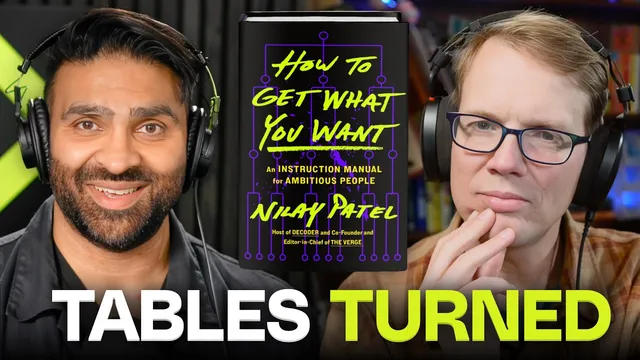
Is Anthropic turning into OpenAI?
Hayden Field says Anthropic’s IPO will test whether its safety commitments can survive pressure to grow revenue and fund compute.
 Decoder · Nilay Patel
- Hayden Field is a senior AI reporter at The Verge.
The best minutes
- 12:35Companies route only their hardest tasks to costly frontier models4 min
- 16:42Anthropic’s trust has limited power over its foundersPro pick 5 min
- 21:35Safety can become a justification for winning at any costPro pick 3 min
Also worth watching
- 2:40OpenAI let Anthropic set the first IPO precedent4 min
- 5:55Anthropic needs far more revenue to meet investor expectations5 min
- 28:33Compute shortages put Anthropic's growth and research in tension6 min
Skip the CrowdStrike ads and security interview, along with the opening show setup and closing credits.
Full analysis · 6 min read
Real Alpha · Nov 21
Hayden Field says Anthropic faces a roughly 17-fold revenue hurdle
- One industry estimate puts Anthropic's needed revenue growth at roughly 17-fold over 10 years.
- Field says the IPO reflects peak AI hype, while some small businesses route suitable work to cheaper models.
- Watch earnings for compute choices and any safety work the company says it has sidelined.
Free with an account
Read the rest of the analysis
6 sections, the 6 other voices it tests Field against, and what it means for you. Every episode we cut gets one.
Check your inbox
We sent a link to your address. Click it to finish signing up. Not there in a minute? Look in spam.
or
Signed up before? The same buttons sign you in. The episode, its moments and the transcript stay free.
IPO day measures appetite, not durable AI demand
Field said the IPO gave no new information about whether the AI bubble will pop. She called this peak AI hype, not evidence that the boom will last. The distinction matters because a listing prices expectations before proving paid use can cover serving costs.
Field said tech workers she spoke with saw AI pushed into more company work. Some said it happened even when it made workers less productive or the work worse. That shows deployment pressure, not business-wide returns. But it complicates any claim that more AI use automatically improves output.
Field said she had heard Sam Altman was once focused on beating Anthropic to an IPO. After OpenAI's bad press, she said the company seemed happy to let Anthropic go first. That is reported hearsay and Field's impression, not proof of OpenAI's motive.
Rachel Metz, on Bloomberg's Everybody's Business in November 2026, said investors should watch customers, revenue, releases, and safety commitments. Those operating signals will tell more than the day's price alone.
Our read
Treat the listing as evidence of investor appetite, not proof of lasting product value. The next test is whether customer use and revenue hold up under cost pressure.
Revenue targets meet buyers' model-routing discipline
Field cited an industry estimate from Steve Ratner. Anthropic would need roughly 17-fold revenue growth over 10 years for returns comparable to some competitors. That is an estimate, not a disclosed company target or a near-term sales forecast.
For example, Field described small and midsize businesses, including legal firms, building their own task benchmarks. Her scope was explicitly not huge enterprises. Take her split as an illustration, not measured market data.
It assigns 10% of tasks to Anthropic's expensive model, 40% to open source, and 50% to cheaper mid-tier models. That shows cost-conscious routing among the firms she discussed, not the entire market.
On The TWIML AI Podcast in November 2026, Sadeepa Wijesekara called for tracking token spend by agent and use case. That accounting makes routing decisions testable. Byron Deeter said on Newcomer Pod in November 2026 that Anthropic's enterprise API business had overtaken OpenAI's. That supports traction, but not the durability of margins.
- SWSadeepa Wijesekara · The TWIML AI Podcast · Nov 17Token spend has to be traced to agents and business processes
 Byron Deeter · Newcomer Pod · Nov 17Anthropic’s enterprise API business put it ahead of OpenAI
Our read
The revenue estimate matters only if customers keep paying for enough model use. Measure cost per successful task, not token volume alone.
The host says safety branding supports enterprise sales
Nilay Patel, the host, connected Anthropic's safe and trustworthy positioning to its pitch to enterprise customers. He said large buyers may require data sovereignty and quick provider switching, which can limit lock-in. That was the host's analysis. Field agreed, but did not make that case herself.
Field separately described consumers objecting to higher prices for the same or worse service. She said Anthropic rolled the increase back a little, while still needing to drive revenue. That history makes buyer willingness to pay a test, not an assumption.
For example, a buyer could compare failure rates on sensitive work against the added model bill. Safety branding only earns a premium if measurable risk reduction matters to procurement. Yet the episode supplies no customer-level study showing the size of such a premium.
Our read
Anthropic's safety positioning may help open enterprise doors, but it does not guarantee pricing power. Buyers should test claimed benefits against task outcomes and switching options.
The trust cannot directly stop a model release
Field said the Long-Term Benefit Trust cannot intervene in everyday choices, including whether Anthropic releases a model. It can appoint or remove certain board members, but that is narrower than a direct safety veto. The difference turns a reassuring name into a question about actual authority.
Field outlined seven board seats, with three selected by the trust and three by the founders. She said the trust formally selects the seventh, but founder approval is effectively required. Ed Ludlow reported on Bloomberg Businessweek in November 2026 that the founder entity holds a 50% voting stake.
Patel described the seven founders' single share through Founder LLC. Field agreed that the layered structures leave the founders with pretty unchecked power. Public share ownership therefore does not tell the whole control story.
That control matters because the trust's board power is not authority over product decisions. Investors should read voting rights and intervention rights separately.

Our read
The governance structure creates a check on board composition, not a direct check on safety decisions. Those powers should not be conflated.
Founder conviction can weaken the safety case
Field's warning is that leaders can rationalize dropping safeguards if they believe only they can win the race responsibly. She said that pattern is increasingly happening and described Anthropic as increasingly resembling OpenAI. She did not identify a particular safety initiative already dropped.
Her concern is stronger than a hypothetical, but narrower than proof of a named cut. Field tied founder control to their belief that they have the right plan for AI safety. That explains why they might resist outside checks without proving their commitment insincere.
Still, control over the definition of safety and its enforcement sits with the same leadership. External auditors or regulators would change who can challenge choices. But the episode does not establish that such checks are in place.
Bradley Tusk said on Bloomberg Tech in November 2026 that quarterly scrutiny could intensify pressure. He warned this could push frontier releases without safety controls. That is Tusk's warning, not a report that Anthropic has done so.
Field said company reports and earnings calls matter most. She wants readers to notice any team sidelined or safety initiative discontinued in the name of being first.
Our read
The concern is not that safety commitments are necessarily insincere. It is that conviction without independent review can make trade-offs hard to challenge.
Compute choices will surface in earnings disclosures
Field relayed Dario Amodei's description of compute as Anthropic's deepest business dilemma during a livestream with JPMorgan Chase's CEO. Amodei said buying too much could overextend the company financially. Buying too little could limit customer inference and research on new models. So the constraint touches both current service and future products.
Field suggested Anthropic may be more compute constrained than OpenAI because it invested less in compute earlier. That is a comparison she hedged, not a precise cost or supply figure. Field said Nvidia agreed to buy $10 billion in Anthropic shares through a private placement. She also cited a separate $10 billion funding promise from Nvidia made last year.
Heath Terry said on Bloomberg Surveillance in November 2026 that compute costs were up 40% year over year. He also cited financing, power, labor, and data-center limits. These constraints make capacity planning part of Anthropic's product economics, not only an infrastructure issue.
Field said earnings reports and calls matter most. She wants readers to notice any team sidelined or safety initiative discontinued in the name of being first. But those disclosures, not stock swings, can show what management funds when compute is scarce.
Our read
Daily stock moves are a weak proxy for whether Anthropic is balancing research, service, and safety. Earnings disclosures can show what the company chooses to fund when compute is scarce.
What it means for you
- Benchmark task costs. Choose representative work and compare model cost, accuracy, and latency per successful task. Include frontier, mid-tier, and open-source options where they meet the same quality bar.
- Trace token spending. Track cost by agent, task, and team, then identify which work needs a costly model. This makes routing savings measurable instead of anecdotal.
- Test safety value. For sensitive workflows, record the failure modes and protections that matter to your business. Compare those results with the added cost before treating a safety promise as a buying reason.
- Review safety disclosures. At each earnings update, note safety team or initiative changes alongside compute spending and model releases. Separate stated commitments from reported actions.
What to watch
- Earnings disclosures about safety teams or initiatives being sidelined to move faster.
- Whether small and midsize firms keep routing routine tasks away from expensive frontier models.
- How Anthropic balances compute commitments against inference demand and model research.
Send this to the CFO, product lead, and board risk committee.
Watch the minute where Field cites the roughly 17-fold revenue estimate.
Written by Real Alpha from the episode's transcript and the other moments it links, then checked against the transcript. Quotes are the speaker's exact words.
Minute by minute
A Pro write-up, open to you here. Try Pro free for 7 days
A Pro write-up. The minute by minute is in Real Alpha Pro; the episode, its moments and the transcript stay free.
Read it with Pro, 7 days free- 2:40The IPO reflects peak AI hype
Field says the IPO offers little new evidence about whether the AI bubble will burst. She describes AI hype swelling inside companies, where workers are being pushed to use AI even when it makes them less productive, and says a reckoning will come. She also says OpenAI seemed content to let Anthropic go first after a year of setbacks and bad press.
- 5:55Revenue must cover growing costs
Field says Anthropic has a long way to go on profitability and cites Steve Ratner’s estimate that it would need to grow revenue roughly 17-fold in 10 years to deliver returns comparable to some tech competitors. She says investors will expect revenue growth and that pressure to fund compute could push expensive safety efforts aside. She also describes Anthropic’s efforts to raise prices, build customer lock-in and win enterprise and government contracts.
- 12:35Enterprise buyers route work to cheaper models
Field says large customers may seek data sovereignty and the ability to switch providers, making safety and trust important parts of Anthropic’s pitch. She says small and midsize businesses are building internal benchmarks to route tasks among expensive Anthropic models, open-source models and cheaper mid-tier options. Patel and Field agree that buyers may choose a model that is good enough rather than pay for the frontier model every time.
- 15:53Safety meets public-market pressure
Patel and Field discuss whether Anthropic can keep funding safety work while competing to build frontier models. Field says the company’s unusual governance structure limits shareholder power, but public-market expectations still create pressure to make money and buy compute. She says some safety efforts could fall by the wayside.
- 16:53The trust has limited power to intervene
Field says Anthropic’s Long-Term Benefit Trust has four members, none with much AI experience, and cannot intervene in everyday company decisions. It can appoint or remove certain board members, but Field says the process is constrained and the founders retain substantial influence over the board.
- 20:00Founder voting control is concentrated
Patel says Anthropic’s seven founders co-own Founder LLC, which holds a single share with 50.1% of the company’s voting power. Field says the structure gives the founders near-unchecked control and cites a former employee who described that control—not making the most money—as a key founder interest.
- 21:35Safety can justify moving faster
Field warns that a company convinced it must win the AI race for the greater good could use safety as a rationale for dropping safeguards that slow it down. She says former Anthropic employees want external oversight, arguing that the founders should not be the only people deciding what counts as safe.
- 24:44Anthropic blends safety and founder control
Patel compares Anthropic’s founder-led governance with Nvidia’s board structure. Field says Anthropic’s control arrangements serve both the founders’ stated aim of protecting their vision and a desire to keep control from others; she characterizes the motives as roughly 50-50.
- 28:59Compute is the financial constraint
Field says the real constraint on Anthropic’s founders and trust is the company’s need for money. She cites Dario’s description of compute as the company’s deepest business dilemma: buying too much risks financial overextension, while buying too little limits customer inference and research and development.
- 31:12Nvidia could reshape compute costs
Patel suggests that changes in Nvidia’s financing and chip supply could affect compute prices and availability. Field says Anthropic had not commented on the market effects, and notes Nvidia had agreed to buy $10 billion in Anthropic shares through a private placement, on top of a $10 billion funding promise made the previous year.
- 33:04Watch earnings for safety trade-offs
Field says daily stock movements can reflect hype or fear, and recommends paying closer attention to company reports and earnings calls. She wants to see whether Anthropic discloses that it sidelined teams or discontinued safety initiatives to move faster.
Published Nov 21, 2026.
Transcript · 29 min read
Decoder, hosted by Nilay Patel, with Hayden Field.
Transcribed by machine (Whisper) from the episode’s audio, so a word may be off here and there.
Hello and welcome to Decoder. I'm Eli Patel, Editor-in-Chief of The Verge, and Decoder is my show about big ideas and other problems. Today I'm talking with Hayden Field, The Verge's senior AI reporter, about the Anthropic IPO for our third and final episode in our series about AI in real life. Anthropic, the AI lab behind Claude, went public on the NASDAQ last Thursday. The numbers are gigantic, but not really important for this conversation, except to say that Anthropic has become one of the most valuable companies on the planet. The real story is what happens now, and whether Anthropic can continue to thread the needle of caring about and investing in AI safety, while also being a public company beholden to shareholders. Oh, and it also has to continuously grow the amount of money it makes so it can keep paying its ever-increasing compute bills, which total roughly $900 billion over the coming years. All of these ideas sit in fascinating tension with one another. So Hayden and I really try to break down how we think this might play out as Anthropic navigates the pressures of the public markets. You'll hear us talk about the company's unique corporate governance structure, which feels increasingly relevant as the ongoing NVIDIA and Jensen-Wang scandals play out.
We also got into why OpenAI seems happy to have let Anthropic go public first, and why Anthropic's whole pitch to big enterprise customers boils down to the same safety branding that now sits in conflict with the profit-oriented part of its business. Before we get going, do me a favor and subscribe to Decoder on YouTube, where we put out new episodes every Monday and Thursday. Okay, Hayden Field, the Verge's senior AI reporter on the Anthropic IPO and the economics of Frontier AI. Here we go. Hayden Field, welcome back to Decoder. Thanks, great to be here. I'm excited to talk to you today because it's not pure soap opera drama chaos.
I know. It's like a normal thing that happened. It's for once not like personality-based and soap opera. It's like, yeah, cold hard would be cash. Well, there is some personality in it because we're going to talk a lot about Anthropix IPO, which has a bunch of big personalities in it, and the way they have structured this company to repel the rapacious pressures of capitalism are, I would say, very eccentric. They reflect the beliefs of a number of eccentric people. Absolutely. It's really been interesting digging into the S1 again and just seeing who was on what committee and, like, which founders have the most control here and how much control the founders actually have, which is more than it may seem. Let's start at the start. You and I are talking
Read the whole transcript
“And so they were like, you know what, let's just take a step back and let Anthropic go first.”
“Anthropic is going to have to increase its revenue roughly 17-fold within the next 10 years”
every time there's a major shift in computing, new attack surfaces are created. That's right. A conversation about AI and enterprise is incomplete without considering how cybersecurity comes into play.
If you're a security decision maker, at enterprise level, I don't need to tell you about that. You know all about it firsthand. CrowdStrike knows it too. That's why AI Detection and Response, or AIDR, is emerging as a new category of cybersecurity for the AI era. It helps organizations see, monitor, and secure AI across the enterprise wherever it executes. With AIDR, your organization can accelerate secure AI adoption and development, and in turn, drive innovation at speed and scale. According to their data, more than 70% of the Fortune 100 trusts CrowdStrike to protect their businesses. CrowdStrike. We secure AI. We stop breaches. Go to crowdstrike.com slash decoder to learn more.
That's crowdstrike.com slash decoder.
“are literally creating their own internal benchmarks about, okay, let's save money as much as we can”
And like you said, Open Ananthropic have some of the most complicated governance structures in history. If you think that Anthropic's future is to sell the best intelligence, the most capable, the most cutting edge frontier, close to AGI intelligence possible, you would probably not do a bunch of safety work, right? You would probably not kill your margins on a bunch of researchers who are telling you to stop or slow down or not release the best model. Anthropic is deeply committed to doing that. And you and I have had conversations before about whether that can withstand the pressures of capitalism and growth.
That was hard when they weren't a public company.
“the founders have pretty unchecked control here. And I think that's something that's kind of getting lost in the narrative of, oh, this trust is above us, don't worry.”
“I think it's more something a little more dangerous in that they want complete control because they believe that they have the right plan for AI safety”
Yeah, exactly. It's going to be totally fine. They all went to the White House, and they looked deeply into each other's eyes and said it was going to be fine. You know, obviously Anthropic came up with this structure well before the events with NVIDIA and Jensen Wong, but I can't help but put them together in my head, right? They are happening at the same time. And NVIDIA has a very traditional corporate governance structure, right? Jensen owned 3% of the company, but he had a board of directors. The board of directors determined that he had violated the company's code of conduct in some way.
He resigned. It's very obvious that he was thoroughly encouraged to resign. But that's just normal corporate governance. That's what you learn about in school. A company has a board of directors. Their number one job is to hire and fire the CEO. That's very different in the Valley, right? Like founder control of companies is a big story everywhere. Mark Zuckerberg famously has control over Meta, even though Meta shareholders repeatedly vote to remove him, which is one of the under-emphasized stories in all of American business. Sergey Brin and Layer Page control Google. Is this more in the we need to insulate our founders from the demands of the market and boards of directors in like classic Silicon Valley style?
Or is it we need to insulate our founders and Dario from the demands of the market so we can stay focused? on AGI and safety? Because it feels like a combination of both. It's definitely a combination. I mean, they say it's the latter. I think in a lot of ways, it's like the former. It's totally a combination. I'd say it's about 50-50. I mean, they want control so that they can focus on what they think is best and not lose control to someone that they don't think knows best. But ironically, as we know, no one group of people should be in control of what is best here. So at least that's what a lot of my sources say. So I think that, yeah, I mean, it's just a combination. Elon Musk famously won't run a company that he doesn't have voting control on. So I think it's just a New Valley thing and it's pervading here for a couple of different reasons. There's seven of them. What seven different people do over the course of the next five to 10 years is as unpredictable as anything. What happens if one of them does something illegal or lies to the board or smuggles chips to China or anything? Is there some way to remove one of these founders from this LLC? Yeah, I mean, allegedly, the LTBT has the power to remove. They haven't said whether they have the power to remove all of the board
or just some. But in some way, when you're looking at the fine print of the S1, basically, if, you know, the LTBT gives 30 days notice to essentially Daniela Amodei and her other two people on this subcommittee, then they can, you know, suggest removal of a board member. Again, you know, they can waive that 30-day notice if they deem it correct, if Daniela does. But And yeah, it's just, I mean, there's a lot of fine print here. Essentially, yes, you can remove someone. And there's stuff about that in the S1 saying, like, you know, if they've done something illegal, if they've done something really bad, yes, you can remove.
But it's definitely not easy. And it also depends on who it is, I think. It's interesting. You know, I keep coming back to this because it is so complicated. It's so unusual. And it is right next to the NVIDIA situation where he materially misrepresented his relationship to the shareholders by having his PR people issue statements saying it was all normal. And then he had to admit that it wasn't all normal. And he was, in fact, involved in extramarital affairs. I felt a little bad for that PR guy who had to put his name on all those statements that ended up being a lie. I feel nothing. As the audience may know, as Hayden is well aware, we make all the PR people put their names on everything just in case something like this happens.
“compute is the deepest business dilemma that the company faces.”
You heard it here first. Former CNBC reporter Hayden Field says, look past the day-to-day swings into the fundamentals of the company. That's good. Also, the stock market is only vibes. That's the other thing I heard you say. Yeah. I mean, it's controversial, but after being a financial reporter, yeah, I mean, it's a lot of vibes there. It's a lot of vibes. Oh, I agree. I think sometimes the only thing they ask me to go on CNBC to say is, this is just vibes. Yep. And then they usher me off the air very quickly. Aiden, this is great. We're obviously going to be talking about this story many times with you in the year to come.
Hopefully, we can do another straightforward business story and not just a soap opera story. You know, I'll be here for both. We got to do it both. Amazing. Thank you so much, Aiden. Thanks. I'd like to thank Hayden for joining me and thank you for checking out this episode of Decoder. To get new episodes every Monday and Thursday, subscribe to our YouTube channel at DecoderPod. Find us on TikTok and Instagram under DecoderPod as well for more fun stuff we put out every day. If you'd like to let us know what you thought about this episode or really anything else at all, let us know. You can drop us an email at decoder at theverge.com.
We really do read all the emails. Or you can be up directly on Threads or Blue Sky. If you enjoyed this episode, please send a link to it to someone you think you might like it as well.