News· The long read
Ege Erdil puts lab bankruptcy odds above 10% and below 50%
A model provider can own valuable assets and still struggle with commitments made at higher prices.
 Ege ErdilResearch Engineer, Google DeepMind
From Why Frontier AI Labs Could Go Bankrupt | Ege Erdil, on MTS
The short version
Ege Erdil sees more than a 10% chance of lab bankruptcy, but puts it below 50%.
He says falling compute prices could make long-term commitments expensive, though rental prices have recently risen.
AI buyers can test a fallback model and examine the exit terms on their own compute contracts.
On MTS, Ege Erdil put frontier lab bankruptcy odds above 10% but below 50% over three years 12:39. He worries that labs could promise to pay for compute that later becomes cheaper.
Erdil is a research engineer at Google DeepMind. Google sells AI models and cloud compute, so his employer has a stake in this market. If your product depends on another lab, the distinction between its technology and its finances matters.
Below is the case for that risk, a check on compute prices, and a way to test your fallback.
A price drop can leave contracts underwater
Erdil described a chain of events, with each step depending on the last. A lab signs a multiyear compute agreement. Later, demand disappoints and compute prices fall.
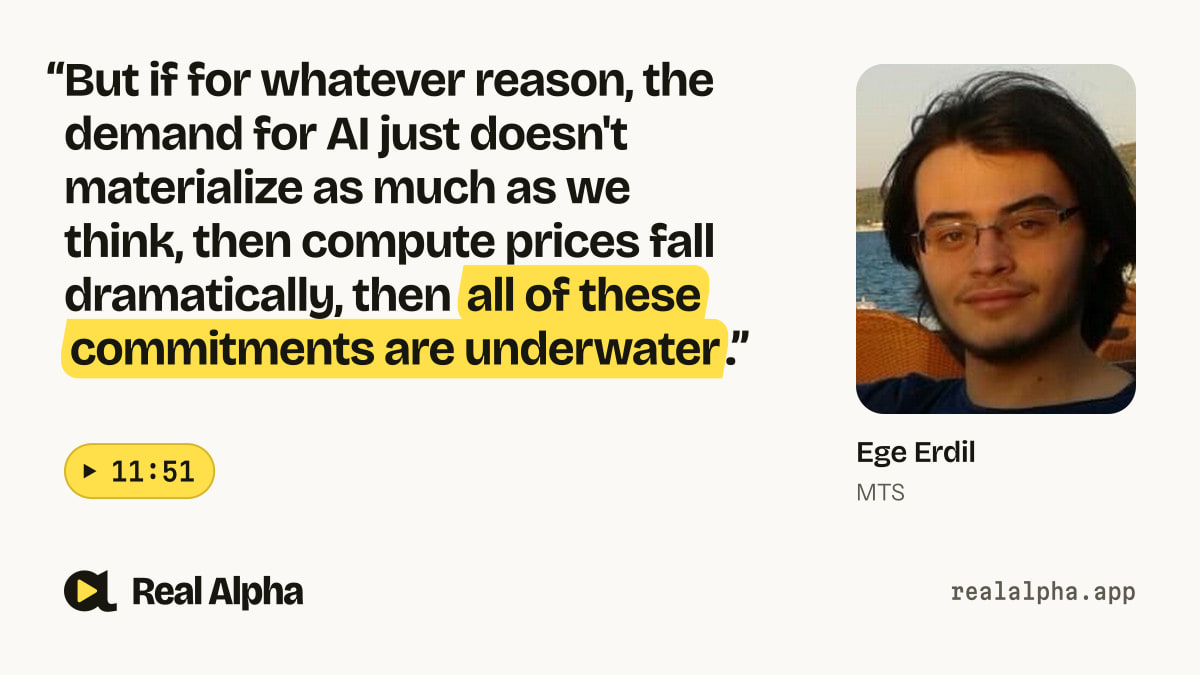
For example, Erdil imagined a lab committed to a $3 H100 GPU-hour when the market price falls to $1. Those prices illustrate his scenario. He did not identify them in a real contract.
A rival buying at the lower price could have cheaper compute for serving customers.
But the outcome depends on the actual contract. A buyer’s exposure would differ if it could change volumes, renegotiate or resell capacity. Erdil did not establish those terms for a particular agreement.
And a lower market price alone would not reveal whether a lab can pay. Its revenue, other expenses and financing would also matter. Buyers should distinguish a contract disadvantage from evidence of an imminent failure.
GPU rental prices have risen rather than collapsed
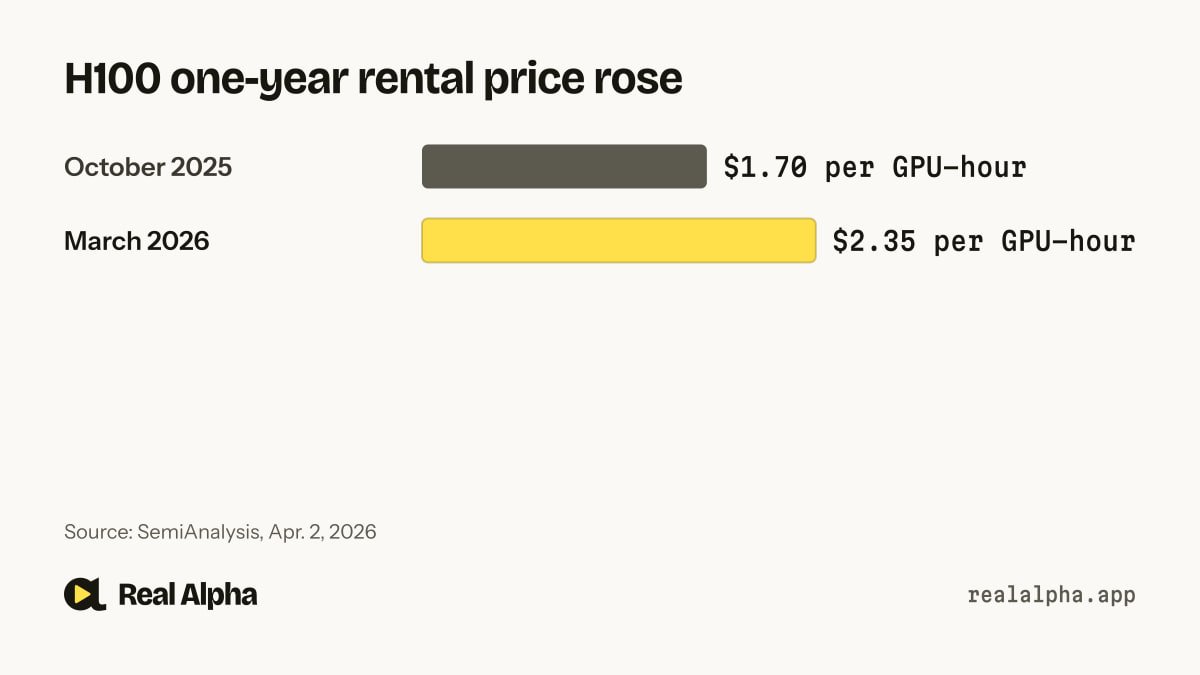
The available price data checks the direction of Erdil’s scenario, not his bankruptcy odds. SemiAnalysis reported that its H100 one-year rental index rose almost 40% between October 2025 and March 2026. The index covers rental contracts, not the private terms of a frontier lab’s purchases.
A separate GetDeploying survey found on-demand GPU rental prices up 15% over the preceding 12 months. It compared 22 GPU models listed at both ends of the period. Its medians can move when providers enter or leave the listings, as well as when prices change.
So these measures show recent increases, not a guarantee about future prices. They also cover different rental terms. Neither establishes what a particular lab owes or whether it can meet those obligations.
- Contract length separates the one-year index from on-demand listings.
- Market coverage can change when providers enter or leave the listings.
- Lab exposure depends on private terms these indexes do not show.
A restructuring need not erase the compute
Erdil distinguished a lab’s assets from its shareholders 9:51. He said bankruptcy could involve restructuring and leave equity holders wiped out. The compute or access arrangements would not simply vanish because ownership changed.
But a customer cannot infer uninterrupted service from the survival of assets. A restructuring could change commercial terms or priorities, though Erdil did not predict a particular service outcome. The relevant question for a buyer is how quickly its own product could operate elsewhere.
His probability range is a judgment. It does not represent a measured bankruptcy rate. He did not specify whether it applies to each lab or to at least one.
No independent study of those odds was identified among the sources available for this piece. So the range is useful as a statement of Erdil’s concern. It cannot establish a frequency that buyers can plug into their own forecasts.
Erdil says labs must keep spending to hold their lead
Erdil’s concern extends beyond a single contract. He said a leading lab must keep spending to maintain its model advantage.
“Their position is entirely dependent on them staying in the lead, which is a very expensive thing to do.”
Ege Erdil, on the cost of maintaining a model lead 5:19
That distinction matters when a provider reports a strong margin on serving a model. Serving costs alone do not tell a customer what ongoing research and future training will cost. Nor do they establish how long a model will command a premium.
For instance, investor Jamin Ball described the need for a repeatable model factory. He said a lab needs compute and talent for subsequent releases as well as a successful first model. Ball also said Anthropic’s revenue had grown much faster than its training compute.
So continued spending need not rule out improving economics. It does mean that a lead today cannot settle the question by itself. The answer depends on revenue, future costs and how much customers will pay for the next model.
Yet buyers may value a model lead even if maintaining it proves expensive. That creates a separate decision for customers. They must weigh today’s performance against the cost of relying on a single provider.
Switching models is not always trivial
Erdil contrasted model switching with the difficulty of moving an entire business between clouds. He put the model switch this way.
“So you can very easily just switch to a different model.”
Ege Erdil, on model switching 8:40
I think that is a useful challenge to lab pricing power, but too broad as operating advice. Changing an API call is not the same as checking whether the replacement meets a customer’s requirements. Quality, latency and the behavior of a workflow can all matter to that decision.
Steve Eisman also sees low switching costs exposing models to price competition. Satya Nadella, meanwhile, recommends keeping a company’s evaluation and context separate from its models. Microsoft sells AI services too, but his proposed separation gives a buyer something specific to test.
But a second provider only helps if its model can handle the work. A test can reveal which tasks move easily and which need further changes. That evidence makes a fallback plan more useful than a provider name on a list.
Discounted compute carries a longer commitment
The same trade can reach companies that rent GPUs themselves. Erdil said long commitments reassure the companies funding compute capacity 10:50. For a renter, the attraction is a lower price in exchange for a longer obligation.
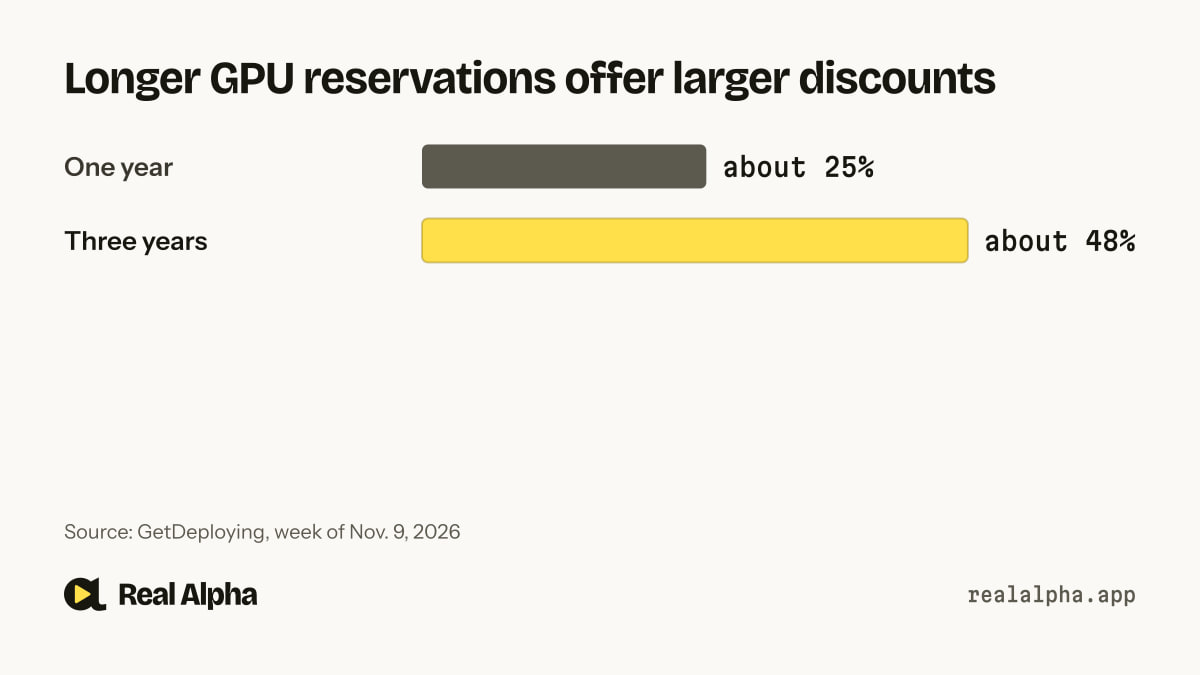
GetDeploying found a median discount of about 25% for one-year reservations. The median for three-year reservations was about 48%, compared with each provider’s on-demand rate for the same GPU. These are listed discounts, not savings measured for a particular customer.
Yet a discount against today’s on-demand price does not guarantee the best price later. Nor does it establish whether unused capacity can be returned. If you rent compute, ask for the commercial terms before treating the discount as a budget saving.
- Check minimum spend against the workload you expect to run throughout the term.
- Ask about reductions if demand falls or a workload moves to another provider.
- Price the exit using any termination fees and notice periods in the agreement.
AI buyers can prepare for either outcome
If your product relies on a frontier model, test a second model on your own important tasks. Record quality, response time and cost under the same workload. That turns Erdil’s easy-switching assumption into a result you can inspect.
And if the alternative fails, record the failure rather than counting it as a fallback. You may decide the leading model is worth a dependency. The useful result is knowing the cost and limitations of leaving before a renewal or disruption.
Watch GetDeploying’s weekly GPU listings for changes, while keeping their coverage limits in mind. Falling rental prices would support one part of Erdil’s scenario. They would not, by themselves, show that a lab cannot pay its bills.
Three checks to bring to the next renewal.
- Test the alternative on real tasks before naming it as a fallback.
- Read the commitment for minimum usage, changes in volume and termination terms.
- Separate the risks of a provider’s ownership changing from the risk of your service stopping.
Copy this line for the next planning meeting. The primary model is [name]. The fallback is [name].
Test both against [tasks] by [date].
Send this to whoever plans your model-provider fallback.
Watch Erdil give his estimate of lab bankruptcy risk. 12:39
By email
The best moments, twice a week
Wednesday and Saturday at 7:00 in New York.
Check your inbox
We sent a link to your address. Click it to finish signing up. Not there in a minute? Look in spam.
Long reads also go out by email. Get them at read.realalpha.app