News· The long read
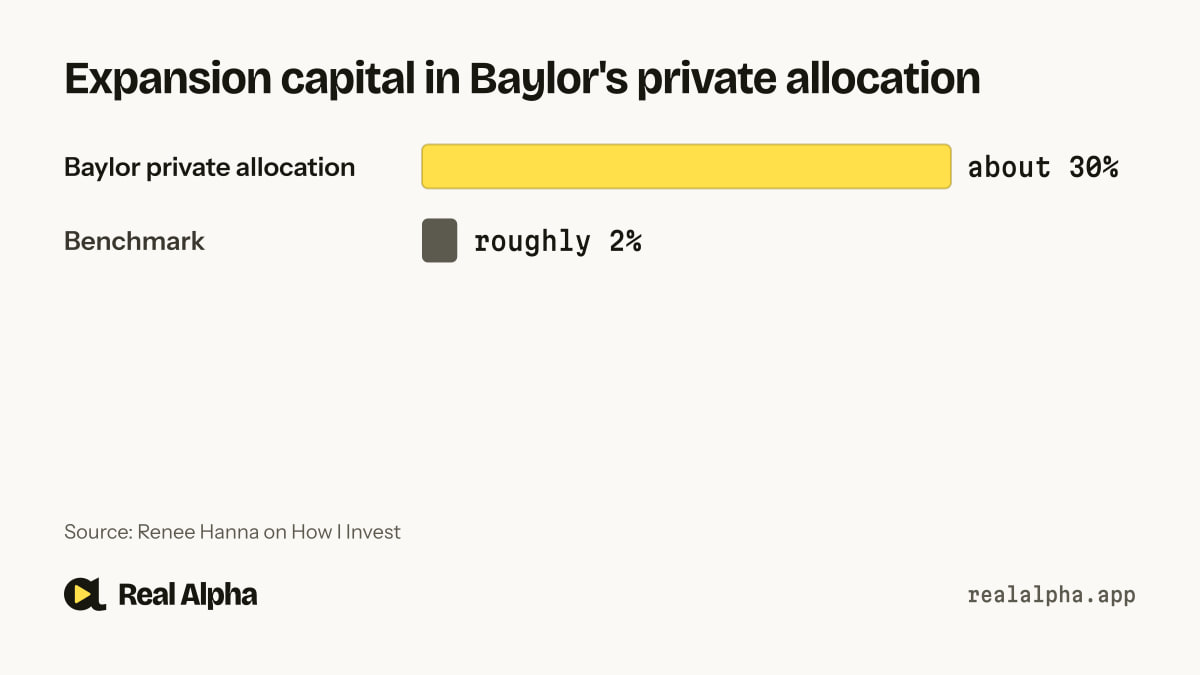
Hanna says Baylor puts about 30% into expansion capital
One endowment's preference for shorter holding periods offers founders a way to test investor fit.
From Baylor Endowment on Rethinking Venture Capital, Concentrated Portfolios, and Power of Compounding, on How I Invest
The short version
Renee Hanna said Baylor allocates about 30% of its private portfolio to expansion capital, against about 2% in its benchmark.
Her compounding example depends on investors receiving cash and finding another investment with the same return.
Founders should test a growth investor’s ownership needs and exit timeline before accepting its capital.
Renee Hanna put Baylor’s expansion capital allocation at roughly 30% on David Weisburd’s podcast, against 2% in a benchmark. She manages investments for the university, whose endowment needs both growth and cash for spending.
For founders, that preference affects which investors may fund a company after its first rounds. It does not establish that growth capital is a deeper pool across the market. You’ll have a set of questions for an investor about returns and exit timing.
Baylor sought growth without established venture access
Hanna said Baylor rebuilt its portfolio without established positions in some prominent early venture firms. It looked instead for growth companies outside those firms’ usual targets. Some were in the middle of the country or had smaller addressable markets.
For example, Hanna described managers backing companies with $5 million in annual recurring revenue and growth above 50% a year. She said those managers sought ownership stakes closer to 30%.
That is a specific investor profile. Hanna did not set it as a threshold for every founder.
The university has a reason to care about losses as well as upside. Hanna described that trade-off for Baylor’s overall portfolio.
“we very much want to defend zero.”
Renee Hanna, on Baylor’s portfolio 12:34
But she distinguished that overall goal from early venture, where she expects losses. Baylor’s own endowment page says it distributes approximately 5% of its value annually. It distributed $101 million in fiscal 2026 for scholarships and other university purposes.
Hanna’s 27x example depends on getting cash back
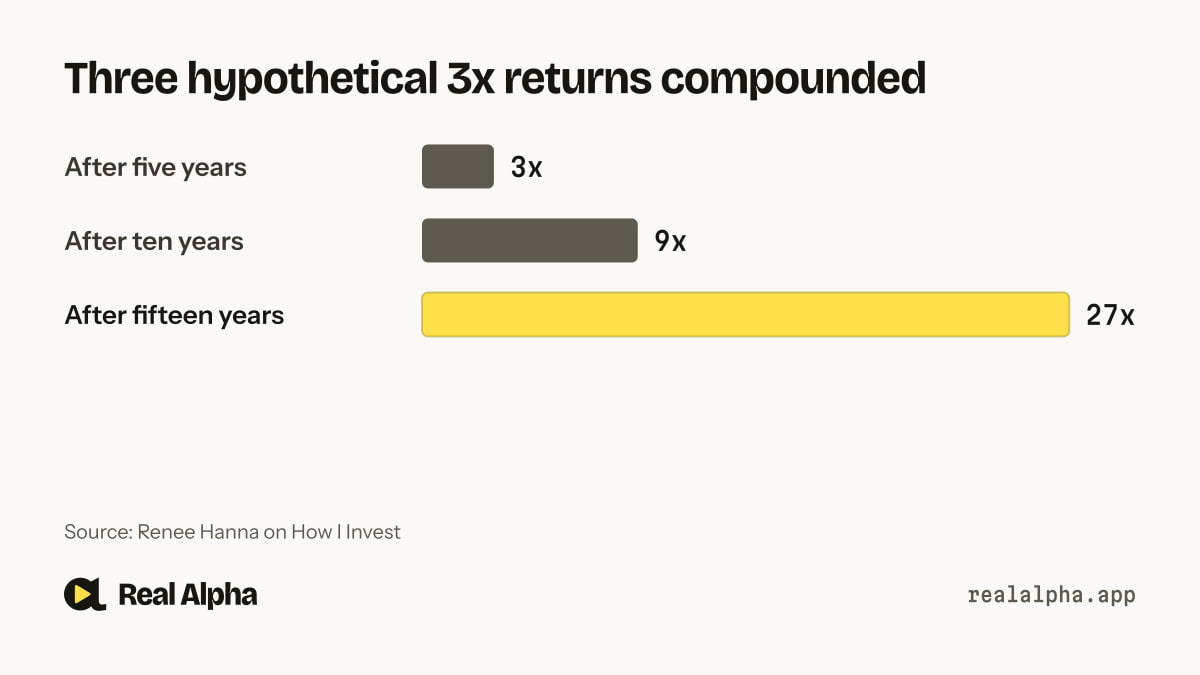
Hanna compared a 15x early venture return over 15 years with three successive 3x returns over five years each. The multiplication is straightforward. But the example only works if the proceeds return on schedule and find equally successful investments.
Multiply 3x by 3x and you get 9x. Multiply 3x by 3x by 3x and you get 27x. Neither result tells an allocator how often those returns will occur.
A founder sees the other side of that calculation. An investor seeking cash back on a shorter clock may favor a sale or another liquidity event. A later round can offer a path to cash, but it does not guarantee one.
The arithmetic does not establish a repeatable return
Baylor’s investment chief David Morehead made a related comparison in Scuttlebutt. He compared a 15x venture return over 18 years with three 3x growth equity returns over six years each. That’s another hypothetical sequence from Baylor, not an independent test of repeatability.
For instance, AngelList studied 1,808 early-stage investments and found very large winners skewed returns. Its sample included realized and unrealized results before fees. AngelList sells services in this market, and its platform data may not represent the wider market.
The study did not compare early venture with expansion capital. The research provided for this piece includes no independent study testing that comparison. So Hanna’s preference is useful evidence about Baylor’s choices, not proof that expansion returns compound more reliably.
- Cash returned matters more to reinvestment than a paper valuation.
- Fees and timing can change what the end investor receives.
- Access to successors matters if each returned dollar needs another opportunity.
There is also a cost to avoiding expensive early deals. Matthew Harris of Bain Capital Ventures said valuation discipline can screen out the biggest winners. His point challenges the idea that a lower entry price alone makes a better portfolio.
Baylor’s 15% hurdle puts a price on illiquidity
Hanna gave Baylor’s threshold for new private investments. Net internal rate of return measures an investment’s annualized return after costs, taking cash timing into account.
“Anything coming into the private investment portfolio has a line in the sand of generating a 15% net IRR.”
Renee Hanna, on Baylor’s private investment hurdle 28:22
That is a hurdle for future investments. It does not establish what Baylor has earned.
Hanna said Baylor uses it to account for public-equity alternatives and the cost of tying up capital. She also said the return profile helps explain why Baylor does not invest in private credit.
Yet a founder should not treat that 15% as the target for a single company’s next round. Baylor allocates across private investments, including funds with their own fees and portfolios. Ask the prospective investor for its own return requirements instead.
Founders can test the investor’s liquidity timetable
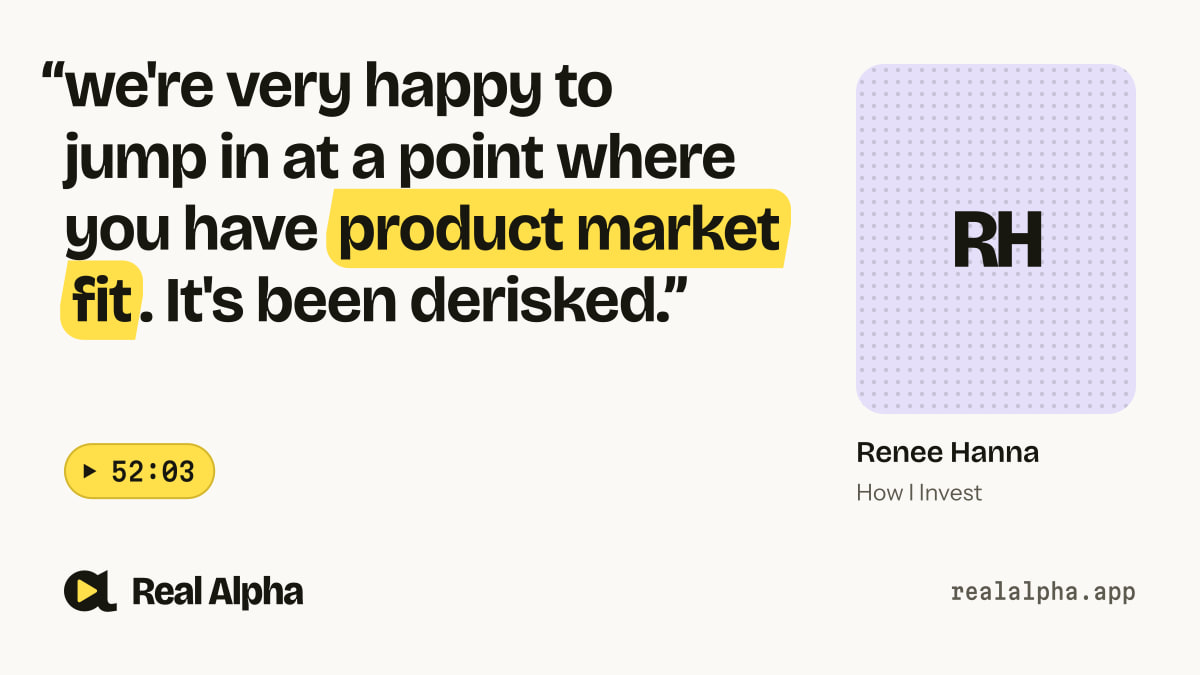
For direct co-investments, Hanna described a typical path to 3x to 5x in three to five years. She wanted a line of sight to an acquisition or public listing. That differs from a fund holding many early-stage companies for longer.
Now consider the same company from the founder’s seat. A plausible sale in that window may fit both sides. But a company planning to stay independent for longer needs to know whether its investor can wait.
Jason Lemkin separately said high seed prices and smaller allocations can weaken seed returns. Hanna also worries about early entry prices. Neither observation proves a later round will be cheaper or easier to close.
I think founders should compare terms alongside valuation. A larger check can change ownership and governance. The right timetable depends on the company and the people providing the money.
Hanna sees established software companies adapting to AI
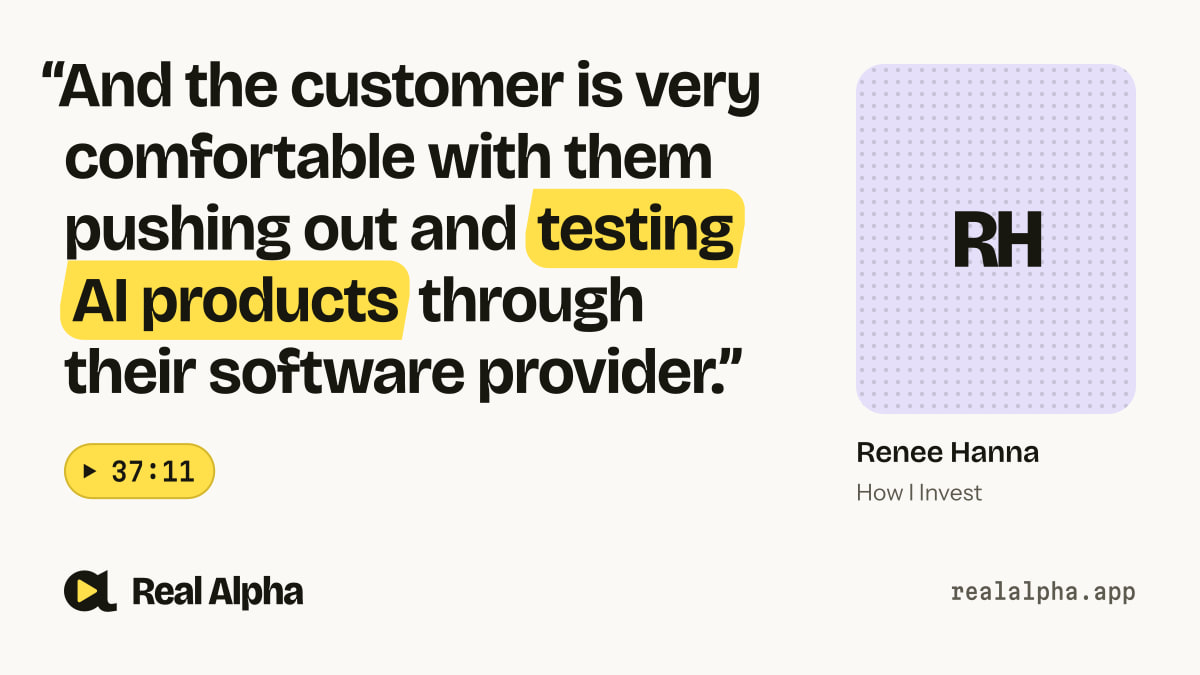
Hanna said Baylor had added to software despite concern about AI displacing the sector. She sees an advantage for software companies with data and established customer relationships. In her view, customers may be comfortable testing AI products through an existing provider.
But customer familiarity does not establish that a new feature earns revenue. Hanna did not give adoption or pricing figures for those products. A founder pitching that thesis still needs to show what customers use and pay for.
And the distinction matters when choosing a funding story. A manager seeking an established software company may value its existing revenue and relationships. An early-stage investor may instead underwrite a larger but less certain market.
A funding plan needs ownership and exit assumptions
If you’re preparing a growth round, ask how each investor expects to make its return. Hanna wants managers to put follow-on capital behind their strongest opportunities 47:47. That preference does not promise every company another check.
So put the assumptions beside your operating plan before discussing a term sheet. Revenue growth and a credible route to liquidity may attract an expansion investor. But the desired ownership and timing still have to fit your company.
A later-stage investor can have a different starting price and a different view of risk. Ask how that price affects the outcomes it needs. Then compare those outcomes with the business you intend to build.
- Check ownership needs before treating a large check as interchangeable with smaller ones.
- Ask about timing for a sale, listing or other path to liquidity.
- Discuss follow-on capital and what evidence would support another investment.
- Compare exit assumptions with the company’s own plans and growth forecast.
Copy this into your fundraising notes. The prospective investor needs ___ ownership and expects liquidity in ___ years, while the company plan assumes ___.
Send this to the founder preparing your next growth round.
Watch Hanna compare Baylor’s expansion allocation with its benchmark. 7:49
By email
The best moments, twice a week
Wednesday and Saturday at 7:00 in New York.
Check your inbox
We sent a link to your address. Click it to finish signing up. Not there in a minute? Look in spam.
Long reads also go out by email. Get them at read.realalpha.app