News· The long read
Tusa says 5 gigawatts were lit in Texas's 375 gigawatt queue
Power requests are not operating capacity, and the wait has consequences for buyers and suppliers.
From The Industrials Riding the AI Data Center Boom with Steve Tusa | The Real Eisman Playbook Ep 85, on The Real Eisman Playbook
The short version
Steve Tusa said about 5 gigawatts were energized against a Texas queue of 375 gigawatts.
ERCOT’s records show a different queue total, but also distinguish requests from projects drawing power.
Builders and buyers should separate requested power, approval and energization in their plans.
About 5 gigawatts were lit in Texas’s 375 gigawatt queue, Steve Tusa said on Eisman’s podcast 26:48. The Wells Fargo industrials analyst also said a gigawatt project takes around three years to energize.
But the queue figure needs a check. ERCOT’s published totals differ, and a request for power is not a finished data center. Tusa covers equipment suppliers with a stake in the buildout.
If you buy compute or sell equipment to builders, the distinction affects your schedule and budget. Below is a way to separate a supplier’s pipeline from power customers can use.

Tusa’s national pipeline measures plans, not supply
Tusa put the American data center pipeline at about 450 gigawatts. That includes people seeking to build who have secured land or filed permits. And he described his tally as his own work using permits, land purchases and news reports.
He contrasted it with an installed American data center base of about 20 gigawatts around 2022 or 2023. Still, those measures are not interchangeable. One describes existing capacity, while the other includes projects at earlier stages.
“you don’t just show up and throw 100 gigawatts up in a year or two or even three.”
Steve Tusa, on the pace of construction 24:29
That distinction matters before anyone uses the pipeline as a sales forecast. A land purchase can signal intent without establishing a power date. And a permit filing does not establish when a customer can run a workload.
Tusa’s national total is his estimate. No independent source confirms the count.
It is useful as a measure of the projects he has collected. It should not become a delivery commitment in someone else’s capacity plan.
ERCOT’s records put the queue at different sizes
Tusa attributed his roughly 375 gigawatt Texas figure to ERCOT documents 26:31. Yet the grid operator’s June board materials tracked about 438 gigawatts of large-load interconnection requests.
Those are requests to connect large electricity users, not a count of completed data centers. ERCOT said the vast majority had no studies submitted. The materials do not establish why Tusa’s figure differs.
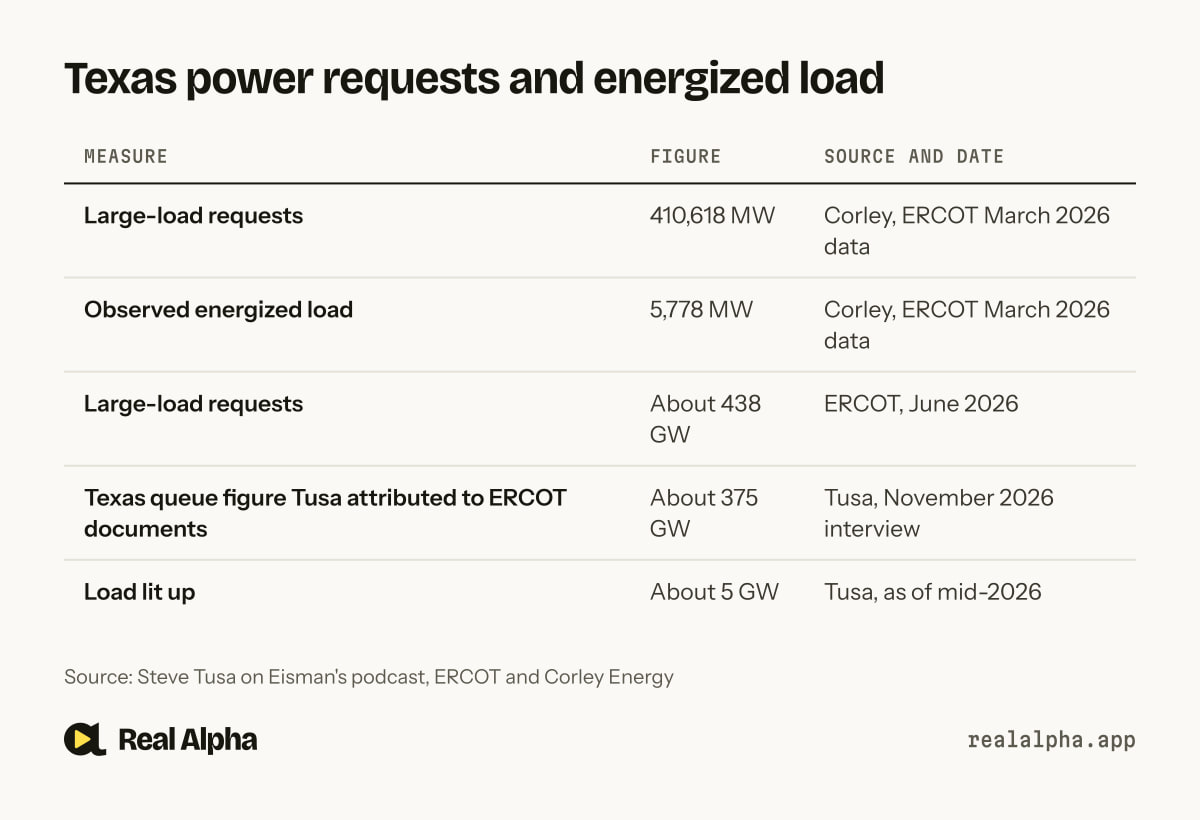
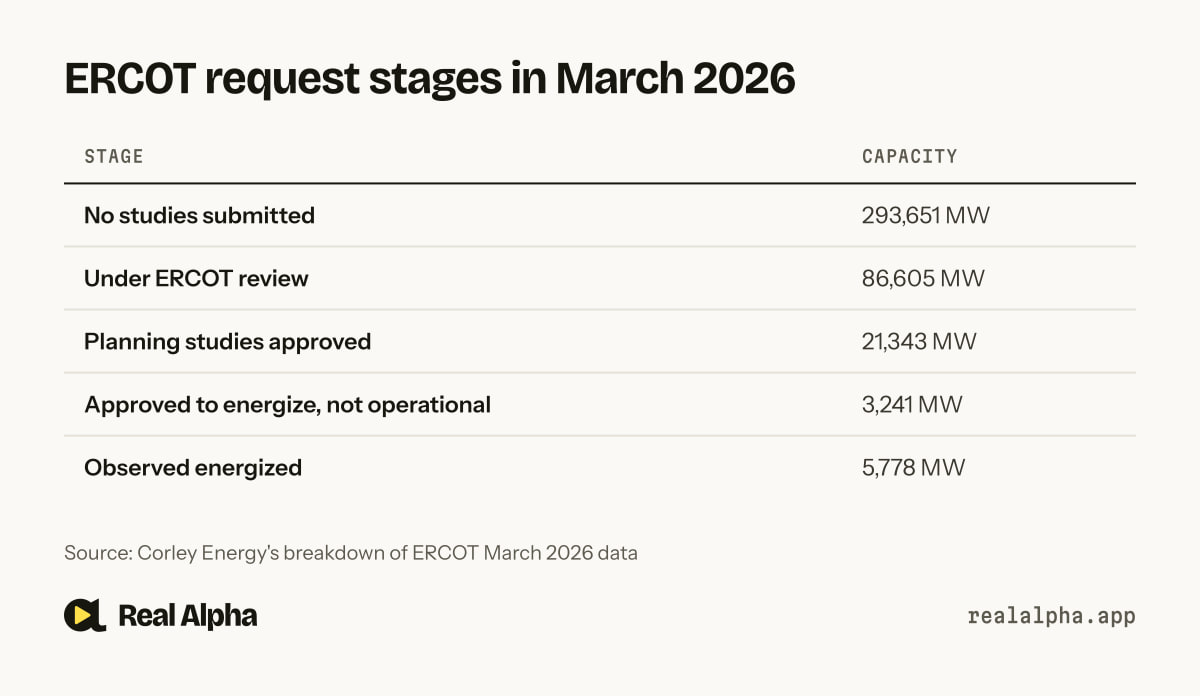
For example, Corley Energy’s breakdown gives 410,618 megawatts of requests in ERCOT’s March data. It lists 5,778 megawatts as observed energized. Corley sells power services to this market, so it also has a commercial interest.
So the energized figure is close to Tusa’s approximate 5 gigawatts, but the queue totals do not match. Nor do the sources establish that every request will become a built project. The difference is a reason to keep the source and date attached to either figure.
- Tusa also mentioned another 3 gigawatts approved to energize.
- Approval and observed use are different stages.
- Adding them may describe progress through the process, but it would not describe power already in use.
A gigawatt project needs time and power
Tusa used the Stargate project in Abilene, Texas, to explain the timeline 28:23. He said it broke ground in June 2024. He described a target of 800 megawatts to a gigawatt of computing load.
He said a gigawatt takes three years to energize. The figure comes from his example.
It cannot establish an average for every project. No independent study found for this piece establishes that timeline.
For instance, Paul Meeks separately put a typical data center buildout at about three years. His remark points in the same direction, but it does not validate Tusa’s gigawatt-specific estimate. The projects and milestones need not be the same.
So a builder should ask for the date each part of a site can actually draw power. A construction completion date alone may not answer that question. For a compute buyer, a phased delivery schedule is more useful than a single eventual capacity figure.
Denser racks add another installation dependency

Power reaches a rack only after equipment converts and conditions it. Then the heat has to leave. Tusa described racks moving from 10 kilowatts to 200 kilowatts and said denser chips need liquid cooling.
A cold plate takes heat from the chip into liquid. And larger chillers still help move that heat into the air. So getting electricity to a site is one milestone within a wider equipment plan.
“it’s going to be a $7 billion to $10 billion industry.”
Steve Tusa, on liquid cooling 10:36
That is Tusa’s forecast for the market’s size. He gave no date for reaching it in the interview. No independent study found for this piece confirms that liquid-cooling estimate.
If you supply equipment, separate orders tied to powered sites from orders tied to earlier plans. The former still need installation, but their power status answers a different scheduling question. Ask the customer which milestone triggers delivery and payment.
Permits and power can both delay projects
Tusa said he did not see near-term political influence stopping projects already in flight in Texas 30:15. He also noted that permitting is local. His view covers Texas at the time of the interview.
Dylan Patel gave a different constraint in another conversation. He said permitting pushed several gigawatts out of 2027 into 2028.
That does not prove Tusa wrong about Texas. It does show that permits can change a schedule in other cases.
Ascend Analytics describes different approaches to large-load connections across grid markets. It also sells forecasting and consulting services. Its discussion supports treating grid access as a project-specific issue, rather than assuming one national timeline.
The practical distinction is between a delay’s cause and its effect. A power connection, a permit or installation work can each move the date. The buyer still needs to know which dependency remains open and who owns it.
Supplier exposure rises and falls with customer spending
Tusa said eight of the 16 industrial companies he covers are deeply involved in AI data centers. Their businesses do different jobs. The show’s post describes Vertiv’s power and cooling work and Forgent’s electrical equipment.
Tusa described his companies as parts of supply chains driven by their end markets 15:15. A supplier can execute its own work well and still face a customer spending change. Its exposure depends on which customers and projects account for its orders.
- For equipment suppliers Separate projects already drawing power from those awaiting connection.
- For site builders Track electrical equipment and cooling alongside the power milestone.
- For compute buyers Ask when capacity becomes usable and when construction ends.
These checks do not predict which projects will finish. They make the assumptions behind a delivery or revenue plan visible. Then a team can revise the plan when a customer changes a milestone.
Buyers can separate power dates from demand forecasts
Tusa said he did not think anybody was arguing there is a supply overhang 29:08. He said the longer-term debate concerns demand and returns. He raised the possibility that customers could eventually decide AI costs too much.
His example describes a possible fall in demand. It does not establish that demand has already fallen.
I think his either-or framing is too narrow. Slow construction can coexist with an eventual overbuild if expected demand weakens. A shortage today does not establish what customers will pay for capacity delivered later.
H.J. Schmidtke described clusters reserved for workloads that do not arrive.
His example concerns underused capacity, not the Texas queue. But it gives buyers another question to ask after power arrives.
If your company is committing to future compute, review the delivery milestones this quarter. Keep the demand assumption beside them. A late site and an unused site create different problems, so they need different responses.
- Power status Ask whether the stated capacity is requested, approved or already energized.
- Delivery dates Ask for each phase’s usable date and the dependencies still open.
- Demand review Compare the expected workloads with the capacity your team plans to reserve.
Copy this into your next capacity review.
Capacity requested is __. Capacity approved is __. Capacity available for the team’s workloads by __ is __.
Forward this to your compute procurement lead before the next capacity review.
Watch the moment where Tusa compares the Texas queue with energized power. 26:48
By email
The best moments, twice a week
Wednesday and Saturday at 7:00 in New York.
Check your inbox
We sent a link to your address. Click it to finish signing up. Not there in a minute? Look in spam.
Long reads also go out by email. Get them at read.realalpha.app