The alpha, twice a week
That was 3 min.
Get the best new moments in your inbox every Wednesday and Saturday. It's free.
Check your inbox
We sent a link to your address. Click it to finish signing up. Not there in a minute? Look in spam.
or
TBPN · 3 min · Dec 17, 2025
A cheaper model increased usage without a product rebuild
 Logan Kilpatrick
 says a silent test swapping Gemini 3 Flash into AI Studio lifted retention, engagement and activity while lowering costs.
In this episode
Full analysis- 1:14:51Model labs can compete by focusing their spending6 min
- 1:39:48Amazon's infrastructure execution is an AI advantage7 min
- 2:53:00Strong storytelling starts with knowing the product deeply8 min
- 2:41:34A cheaper model increased usage without a product rebuild3 min
- 2:00:35Equinix ordered 20 portable reactors from Radiant6 min
- 1:33:24LLM ads could scale quickly on high-intent queries3 min
- 2:26:22Human video data improved a capable robotics model4 min
- 1:49:37Space data centers would initially favor SpaceX4 min
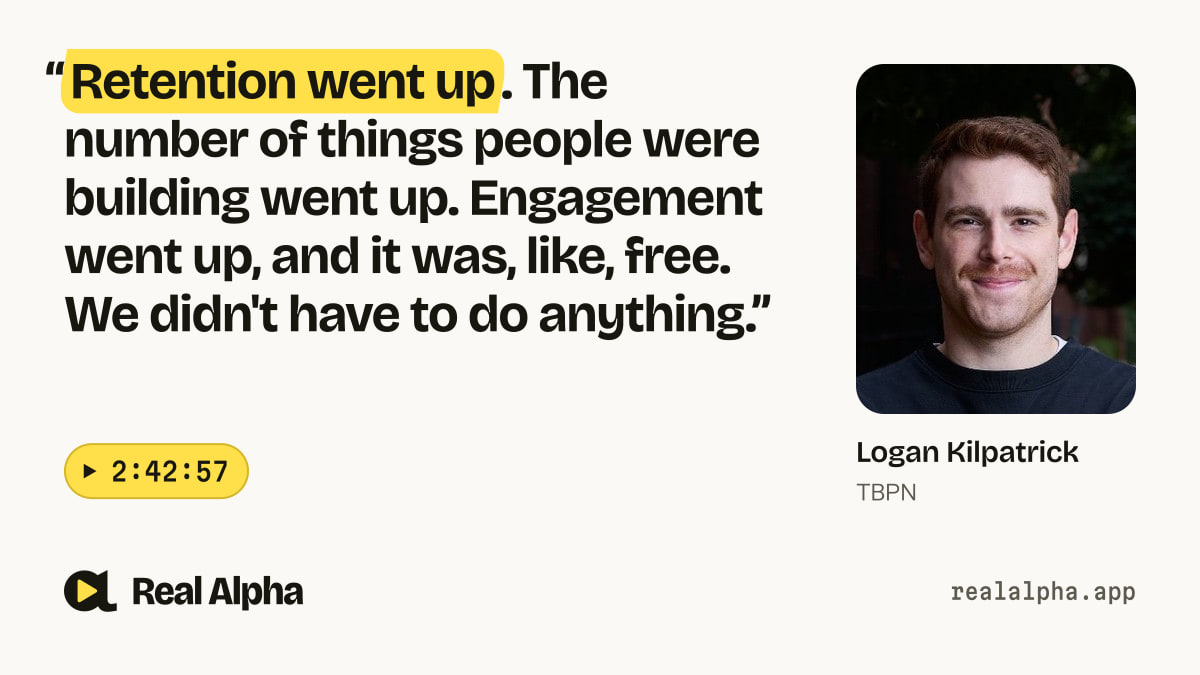
“Retention went up. The number of things people were building went up. Engagement went up, and it was, like, free. We didn't have to do anything.”
 Logan Kilpatrickat 2:42:57 · TBPN
Takeaways
- The silent test showed higher retention and engagement.
- Users built more after the model switch.
- The new model was cheaper to run.
About this segment
Logan Kilpatrick says a silent test swapping Gemini 3 Flash into AI Studio lifted retention, engagement and activity while lowering costs. The upgrade took only a model switch.

Product Lead, Google AI Studio
Leads product for Google AI Studio and the Gemini API; previously led developer relations at OpenAI.

John Coogan, Host · Co-host, TBPN
Co-founded Soylent and Lucy; OpenAI bought his show TBPN in April 2026.

Jordi Hays, Host · Co-host, TBPN
Founded Branded Native; co-founded fintech Capital, which Rho bought.
From “Amazon + OpenAI, Sarah Guo, Doug O'Laughlin, David Senra”, Dec 17, 2025. Watch the full episode
Answers “Is AI paying off for companies?” See all 116 answers
Thanks. We'll look at and fix what's off.
Transcript
From the transcript TBPN publishes with the episode.
- 2:41:44
Yeah. Maybe getting a little bit more specific, how how have conversations been going with with startups that are leveraging kind of the suite of models? Sure. Like, what where's where's where are people most excited in terms of actually implementing them?
- 2:41:58
Yeah. I think the cool thing and this is, hasn't been unique to this launch, but I think the cool thing is that for 2.5 pro customers who are paying, I think it's, like, between a dollar 25 and $2.50 per million input tokens and then, like, 10 to $12 per million output tokens. Yep. It this model is actually almost across the board completely. Three flash better than 2.5 pro. So, like, if you're a startup and you were, like, 2.5 pro was the model that which for meant, like, literally tens to hundreds of thousands of customers in production right now. This is the case for them. Yeah.
- 2:42:32
Yeah. They're able to sort of migrate over to this new model and, like, out of the box cost saving, their product just gets faster. And I was talking to someone earlier today and, like, the fact that two years ago, this, like, narrative of being a model wrapper was, like, a sort of, like, bad idea. And then now I think about this for our team, actually. Like, we have APIs for developers to build with, but we're also building a vibe coding product in AI Studio.
- 2:42:57
And, like, the vibe coding product, we ran the, like, silent test behind the scenes, and it was, like, just with Reflash actually because of how much faster it was, and it was, like, reasonably the same quality as three Pro. Retention went up. The number of things people were building went up. Engagement went up, and it was, like, free. We didn't have to do anything. We literally just changed the model in the drop down. It's actually cheaper for us to run that. And, like, as a product builder, I don't think there's been a time in, like, human history of building startups where, like, you just get to show up one morning, somebody made your product 40% better and saved you 50%. Like, the Yeah. The analogy is,
- 2:43:34
like, if you make something 40% better, you're, like, get ready to pay 50% more. You know?
- 2:43:41
Exact exactly. So it's it's crazy. I I think it's like that that continues to get me just, like, in the fiber of my being so excited about what startups are able to go after. And, yeah, it's it's a great moment. So, hopefully hopefully, folks get a chance to adopt. And then I think the next thing that I'm excited about is, like, taking these these two models, Flash and Pro, now become, like, the default models to build on top of for our other, like, custom variants and, like, the the image generation is one example of this. But, also, we have text to speech models and live audio models and a bunch of other stuff in the works, computer use models, and they all sort of rebase onto this new thing. And then, again, by default, just, like, get better out of the box, which is really, really cool. So I think you'll see the not just, you know, coding and all these other agentic capabilities, multimodal that we've showed with this specific three Flash based model, but you'll see this across pretty much every other dimension as all those more bespoke checkpoints rebase to these new three Flash and three Pro variants.
- 2:44:39
What's going on with the agent builder that, that that you got did you roll it out last week? I'm losing I'm losing track of time. But