The alpha, twice a week
That was 3 min.
Get the best new moments in your inbox every Wednesday and Saturday. It's free.
Check your inbox
We sent a link to your address. Click it to finish signing up. Not there in a minute? Look in spam.
or
TBPN · 3 min · Dec 17, 2025
LLM ads could scale quickly on high-intent queries
 Sarah Guo
 cites a reported rise in OpenEvidence’s ad run rate from $2 million to $150 million.
In this episode
Full analysis- 1:14:51Model labs can compete by focusing their spending6 min
- 1:39:48Amazon's infrastructure execution is an AI advantage7 min
- 2:53:00Strong storytelling starts with knowing the product deeply8 min
- 2:41:34A cheaper model increased usage without a product rebuild3 min
- 2:00:35Equinix ordered 20 portable reactors from Radiant6 min
- 1:33:24LLM ads could scale quickly on high-intent queries3 min
- 2:26:22Human video data improved a capable robotics model4 min
- 1:49:37Space data centers would initially favor SpaceX4 min
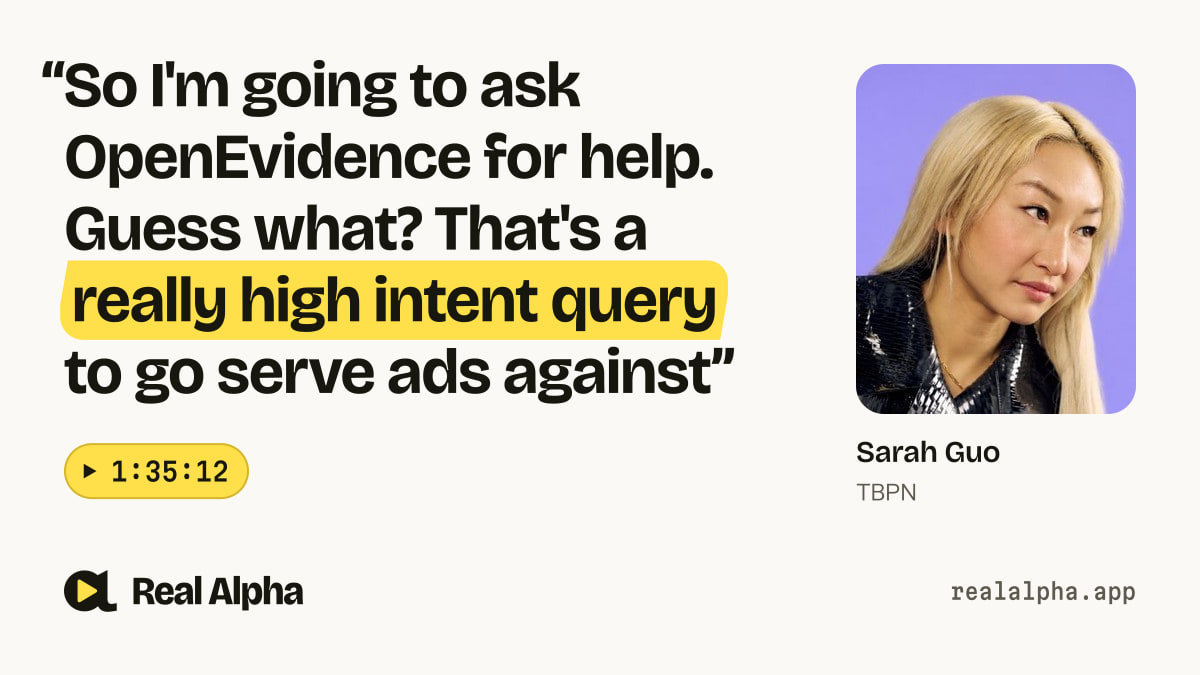
“So I'm going to ask OpenEvidence for help. Guess what? That's a really high intent query to go serve ads against”
 Sarah Guoat 1:35:12 · TBPN
Takeaways
- OpenEvidence was reported to reach a $150 million ad run rate.
- Clinical questions can signal specific commercial intent.
- Guo thinks AI ad products could scale quickly once built.
About this segment
Sarah Guo cites a reported rise in OpenEvidence’s ad run rate from $2 million to $150 million. She argues that question-driven AI products can offer unusually high-intent ad inventory.

Founder & Managing Partner, Conviction
Ex-Greylock partner; early investor in Cognition, Harvey and Mistral.

John Coogan, Host · Co-host, TBPN
Co-founded Soylent and Lucy; OpenAI bought his show TBPN in April 2026.

Jordi Hays, Host · Co-host, TBPN
Founded Branded Native; co-founded fintech Capital, which Rho bought.
From “Amazon + OpenAI, Sarah Guo, Doug O'Laughlin, David Senra”, Dec 17, 2025. Watch the full episode
Answers “How do AI companies make money?” See all 122 answers
Thanks. We'll look at and fix what's off.
Transcript
From the transcript TBPN publishes with the episode.
- 1:33:33
I guess, one question, maybe fun prediction. How much do you how many dollars do you think will be spent on ads within LLMs next year? Do you think next year? A little early. Little early. Yeah. That's that's my feeling. Yeah. Like, I could see it ramping in the back half of the year and, like, actually because I think the ads are gonna be extremely effective. People are saying, like, oh, a lot of these queries are not that high intent.
- 1:33:57
It's just research. But I think that a lot more of them I'd I think a meaningful amount are product research. Mhmm. And once you're driving these sort of, like, high intent clicks Mhmm. I think it will scale pretty quickly, but I think it will take I think it will I think this will be, like, a second half of the year 2026 story as it starts to scale. But we've had founders on the show that have said, like, when somebody lands on my site from ChatGPT, they can convert at 7%, and my average conversion rate is like 3%. Yeah.
- 1:34:27
So it's like I think people don't quite I think when it happens, it's gonna happen really fast. Mhmm. And the question is just like, how quickly can the companies with a bunch of traffic build any kind of product? Because the inventory is going to be so good. And I think it's useful to look at open evidence as a precursor here. So it has been reported that the company went from like two to a 150,000,000 of ad run rate already.
- 1:34:52
Oh, yeah. It's fully ad supported. It's just the biggest ad business in AI today. Right. I forgot about that.
- 1:34:59
And like what happened? They made a product that was free, that so useful to doctors because you're literally answering the question of like, well I don't know what's happening in this area of like personalized medicine for this domain of oncology for this type of patient. Right? I'm from Wisconsin, so we'll use Wisconsin as an example. Like I am a doctor in rural Wisconsin that's never seen this type of leukemia.
- 1:35:21
So I'm going to ask OpenEvidence for help. Guess what? That's a really high intent query to go serve ads against Here's a treatment. Yeah. So think when you compare that to the ad inventory that exists in the world, which is just like, I'm looking at a bunch of random stuff, my average is two words or whatever. Yeah. Like, I I think that
- 1:35:42
there's gonna be amazing. There's a level of trust that I think someone will have with open evidence that they maybe don't have with Google search.
- 1:35:50
Totally. Yeah. They understand what the sources are. Yep. It's it's, you know, research That is. Trials, etcetera. It's generated data from other doctors. Yep. So I think I think that if you can make the right products here, it's gonna be very big. The my only question is how how quickly they make those ad products.
- 1:36:05
Last last question. Mhmm. Are you long or short, forward deployed, engineered? Like, the model.