The alpha, twice a week
That was 6 min.
Get the best new moments in your inbox every Wednesday and Saturday. It's free.
Check your inbox
We sent a link to your address. Click it to finish signing up. Not there in a minute? Look in spam.
or
Newcomer Pod · 6 min · Nov 5, 2026
A growing agent economy will need new search and identity layers
 Aydin Senkut
 argues agents could multiply searches and make identity and security infrastructure essential.
In this episode
Full analysis- 17:40Robotics has a new learning breakthrough and a huge market4 min
- 12:55AI biology needs scalable experiments to test its discoveries5 min
- 42:58Underlying business growth matters more than bubble talk5 min
- 7:25A growing agent economy will need new search and identity layers6 min
- 24:38Senkut turned international product work into his first venture fund6 min
- 51:04Google's data assets support an AI and autonomy advantage3 min
- 36:34Felicis sets aside 1% of each check for founder development7 min
- 48:06Canva built its image library by working directly with creators3 min
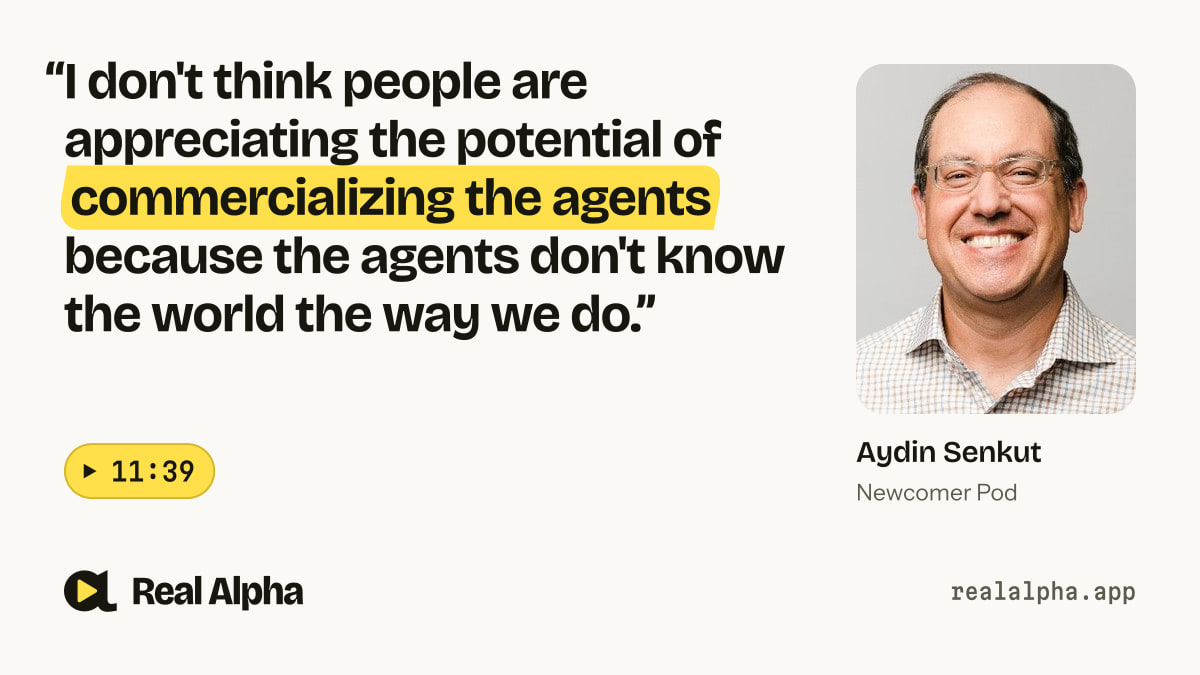
“I don't think people are appreciating the potential of commercializing the agents because the agents don't know the world the way we do.”
 Aydin Senkutat 11:39 · Newcomer Pod
Takeaways
- Inference matters because models now complete jobs and make decisions.
- Agents may generate far more searches than human users.
- Identity and security become bottlenecks as agents scale.
About this segment
Aydin Senkut argues agents could multiply searches and make identity and security infrastructure essential. He sees opportunity in services that help agents navigate and operate, not only in models.

Aydin Senkut is founder of Felicis and former Google product manager.
Founded Felicis, a Menlo Park VC firm; former Google first product manager now backing AI and infrastructure companies.
- EN
Eric Newcomer, Host · Newcomer
From “Aydin Senkut on Why AI Is Fueling a Robotics Boom”, Nov 5, 2026. Watch the full episode
Thanks. We'll look at and fix what's off.
Transcript
Transcribed by machine (Whisper) from the episode’s audio, so a word may be off here and there.
- 7:30
I mean, look, I think the way to look at inferences, the moment AI became interesting is when it transcended from one token in one token out when you think about how we think like the way that brain works there are some things like you take extreme shortcuts and some things we're actually like spending literally all of your neurons are like focusing getting it right um and the big difference to crypto in my mind and what the reason why inference is really important is now all of a sudden you're getting real jobs done and like you're making real decisions and that honestly like if you think about what human beings like use their brain for like we make decisions and even when you're not realizing it when you're like seeing something hearing something smelling something each one of these things have like hundreds if
- 8:13
not thousands of processes that is not completely oblivious to you and all of the stuff like includes like making some decision and like oh like I'm going to use this signal and not that signal so in some essence inferences like a key unit of how our brain work and now we have like manage to scale it and then you think about well human brain even with his ingenuity can do X and now we can be in a world where that X can be 10x or 100x and the reason why that's really important is that can produce uncapped value right there might be like a lot of things we do that previously we couldn't do or we could do it but we could not scale it so unlike crypto that's why I feel the whole inference thing is not a toy and trust me like I'm speaking I was an early Google employee and I'm like God please let this be and
- 8:58
a $10 billion company became a $5 trillion company. And that's just given human beings information, access to information, equalize it, scale it. And now like what we can do is if we basically change it and say now we can allow human beings like make better decisions or even do their work for them. It's just a new era. And so, but the reality is if you also ask me, do you ever envision a world where Google is gonna spend a hundred billion in CapEx a year?
- 9:26
And I'm like, what are you talking about? Like that is never going to happen, you know, like this is a company that's going to ruin the beauty of the business. This is a company that didn't even want to do advertising, you know. So, you know, there is real. I think the scary thing is you cannot not spend that money. I feel like we're in some kind of like survivor game and like the winner is going to take a lot of value.
- 9:49
But like five, ten people are spending the money. And at the end, I'm not sure if all five, 10 players will, the economic returns will be equally distributed. So there will definitely be some changes, but look, every time like we get afraid of momentary like stock market changes or whatever, like, oh, like we're going to see like some shock in the economy, whatever. What follows is like a 10X improvement, like 2008, 2009, people are like, oh my God, this is the worst thing.
- 10:17
Stocks lost all the values. but then that became a great foundation and some of the most interesting and valuable companies got created. So I'm an eternal optimist and I do think there is some really exciting stuff to come there. Are you investing in agent infrastructure in particular companies to allow some sort of agent economy or are you waiting for more to build out there? I am. And the way that we're thinking about it, like I think all you have to do is like, I don't even think you need to be like the most incredible expert. You just have to imagine a world where like instead of just humans, now you have millions, billions of agents and millions, billions of robots. What changes in that world? And so a lot of it is around developer ecosystem and it used to be just people that can code, computer science degrees. Now you have citizen developers and the agents themselves.
- 11:01
And it's awesome because these agents, there are so many ways that- Citizen developer. I don't know if I've heard that phrase before. Citizen developers isn't like, look, think about all the replets and lovables of the world. All right, no, I get it. People that didn't even like can barely speak English or their language is now like coding and creating apps. Yeah. How cool is that, right? Like it's democratization.
- 11:21
Also, I feel like every great Felicis company is democratization of something, Canvas, democratization of design, Shopify was like democratization and scaling of like entrepreneurship and commerce, make it available to people like citizen, you know, entrepreneurs, and now we have citizen developers. But I think more importantly than that, like, one of the things that fascinates me, like, imagine, like, I don't think people are appreciating the potential of commercializing the agents because the agents don't know the world the way we do.
- 11:51
Think about all the years that brought you to here, how many things you learned you don't even think about. Like, you know what a university is. You know what a country is. You know, like. location that's a city or any type of simple thing like you know colors whatever versus the agents have to learn the context and everything from scratch in a world where search was only consumed by humans now imagine a world where search is no longer consumed the way humans do it but via an api by billions of agents that will do like a million more searches compared to like a single human what how exciting is that world um then all of a sudden you're like wow like we created this amazing abundance um in terms of ai but now security is the biggest threat well how do you manage a world where like even the smallest like bad actors have insane ai tools in their hands
- 12:39
now this is going to be really important and like if you told like identity management whatever like that was a big area it's going to be like a thousand times more important critical bottleneck with what's going on and so every time you have this like chaos and unexpected situation or we don't know how this is going to turn out, it is the best foundation for some of the biggest disruptions to happen and surprise us hopefully to the upside. I wanted to turn to the second bucket, which is the, I don't know, biology, health. Where do you see the most opportunity?