The alpha, twice a week
That was 4 min.
Get the best new moments in your inbox every Wednesday and Saturday. It's free.
Check your inbox
We sent a link to your address. Click it to finish signing up. Not there in a minute? Look in spam.
or
Behind the Craft · 4 min · Oct 18, 2026
A quarter of monthly actives pay for Sylvia
 Anthony Pompliano
 says 25% of monthly active users pay, and paying users ask more than 20 questions a week.
In this episode
Full analysis- 13:40Work trials reveal fit faster than interviews4 min
- 25:23Personal financial context can unlock tax and estate planningPro pick 3 min
- 32:05Specialized AI can compete by owning a narrow workflowPro pick 4 min
- 20:44Sylvia grew from a spreadsheet into a tool for wealthy investors4 min
- 10:51Big-company hires can struggle in fast-moving startups3 min
- 28:24A quarter of monthly actives pay for Sylvia4 min
- 18:33He judges hires by the revenue their cost must unlock2 min
- 35:59Sylvia users hold about 10% in Bitcoin and crypto3 min
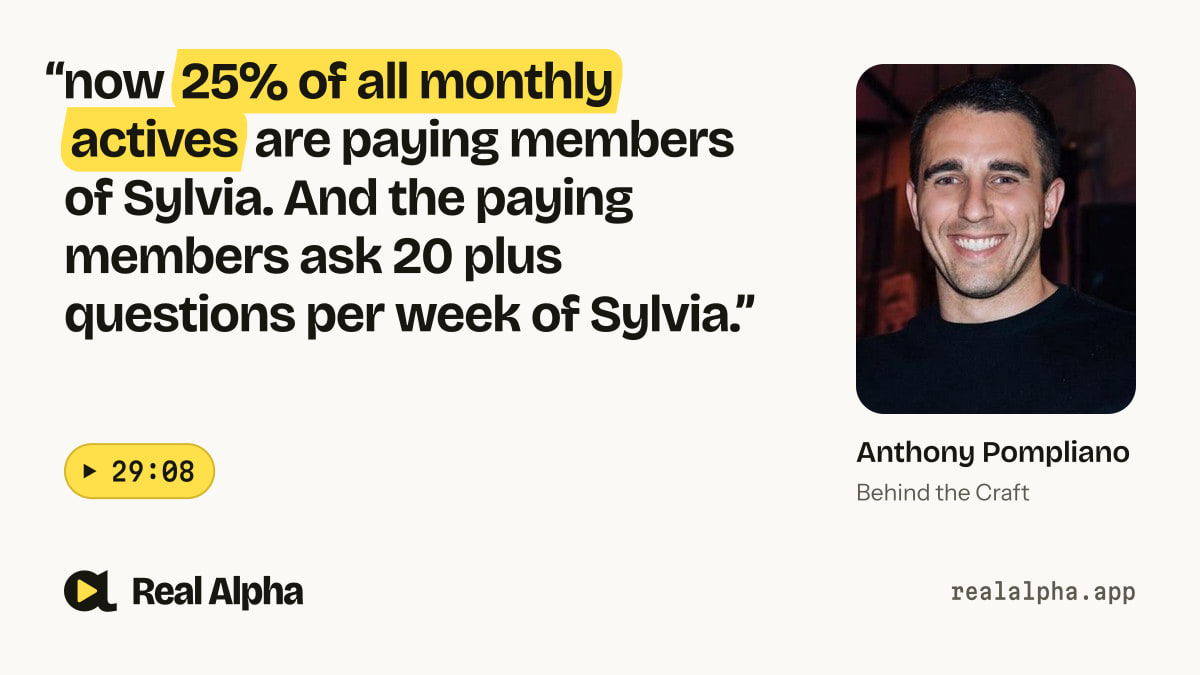
“now 25% of all monthly actives are paying members of Sylvia. And the paying members ask 20 plus questions per week of Sylvia.”
 Anthony Pomplianoat 29:08 · Behind the Craft
Takeaways
- Paying members ask Sylvia 20-plus questions a week.
- Users share more context with AI than they may with a human expert.
- Users can enter assets manually instead of connecting financial accounts.
About this segment
Anthony Pompliano says 25% of monthly active users pay, and paying users ask more than 20 questions a week. He links engagement to richer context and describes security and manual-entry options for people wary of connecting accounts.

Anthony Pompliano is an investor, best-selling author, public company CEO, and founder of Silvia.
Invested in more than 300 private companies, including over 20 unicorns, and hosts The Pomp Podcast.

Peter Yang, Host · Host, Behind the Craft
Led product at Roblox, Reddit, Twitch and Meta for 10+ years.
From “We Built an AI CFO to Help You Grow Your Net Worth | Anthony Pompliano”, Oct 18, 2026. Watch the full episode
Thanks. We'll look at and fix what's off.
Transcript
Transcribed by machine (Whisper) from the episode’s audio, so a word may be off here and there.
- 28:30
super valuable. People usually, when they use a fintech product, do not have the ability to tell the product what are their, not just goals in terms of quantifiable goals, but in finance in particular, there's a lot of philosophical elements or there are emotional elements. So a great example is I tell everyone when you sign up for Sylvia, the first thing you should do is say, interview me so you can get the relevant information you need to be helpful. And she'll start asking you not only about, hey, how much risk do you want to take or what your financial goals are, but also very concrete things like what city, how many dependents, you know, what is your kind of rules based allocation in your portfolio, etc. And so what we find is people start out and they say, okay, let me start trying to use this. And it becomes so helpful that now 25% of all
- 29:15
monthly actives are paying members of Sylvia. And the paying members ask 20 plus questions per week of Sylvia. When you start seeing that, you're like, look, this thing has product market fit, right? It's also good to build for users who actually have the finances to pay for the stuff, right? So, you know. Well, AI, what is AI good at? AI is good at dealing with complexity. People who have 500 bucks in a Robinhood account don't have a lot of complexity. People who the average user connects $2.5 million to the product. So people with two and a half million bucks, they got a lot complexity. They also are thinking, by the way, not only how do I make more money and pay less in taxes, but they're like my friend down the street, he's got a philanthropy and he wants me to donate. Should I do a $10,000 donation or not? How do I think about doing it in the most
- 30:00
tax mitigated way? How do I think about my kid who the Trump accounts come out? Should I use it or should I not? Should I do a 529 plan? These are the things that I think people are underestimating how many questions someone actually has versus how many they ask of an expert. I don't know about you. But if I'm ever talking to one of these experts, I don't just bring like 50 questions. I'm like, I don't want them to think I'm dumb. Yeah, they only make sure for like 30 minutes or an hour, right? Well, there's a time constraint, but also people are scared of being judged or they don't want to come off as being dumb. With the AI, you can ask anything. And what we find is people tell the AI more stuff in terms of context, and they ask more questions that they would otherwise refrain from doing with a human expert. And so the AI is getting smarter, which
- 30:42
actually just makes it better. And then you ask more questions, it just becomes this recursive circle of this thing becomes really valuable to me because I'm willing to talk to it in a way I wouldn't talk to a human. When I talk to my friends about, you know, connecting financial accounts, even just through chat CPT, the number one bear is they're just like, hey, this stuff is going to steal my data. And I'm like, no, it's not going to steal your data. But then they're like, oh, how do I know? So how do you kind of answer this question for your product?
- 31:06
So this was obviously very important for me. I was the first user. And when we started to hire engineers, I was like, well, I don't want the engineers all up in my stuff, right? And so we have done a couple of things. One, bank level encryption, SOC 2 certified, anonymization of PII on the back end. We have zero data retention policies with any of the language labs that we use models for in the model routing, just like step after step after step. The other thing that we did, which I think a lot of people underestimate, is we made it so that if you want to use the product, but you really don't want to connect an account, even though we think that that is the better way to use the product, you can actually go in and manually add your assets so that you never have to connect an account, but you can still use the product.
- 31:46
So we basically have said, look, let's build a product that different people can use in different ways. Let's provide the best security and privacy that we can, but also understand that even if we do all of that, people still may want to use the product, but not connect an account. He added the manual account creation