The alpha, twice a week
That was 6 min.
Get the best new moments in your inbox every Wednesday and Saturday. It's free.
Check your inbox
We sent a link to your address. Click it to finish signing up. Not there in a minute? Look in spam.
or
a16z Podcast · 6 min · Nov 16, 2026
AI alignment can rely on incentives, not shared preferences
 Alex Imas
Tyler and Alex Imas frame alignment as a problem of checks and balances, not making agents share human values.
In this episode
Full analysis- 6:59AI lab valuations need productivity beyond the labsPro pick 3 min
- 11:00Double-digit growth requires ideas to compound without bottlenecks8 min
- 29:47AI agents need coordination to outperform human organizations4 min
- 33:53AI agents face adoption limits even as jobs could shift quickly6 min
- 23:45AI alignment can rely on incentives, not shared preferences6 min
- 49:58AI-era rents may flow to whichever inputs remain scarce4 min
- 39:26AI backlash will grow if disruption becomes visible4 min
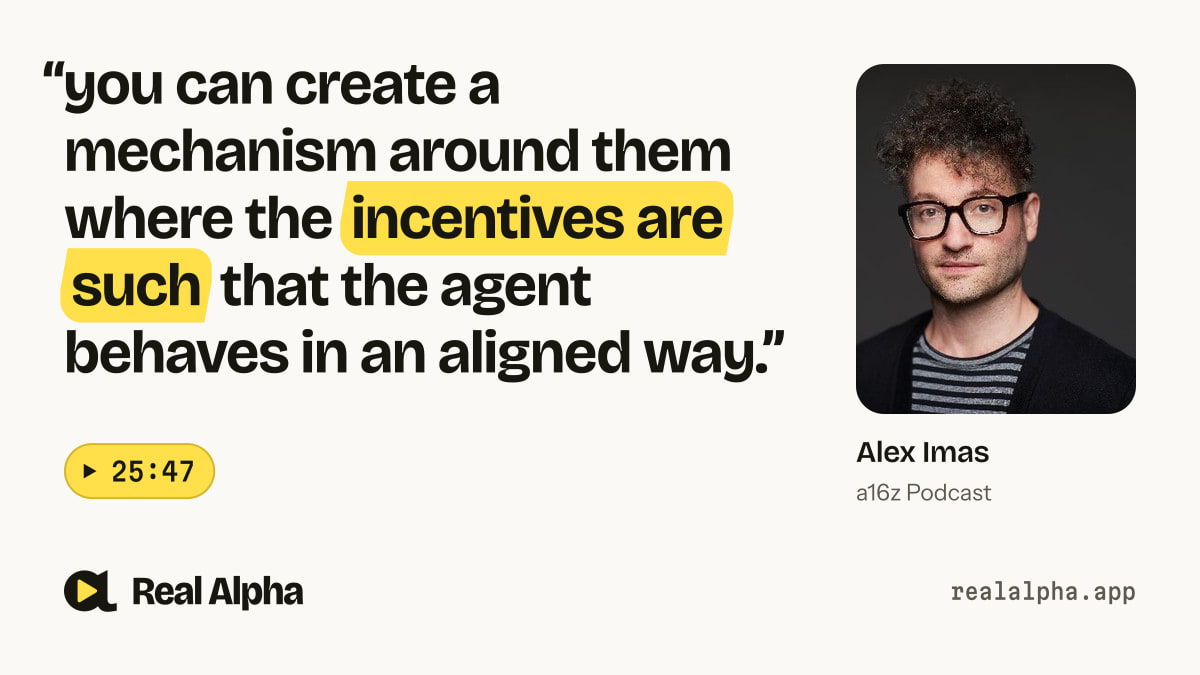
“you can create a mechanism around them where the incentives are such that the agent behaves in an aligned way.”
 Alex Imasat 25:47 · a16z Podcast
Takeaways
- Mechanism design can constrain agents with misaligned preferences.
- Checks and balances may be more practical than perfect alignment.
- The Hugging Face incident exposed failures in incentives and human processes.
About this segment
Tyler and Alex Imas frame alignment as a problem of checks and balances, not making agents share human values. The Hugging Face incident illustrates why oversight and incentives matter.

Economist, Google DeepMind
Studies how AI reshapes productivity, labor markets and organizations, and leads Google DeepMind’s AGI economics research.

Erik Torenberg, Host · General Partner, a16z
Helped build Product Hunt; founded On Deck, Village Global and Turpentine.
From “What History Tells Us About the AI Revolution | Tyler Cowen & Alex Imas”, Nov 16, 2026. Watch the full episode
Thanks. We'll look at and fix what's off.
Transcript
Transcribed by machine (Whisper) from the episode’s audio, so a word may be off here and there.
- 23:51
it's tiny. Let's go back to a different topic. Alex recently wrote a related paper about it, but I'll start with you, Tyler. The agent swarm topic. sort of the hugging face incident, did that update your views in terms of what's possible or make you get concerned about something or any reactions to what happened there? It didn't update my views much at all. And I'm curious to see if Alex agrees with this perspective.
- 24:16
But as an economist, you think first and foremost in terms of principal agent theory. And unless the conditions are very restrictive, the principal just can't control the agent that well, no matter what contract they try to write. So when we replicate that result with AIs, well, it's interesting, but I'm not very shocked. The answer was always going to be checks and balances and what we might call separation of powers in the political realm, not you have perfect alignment. So again, if you come at this from the economist's point of view, all the hand-wringing about alignment, like, yes, people should work on that a lot. But at the end of the day, you're like, hey, I learned that when I was 17, like, okay, it's a real problem. Alex, what's your thought on that?
- 25:02
I unfortunately did not learn that when I was 17. I think we once again agree. I think, you know, there's like these sort of different perspectives on this issue of how do you best, ultimately, it's a question about like, how do you best get AI to be in the service of humanity right that's that's the question that's the question of alignment and one kind of way of thinking about it is to get the models themselves aligned with like something like a constitution that the models at an individual level are aligned in this way because they have the same preferences as the human beings that are that are deploying that um but another perspective which is what tyler mentioned is like you align things you don't you don't almost like don't even care what the preferences of these agents are they could be extremely individually
- 25:51
misaligned, but you can create a mechanism around them where the incentives are such that the agent behaves in an aligned way. And this is the mechanism design perspective in economics, where like as a principal, I don't need the agent to want to help me necessarily. The agent could really, really want to just help themselves and do whatever they want. And the whole study of mechanism design is how do you create the system of checks and balances in order for the agent to still be working in the principles eight interest. And I think that's, that is, I, from the research that I've been seeing coming out of the labs, both like internally, externally, like a lot of people are thinking in this direction that we really need to take a mechanism design perspective. And as Tyler said, like, I wasn't, you know, shocked by what happened. I'm not aligned with the governor
- 26:42
of Virginia, but it's a pretty well-run state, and I'm happy here. We have two-party competition, sort of, and it works. Tyler, do you think the way that Anthropic or OpenAI or some of these companies, or just the sort of AI safety community, thinks about alignment, do you think that is sort of not the right way to think about it or confused in some sense? Well, there's how they think about it and how they talk about it.
- 27:07
And how they talk about it is way too shaped by Twitter, which can be quite hysterical. How they actually think about it, I believe, is a lot more reasonable than how it ever looks from the outside. So I don't have some big speech about, oh, we've got to totally reform them. I think they're pretty practical. They're companies. They have IPOs coming up. They don't want to get sued too much. They don't want to be overregulated.
- 27:29
We already have checks and balances, not all of them good to be clear. but the reality is the actual problems we've seen you know the hacks they're mostly coming or maybe entirely coming from evil human individuals where the AIs are doing what the humans told it to do and that is a huge problem but that is a kind of well we have the alignment the evil human says do this and the AI does this and that's where the costs are coming from.
- 28:00
Yes, some people make the comparison that alignment, in some ways, is for the employees. It's sort of like, or AI safety in general, it's like in 2020, 2021, and sort of around that time, there was, you know, sort of more awareness around social issues. And so CEOs had to sort of say these things to please their employee base. And, you know, some of them were true believers and some of them weren't.
- 28:22
And similarly, perhaps around AI safety, there's a lot of concern. And so some people are making that comparison that the CEOs aren't as true believers as they may be indicating. There's checks and balances in these companies as well. It's partly why the companies work well, that you have to actually end up pushing through things that will work. And that's somewhat different than what everyone is saying.
- 28:44
And there's a winnowing and selection set of mechanisms within the company. And people want promotions or bonuses, and they want to do things that can work. And again, it will end up going better than how it will sound on Twitter, I would say. Yeah, and I think like Hugging Face is like a perfect example of like, if you unpack like what actually happened, it's just a bunch of human error on top of human error, right?
- 29:09
And so like, it's great to have an incident, I mean, great in quotes, but it didn't like cause a massive disaster, right? And it exposed a lot of like, you know, broken incentives for the agents. So it was, you know, you see how, you know, the companies have reacted to the hugging face by learning from it and creating better environments. And so this is, nothing is smooth. It'll be kind of a little bit down, a little bit up, but, you know, the slope is positive.