The alpha, twice a week
That was 3 min.
Get the best new moments in your inbox every Wednesday and Saturday. It's free.
Check your inbox
We sent a link to your address. Click it to finish signing up. Not there in a minute? Look in spam.
or
AI & I · 3 min · Nov 4, 2026
AI can line-edit, but human editors still coach writers
 Kevin Roose
 says AI can line-edit well, but editors also coach writers and help judge which stories deserve more work.
In this episode
Full analysis- 3:47AI models should pass safety tests before public releasePro pick 3 min
- 24:23AI helped fact-check and organize Roose’s book research4 min
- 42:02Use AI for drudgery, not tasks where struggle builds skill4 min
- 15:00Amodei's compute memo pushed OpenAI toward general models3 min
- 10:47Background interviews helped Roose's sources snowball3 min
- 7:16Roose hurried to record AI history before evidence vanished4 min
- 35:52Journalists need to learn from YouTube-native news creators4 min
- 28:17AI can line-edit, but human editors still coach writers3 min
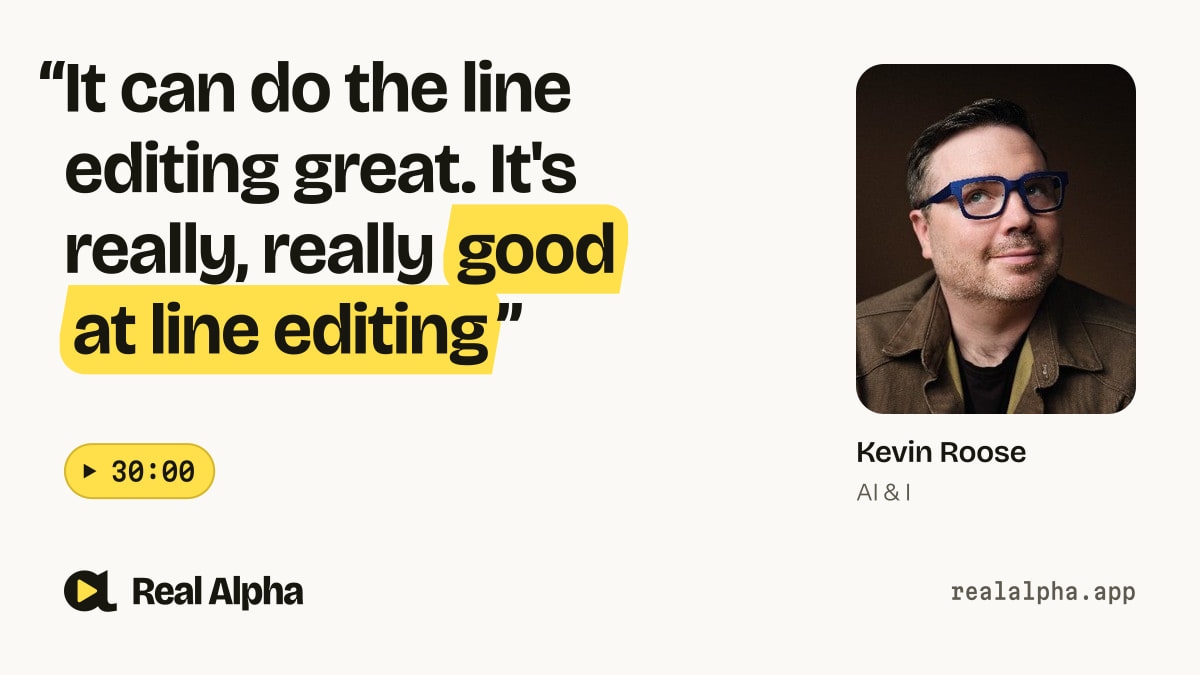
“It can do the line editing great. It's really, really good at line editing”
 Kevin Rooseat 30:00 · AI & I
Takeaways
- AI is strong at line editing.
- Editors also motivate writers and spot unresolved ideas.
- Roose values both technical edits and human coaching.
About this segment
Kevin Roose says AI can line-edit well, but editors also coach writers and help judge which stories deserve more work. He still needs both kinds of support.

Kevin Roose is a tech journalist and cohost of Machine Gods.
Wrote The Shift column at The New York Times; co-hosted Hard Fork.
- NQ
Natalia Quintero, Host · Head of consulting, Every
Ran Silicon Valley Bank's Latin American tech portfolio before Every.
From “The Inside Story of the 50 Who Built Modern AI With Kevin Roose”, Nov 4, 2026. Watch the full episode
Answers “Which jobs will AI replace, and which are safe?” See all 241 answers
Thanks. We'll look at and fix what's off.
Transcript
Transcribed by machine (Whisper) from the episode’s audio, so a word may be off here and there.
- 28:29
So it's it's doing a lot for me. To what extent do you feel like your role as a writer has evolved and kind of become amplified? Right. Because you were at The New York Times for a decade. You had access to some of the best editors in the world. But at some point you also started codifying what a good editor does and looks for. Right. In in giving instructions to the agents that you've set up to do this work for you.
- 28:55
and it sounds like you have a number of agents. So at some point you have to do the thinking of what are the roles that matter? What does it mean to do this role well? How has that evolved how you think about your role as a writer and how it's amplified what else you think about in your creative process? Yeah, I think an editor can do a lot of things, right? And the best human editors do a lot of things.
- 29:20
They are skilled at line editing, at spotting places where things could be sharpened or tightened or expanded on, at thinking about structure and pacing and how to deliver information in a way that is going to be satisfying for the reader. But they're also coaches. They also motivate you. They tell you, it doesn't feel like you've really cracked this yet. Go back to your sources and try to figure this out yet. So that is part of the editor's job. Also just having kind of the ability to say, this story is worth pursuing. This story maybe is less worth pursuing. So I think of the best editors I've worked with in my career, all of whom are human, as sort of compilations of those skills. And AI can't do a lot of that yet. It can do the line editing great. It's really, really good at line editing it's really it's it's getting better at things like pacing and
- 30:20
structure but you know you you need both at least i need both um to produce something that i'm really proud of i need the the line editing the sort of technical editing work and then i also need the coaching the inspiration the motivation the like hey go back it doesn't feel like you've