The alpha, twice a week
That was 4 min.
Get the best new moments in your inbox every Wednesday and Saturday. It's free.
Check your inbox
We sent a link to your address. Click it to finish signing up. Not there in a minute? Look in spam.
or
AI & I · 4 min · Nov 4, 2026
Roose hurried to record AI history before evidence vanished
 Kevin Roose
 wanted to uncover decisions behind the transformer, ChatGPT and reasoning models before private records disappeared.
In this episode
Full analysis- 3:47AI models should pass safety tests before public releasePro pick 3 min
- 24:23AI helped fact-check and organize Roose’s book research4 min
- 42:02Use AI for drudgery, not tasks where struggle builds skill4 min
- 15:00Amodei's compute memo pushed OpenAI toward general models3 min
- 10:47Background interviews helped Roose's sources snowball3 min
- 7:16Roose hurried to record AI history before evidence vanished4 min
- 35:52Journalists need to learn from YouTube-native news creators4 min
- 28:17AI can line-edit, but human editors still coach writers3 min
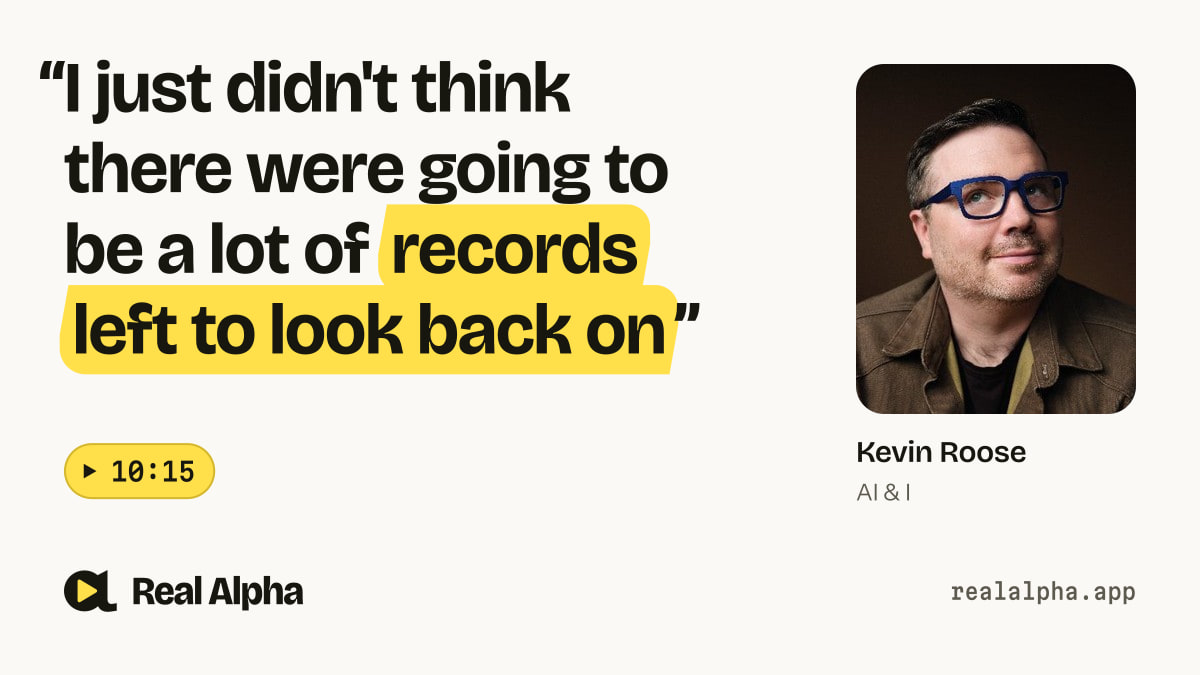
“I just didn't think there were going to be a lot of records left to look back on”
 Kevin Rooseat 10:15 · AI & I
Takeaways
- His earlier AI coverage had left key decisions unexplained.
- Lab records and messages could disappear under NDAs.
- He wanted to capture firsthand accounts while available.
About this segment
Kevin Roose wanted to uncover decisions behind the transformer, ChatGPT and reasoning models before private records disappeared. He saw the book as a race to preserve how the technology was built.

Kevin Roose is a tech journalist and cohost of Machine Gods.
Wrote The Shift column at The New York Times; co-hosted Hard Fork.
- NQ
Natalia Quintero, Host · Head of consulting, Every
Ran Silicon Valley Bank's Latin American tech portfolio before Every.
From “The Inside Story of the 50 Who Built Modern AI With Kevin Roose”, Nov 4, 2026. Watch the full episode
Thanks. We'll look at and fix what's off.
Transcript
Transcribed by machine (Whisper) from the episode’s audio, so a word may be off here and there.
- 7:28
Can you tell me a little bit about what was the moment where you realized that you wanted to write this book? Well, the moment I realized that I wanted to write this book came relatively late in the process. I was trying to avoid writing this book because I thought this is going to be very hard. Uh, someone's going to have to go interview these 150 people and write down their stories. And I hope, uh, that Walter Isaacson or someone of his stature.
- 8:00
wakes up one day and decides to write the book so that I don't have to do it. But that kept not happening. And I had a couple of motivations for eventually deciding to write the book, which I did around the sort of early 2025 time period. One was, as you mentioned, I've been covering tech for more than a decade. I've known a lot of these AI researchers and people for a long time. I had written a previous book about AI that came out in 2021, but I really felt like I had actually not gotten the full story.
- 8:37
I didn't know why, for example, the transformer that had been built at Google in 2017 took off at OpenAI or how that worked. I didn't know what the decision was like to release ChatGPT in 2022. I didn't know what the story behind the advent of reasoning models was in 2023. All of that seemed like historically important. Like we as a species should know how this stuff came into being and who was in the room and what the decisions were at the key moments.
- 9:14
And so I thought that was useful information that I didn't have. I didn't just absorb that from covering the tech industry because a lot of that was secret. And a lot of it was, you know, held by people who didn't particularly want to divulge how they had done all this stuff. So I thought that was job one. And then job two was to do it quickly because I thought there was some chance, some risk that all of this stuff would disappear.
- 9:39
You know, I'm a big fan of history. I love to read books about moments in innovation, scientific breakthroughs. you know, Watson and Crick, the Wright brothers, Marie Curie. Like, I just, I'm obsessed with kind of the moments where something about the fabric of the world changes or goes in a new direction because some brilliant scientist somewhere has made it so. And so my worry was that all this stuff was going to disappear. Because inside the labs, it's all secret. It's all under NDA.
- 10:20
All the Slack messages and signal threads are going to delete themselves after some period of time. And I just didn't think there were going to be a lot of records left to look back on and answer the question, how did we get here? So I thought for those reasons, and because Walter Isaacson didn't wake up one day and decide to write a book about the race to HEI, I ended up doing it.