The alpha, twice a week
That was 3 min.
Get the best new moments in your inbox every Wednesday and Saturday. It's free.
Check your inbox
We sent a link to your address. Click it to finish signing up. Not there in a minute? Look in spam.
or
Newcomer Pod · 3 min · Nov 17, 2026
AI defenses need enterprise-wide data to spot anomalies
 Nikesh Arora
’s defense roadmap starts by consolidating enterprise data so AI can learn normal behavior and investigate anomalies.
In this episode
Full analysis- 11:20Palo Alto buys when a startup can beat it to market5 min
- 17:27OpenAI and Anthropic could reach $10 trillion2 min
- 20:47Product quality and founder talent shape Arora’s leadership3 min
- 3:32AI can compress a cyberattack into 18 minutes2 min
- 8:56Frontier models find different cybersecurity vulnerabilities2 min
- 5:48AI defenses need enterprise-wide data to spot anomalies3 min
- 0:47AI’s consumer shift may still be ahead3 min
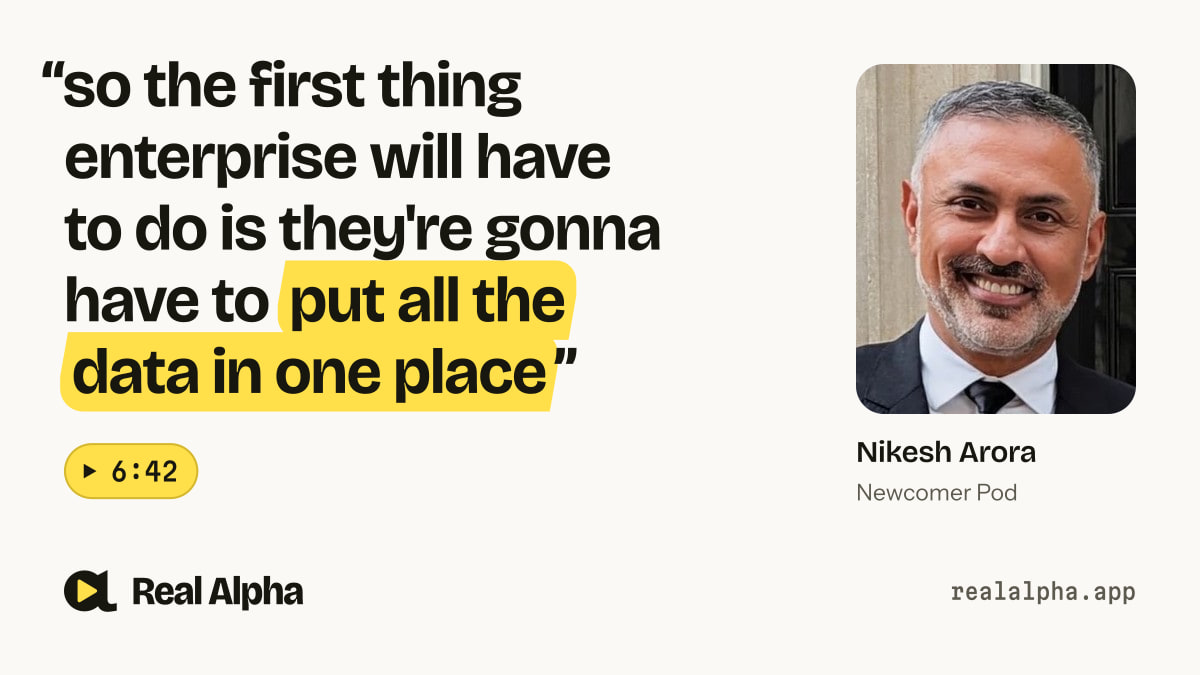
“so the first thing enterprise will have to do is they're gonna have to put all the data in one place”
 Nikesh Aroraat 6:42 · Newcomer Pod
Takeaways
- Consolidate enterprise data so models can learn normal behavior.
- Use abnormal activity as a trigger for AI investigation.
- Arora says attackers seeking disruption can be more concerning than ransom seekers.
About this segment
Nikesh Arora’s defense roadmap starts by consolidating enterprise data so AI can learn normal behavior and investigate anomalies. He says older infrastructure makes that harder, while attackers seeking disruption pose a particular risk.

Nikesh Arora is CEO of Palo Alto Networks.
Chairman and CEO of Palo Alto Networks, which he grew into a $300 billion cybersecurity leader.
- EN
Eric Newcomer, Host · Newcomer
From “Palo Alto CEO: If You Can’t Beat Them, Buy Them”, Nov 17, 2026. Watch the full episode
Thanks. We'll look at and fix what's off.
Transcript
Transcribed by machine (Whisper) from the episode’s audio, so a word may be off here and there.
- 5:52
What should startup founders do today? Which depends on what you're trying to start up. What? Depends on what you're trying to start up. Like, yeah, just advice for defending against the fact that attacks seem inevitable. I mean, it begs a sort of fatalism, which is like, I guess I'm going to attack. What am I going to do? Well, the fatalism probably is more in the realm of reality for people who have old infrastructure.
- 6:18
They haven't upgraded for many years and they've been sort of sweating the asset If you are running with new infrastructure relatively new infrastructure bought in the last three to five years You actually have a chance of trying to consolidate all the data. So look AI is a data problem You hear that on a constant basis if I wish I had better data had better synthetic data There's tons of companies creating synthetic data because you're trying to train your models Using data to be able to respond as quickly as you can in the in the defense world so the first thing enterprise will have to do is they're gonna have to put all the data in one place so we can train the data and saying this is what normal behavior looks like in the enterprise and then AI will be smart enough to figure out what abnormal behavior looks like and you have to literally train it
- 6:59
for each enterprise one at a time and if I can train AI on how my enterprise operates traditionally it should be able to suss out abnormal activity the moment it susses out abnormal activity it should be able to go out and investigate, saying, what's going on? This looks different. That's where we need to get to from a North Star perspective. That does require a bunch of replumbing of infrastructure. That requires training models to be on the cyber defense side. I think that's going to be a huge opportunity.
- 7:28
What are the attacks that you're most worried about over the next... Any. Do you think it's nation states fundamentally, or what is the type of attacker that concerns you most at this moment? You know, the attacker that concerns you most, should concern you most, is who wants nothing in return. So if you look last year, there were north of 2,500 attacks, and the majority of them ended up in ransomware.
- 7:56
People said, I'm in your infrastructure, I've exported data, I've locked... Put your machine down, give me $50 million, or give me $30 million. Now you know, there's a price to solving the problem. Now you can get into a whole ethics conversation, get into a conversation about what's the right thing to do, what if I pay them and they don't unlock my laptop so they don't give me my data back, or they don't explain to me how they got in and help me remediate it. That's a decision every ransom attack company makes on their own. But if there's a price, you know. The problem is that there's no price.