The alpha, twice a week
That was 3 min.
Get the best new moments in your inbox every Wednesday and Saturday. It's free.
Check your inbox
We sent a link to your address. Click it to finish signing up. Not there in a minute? Look in spam.
or
Newcomer Pod · 3 min · Nov 17, 2026
AI’s consumer shift may still be ahead
 Nikesh Arora
 argues AI’s consumer use has barely begun, comparing its potential with search’s shift into digital advertising.
In this episode
Full analysis- 11:20Palo Alto buys when a startup can beat it to market5 min
- 17:27OpenAI and Anthropic could reach $10 trillion2 min
- 20:47Product quality and founder talent shape Arora’s leadership3 min
- 3:32AI can compress a cyberattack into 18 minutes2 min
- 8:56Frontier models find different cybersecurity vulnerabilities2 min
- 5:48AI defenses need enterprise-wide data to spot anomalies3 min
- 0:47AI’s consumer shift may still be ahead3 min
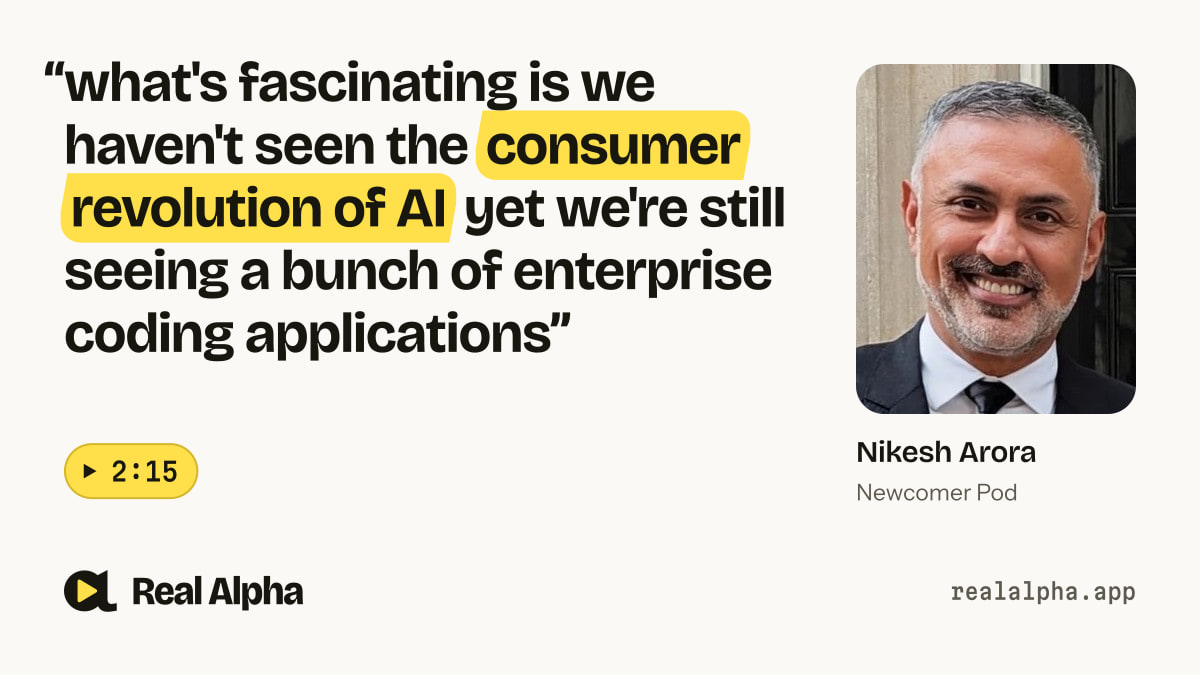
“what's fascinating is we haven't seen the consumer revolution of AI yet we're still seeing a bunch of enterprise coding applications”
 Nikesh Aroraat 2:15 · Newcomer Pod
Takeaways
- Consumer applications could drive AI’s next adoption wave.
- Arora compares AI’s potential with search’s rise in digital advertising.
- He distinguishes durable demand from fluctuating equity prices.
About this segment
Nikesh Arora argues AI’s consumer use has barely begun, comparing its potential with search’s shift into digital advertising. He separates demand for the technology from swings in AI company valuations.

Nikesh Arora is CEO of Palo Alto Networks.
Chairman and CEO of Palo Alto Networks, which he grew into a $300 billion cybersecurity leader.
- EN
Eric Newcomer, Host · Newcomer
From “Palo Alto CEO: If You Can’t Beat Them, Buy Them”, Nov 17, 2026. Watch the full episode
Answers “Is AI a bubble?” See all 99 answers
Thanks. We'll look at and fix what's off.
Transcript
Transcribed by machine (Whisper) from the episode’s audio, so a word may be off here and there.
- 0:51
Everything that's happened in AI has surpassed everyone's expectations. And I've had the pleasure of Sam coming and visiting me every few months at my house. And every time he'd come and tell me that he wants a bigger data center, and he got to a point where I saw that he's lost sight of reality. Like I said, I think we're going to have a $500 billion data center, and we're going to need all that compute.
- 1:13
I'm like, dude, this guy was 10, four months ago, then he showed up with 50, then he showed up with 100, now he was on 500, I don't know, he's delusional. But what he's done, what Dario's done, what Jensen's done is just… Wait, but was he delusional or not? We had that period. I think so. I think so. He was visionary. I think him, Dario, Jensen, all of them have had a vision around how big AI can be. And I think we're all coming to it that this thing is way bigger than we expected. I think now my belief is that demand is insatiable. You know, I have an interesting point of view. Like in 2004, I had the privilege of being at Google. And when I joined Google at point in time you know search was a consumer driven technology and there's just be 2% of advertising is to be kind of like digital now it's probably 75
- 1:58
80% and you sat there you couldn't anticipate in 20 years from now this is going to be 80% of the world's advertising revenue and every every technology you see in the last 20 years has been consumer first search was consumer first YouTube videos are consumer first Facebook you take your pick and these are built trillion dollar companies children's are also the companies what's fascinating is we haven't seen the consumer revolution of AI yet we're still seeing a bunch of enterprise coding applications I think this is gonna this is gonna be so big from a consumer perspective it's gonna upend everything we're just gonna upend what Amazon does in e-commerce gonna upend what Google doesn't search is gonna up and what happens in the social media space so all that does that mean no bubble that means we sort of keep
- 2:42
going strong for the next few years I think your your bubble is a question of trying to separate the consumer demand insatiable demand and equity prices you know equity prices go in and out of bubbles or people get over enthusiastic at some point in time then they get under enthusiastic mark is always right once in a while but every other time it's either over exaggerating things under exaggerating things so from that perspective could be in a bubble I don't know if you look ten years out and look back I think we all say these are all minor blips that we saw. Now, it is true that some companies will fundamentally vanish, and that happened in the Internet era, right? If you go back, some of you are not old enough, but if you go back to the late 90s, early 2000s, a lot of companies started the bang, some vanished. Google was the 13th search engine in the
- 3:27
world. It wasn't the first. And it's now a four or five thousand dollar company. The first 12, you don't remember the names.