The alpha, twice a week
That was 8 min.
Get the best new moments in your inbox every Wednesday and Saturday. It's free.
Check your inbox
We sent a link to your address. Click it to finish signing up. Not there in a minute? Look in spam.
or
Uncapped · 8 min · Jul 1, 2025
AI diagnosis beat physicians in a cited Stanford study
 Vinod Khosla
 cites a Stanford study where AI diagnosed complex cases more accurately than physicians, but adding AI improved doctors only slightly.
In this episode
Full analysis- 24:41Khosla backed OpenAI by following talent and progress8 min
- 39:55Experts avoid mistakes while entrepreneurs invent the futurePro pick 5 min
- 50:14Small on-demand vehicles could replace cars in cities4 min
- 54:24AI diagnosis beat physicians in a cited Stanford study8 min
- 44:30Super-hot geothermal could make power cheaper than natural gas6 min
- 1:08:55Khosla challenges founders without taking control away7 min
- 18:40China could use AI services to shape global political attitudes5 min
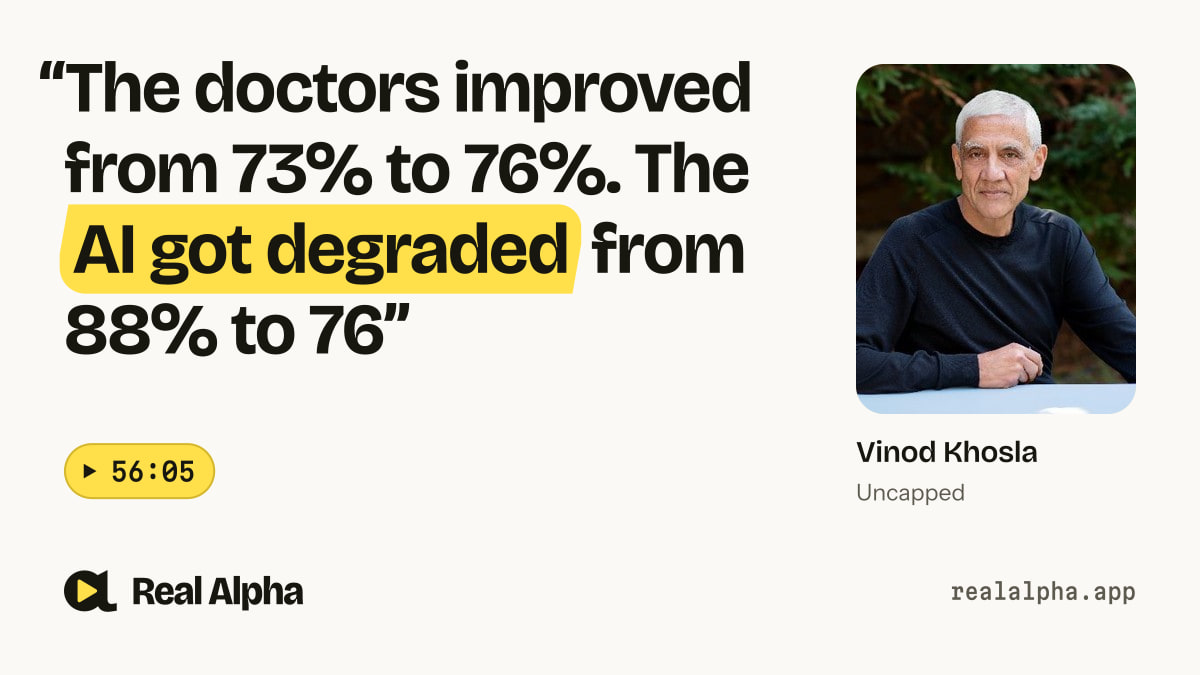
“The doctors improved from 73% to 76%. The AI got degraded from 88% to 76”
 Vinod Khoslaat 56:05 · Uncapped
Takeaways
- In the cited study, physicians scored 73% and AI scored 88%.
- With AI, physicians rose to 76%, while AI accuracy fell to 76%.
- Automated testing could shorten drug trials and support individualized therapies.
About this segment
Vinod Khosla cites a Stanford study where AI diagnosed complex cases more accurately than physicians, but adding AI improved doctors only slightly. He also predicts cheap AI care and automated testing will reshape medicine.

Vinod Khosla is an entrepreneur, investor and technologist.
Founded Khosla Ventures, co-founded Sun Microsystems and backed early investments in OpenAI, Stripe and DoorDash.

Jack Altman, Host · General partner, Benchmark
Co-founded Lattice and ran it until 2023, then started his fund, Alt Capital.
From “Vinod Khosla Predicting the Future | Ep. 15”, Jul 1, 2025. Watch the full episode
Thanks. We'll look at and fix what's off.
Transcript
Transcribed by machine (Whisper) from the episode’s audio, so a word may be off here and there.
- 54:28
So, which is a big part of our GDP, a quarter of that spend is medical expertise. Think doctors. Okay. Almost certainly that goes to zero. Can go to zero. So what are we doing? We're building AI primary care doctors, AI physical, mental health therapists, AI physical therapists, AI oncologists, AI, you name it. Actually, maybe just to get specific on what you mean about that going to zero. If we have, for every 100 doctors per capita we have today, in like 2050, do you think we have like zero or 10 or like what do you think this is?
- 55:11
I don't know the answer. But there are some? You will always have some to learn from, right? For the AI to learn from. For the AI to learn from, though the AI can boot itself to be much better. And I'll give you today's data of a multi-center study at Stanford. They took the best academic institutions and judged complex AI diagnosis. is physicians only, and these are academic learning centers with the best physicians, 73% accuracy.
- 55:49
So 27% of the patients were getting the wrong diagnosis. It's like a lot. It's like one in, yeah, it's a lot. It's wonderful. Think about it. This complex means it was a serious thing. It wasn't just the flu. AI alone, 88%. Accurate. Accurate. But then they gave the AI to the doctors. The doctors improved from 73% to 76%. The AI got degraded from 88% to 76%. That's funny. And this is a serious multicenter study.
- 56:21
I love medicine. What will happen is everybody on the planet for less than a dollar a month will get a free primary care, a free physician initially called primary care, but they'll do everything. My son's company, Cure Eye, is called Multispecialty Primary Care because the AI knows enough gastroenterology to provide that. Now, the hard problem is the American Medical Association won't let the AI write a prescription.
- 56:52
And so we have human physicians who approve the diagnosis and the prescription or testing recommendation or whatever. Yeah, I was going to say, I mean, if the humanoid at home plays out too, then it's probably also doing some amount. I mean, it's not going to do surgery, but it might be doing some amount of giving you a physical or giving you an injection or whatever else you need. Or watch your gate and say, hey.
- 57:16
Yeah, something's up. Yeah, something's up. Yeah. So that's a quarter of medicine. What about the other three quarters? A quarter is pharmaceuticals. So that we are seeing an explosion in AI in drug design. Yes. Both small molecule and... Are you pretty bullish on that? I'm very bullish on that. Do you think it will speed up the rate of drug discovery slash make it cheaper? Or do you think it's more about it will help us discover undiscoverable things?
- 57:48
Probably a little bit of both. The hard part in that is the regulatory cycle. We have a separate effort to say, could you trust test anything against lots of human genetics and lots of human organs? So we have an effort to do 10,000 tests and it could be a thousand different genetics. So people, people and 10 organs each in one week, in one untouched robot. So it just does the test, screens the drug, and looks for effects and growth and all that.
- 58:26
Maybe something like that would replace human trials. Most likely, at some point soon, it'll reduce the size and length of these trials. So I think drug discovery will see not only better molecules. The bigger problem in drug discovery is not to do what's called lead compounds for a disease, for a drug, but to increase the probability of success. The probability once you have a lead drug candied to actual FDA approval is so low, like out of 100, less than five will make it, right?
- 59:08
So it's increasing that probability because you're starting with a better candied and you're managing the process better. So that's a quarter. I do think there is diagnostics imaging. And by the way, we have the most coolest self-driving for MRI machines. So you don't need MRI machines. Now, you need today technicians to run MRI machines. But if you have a self-driver, you don't need that. Cardiac MRI is so specialized because the heart is moving that you can't staff centers with cardiac MRI technicians.
- 59:47
We turn an hour and 15 minute exam into 20 minutes, single button press. You can even do it remotely. Because, so we did the same for ultrasound. Self-driving for ultrasound machines. An ultrasound machine might cost $25,000, but a technician to do a cardiac MRI will cost you $150,000. So why care about the machine? It's the person. If you have self-driving, we had this company that GE actually acquired from us.
- 1:00:18
So all I'm saying is diagnostics and imaging is a quarter of the spend. It'll get cheaper. I'm shocked it's a quarter of the spend. I didn't realize that. Testing of all sorts. And then a quarter is in-hospital care. These are very rough numbers, but in-hospital care. And that will improve, too. So the net of all of this is like a multi-trillion dollar retrofit, I guess. Yeah. But if expertise is free and you can give somebody 10 times the amount of care, The average U.S. citizen gets one primary care visit a year, roughly.
- 1:01:04
In Australia, it's four or five times that. So we are poor anyway. If you provided way more care up front, you'd reduce disease burden downstream. Fewer people would have heart surgeries, which are super expensive, or emergency room visits because you took care of them at the beginnings of the detection of their disease. So every expensive disease, whether it's cardiac, Alzheimer's, Parkinson's, we are well on our way to discovering them 10 years before the symptoms manifest.
- 1:01:41
So I've argued a piece I did called 20% Doctor Included in 2016. I said symptom-based medicine will disappear. You don't detect disease from symptoms. You detect disease based on what's going on in the body. So that's medicine. I'm pretty excited about it. The level of precision that's possible. I think in the next five years or 10 years, biological intervention will approach computer programming in being able to precisely program things, design molecules.
- 1:02:19
So we are starting to, we have a couple of startups looking to do drugs for one patient at a time. So the whole drug only applies to one patient for one genetic anomaly.