The alpha, twice a week
That was 7 min.
Get the best new moments in your inbox every Wednesday and Saturday. It's free.
Check your inbox
We sent a link to your address. Click it to finish signing up. Not there in a minute? Look in spam.
or
Uncapped · 7 min · Jul 1, 2025
Khosla challenges founders without taking control away
 Vinod Khosla
 argues that strong founders benefit from a debating partner, not a decision-making VC.
In this episode
Full analysis- 24:41Khosla backed OpenAI by following talent and progress8 min
- 39:55Experts avoid mistakes while entrepreneurs invent the futurePro pick 5 min
- 50:14Small on-demand vehicles could replace cars in cities4 min
- 54:24AI diagnosis beat physicians in a cited Stanford study8 min
- 44:30Super-hot geothermal could make power cheaper than natural gas6 min
- 1:08:55Khosla challenges founders without taking control away7 min
- 18:40China could use AI services to shape global political attitudes5 min
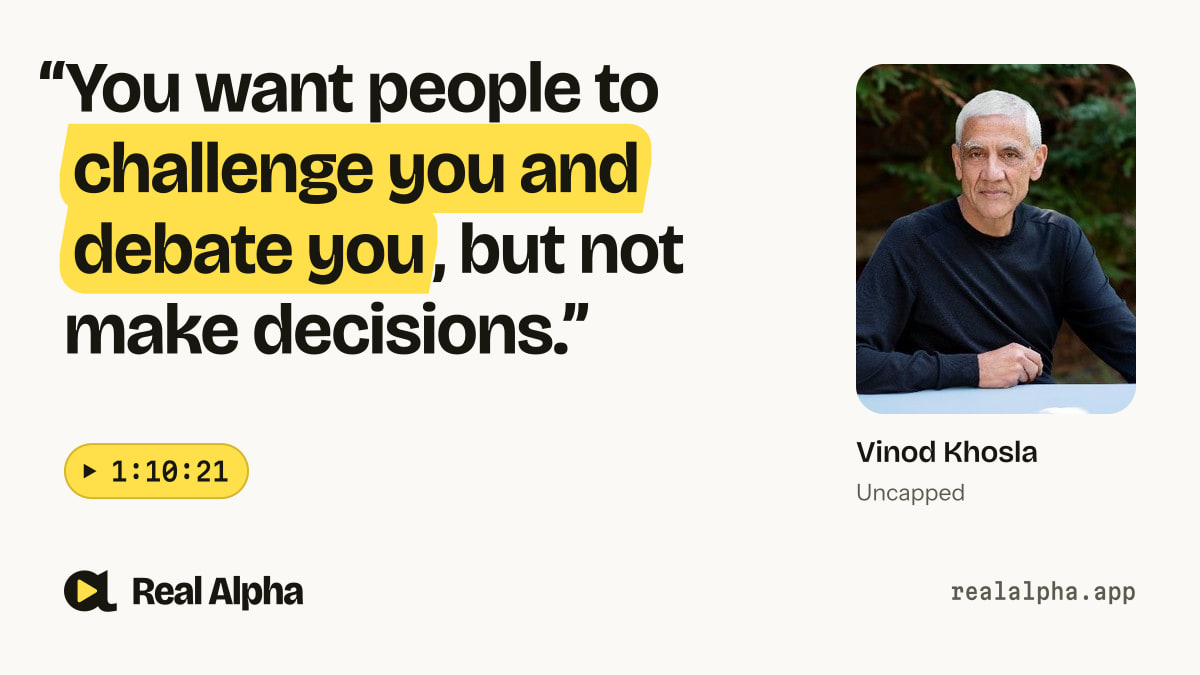
“You want people to challenge you and debate you, but not make decisions.”
 Vinod Khoslaat 1:10:21 · Uncapped
Takeaways
- Strong founders can use challenge without giving up decision authority.
- He says final calls should stay with the management team.
- Hourly operator rental turns automation into a clearer customer offer.
About this segment
Vinod Khosla argues that strong founders benefit from a debating partner, not a decision-making VC. A machinery startup's pitch shifted from selling automation to renting operators by the hour.

Vinod Khosla is an entrepreneur, investor and technologist.
Founded Khosla Ventures, co-founded Sun Microsystems and backed early investments in OpenAI, Stripe and DoorDash.

Jack Altman, Host · General partner, Benchmark
Co-founded Lattice and ran it until 2023, then started his fund, Alt Capital.
From “Vinod Khosla Predicting the Future | Ep. 15”, Jul 1, 2025. Watch the full episode
Thanks. We'll look at and fix what's off.
Transcript
Transcribed by machine (Whisper) from the episode’s audio, so a word may be off here and there.
- 1:08:59
Where I will disagree is they can do even better if they have a debating partner. So my view is very simple. I almost never worked at a board. So I don't even go to boards now. You won't show up to a board, do you mean? I don't get on boards. Yeah, I see. And Square is a great example. I got off the board the week before the IPO. And everybody was like, hey, this is sexy IPO. Why are you getting off the board?
- 1:09:32
I don't like the burden of- The governance. The governance and all that. My responsibility shifted from having Jack do better to governance for the public markets. It's not very fun. It sounds glamorous, but it's not. You know, Jack and I would do regular monthly dinners, and I'd always challenge him and always push him. And he loved that, so he took the time to do these dinners. You talk to Max Lefgen at a firm.
- 1:10:06
It's a public company. We long ago distributed stock. I still do quarterly meetings and challenge him for an hour every quarter, right? Even the strongest founders like Jack and Max need this. It's like even a pro sports player has a coach. Yes. You want people to challenge you and debate you, but not make decisions. I find it silly that boards want to take a vote. I won't even take a vote on the acquisition.
- 1:10:39
I'll just say I'll support whatever management wants to do, even if I disagree strongly. But I do want to have the opportunity to debate it with the management team. So Jigdeep Singh is a founder, one of our robotics companies. I've done six companies with him. There was a company, I'm forgetting the name, called Light Something Optical Company. The team wanted to sell. I only asked, they give me two hours with the whole team to make, and I did over the weekend, And the presentation I gave to them on why they should not sell.
- 1:11:16
But before that presentation, as long as I had the two hours, I signed the papers and said, you have my vote anyway. You can choose to use it or tear it up. I love that. Yeah. So I will always give the final say to the management team. Yeah. But I do want to debate it. And I think every strong founder loves feedback that challenges them. Yes. And it's the only thing really valuable to a strong founder.
- 1:11:47
Great founders love that. Not so great founders are so uncertain of themselves, they don't like that. And there, I prefer to teach them how to be a great founder. But almost every strong founder loves feedback. I had Keith on this podcast and what you're describing is a big part of, I think, what drew him back to Khosla. Yeah. By the way, on that topic, I'm curious, I read that as one of the sort of like generationally great sort of recruiting or re-recruiting moves that has happened.
- 1:12:25
And I think he's an amazing investor, obviously. Did you know for a while that you wanted that to happen? We're a different kind of firm. And I said earlier, I've not called myself an investor ever, right? I always say I'm a venture assistant. If you look at our website, since we started the firm in 2004, the first tagline is venture assistance. By the way, another phrase that has stayed on our website since 2004 is, I prefer brutal a brutal honesty to hypocritical politeness.
- 1:12:58
In vain most VCs give polite feedback to an entrepreneur, they're doing a disservice. They're basically saying, you're doing great. Don't examine anything. You know, makes you feel good as an entrepreneur, but doesn't help you build a better company. And the only things that make you feel better are things that change your thinking or challenge your thinking. So it's an important characteristic for founders to keep in mind.
- 1:13:23
And what are they looking for? The best help or just people who will go, why? So it's a style that's different. We don't think of investments. We've never calculated, never means, not in the last 10 years, I can't think of a single instance where we calculated an IRR, not one. An investment firm that never calculates IRRs because we want to build something significant and then the economics will work out.
- 1:13:55
So that's our approach. But we do want to increase the probability of success of the founder. And we want to increase the magnitude of the potential success also by thinking about should you do X or Y. Founders underestimate that. So let's say a founder is selling 10% of a company, 10 million at 100 million post the founders forget they're keeping 90 percent and what happens to the price per share of that 90 percent whether they give up 10 percent or 12 percent keep 90 or 88 trivial compared to the 500 percent swing you can get by taking one path or a different path that's where the opportunity for maximization is.
- 1:14:49
That's where it's not about investing, but getting the best help building a company. And that's what I sort of spend all my time doing. Just yesterday, I was talking to this founder. It's a very cool company, self-driving for these heavy machines, bulldozers and loaders. That's cool. Right? And we had an interesting session And I reframed his business from automating big Caterpillar machines to, I'll just rent you the driver.
- 1:15:23
You have trouble staffing drivers. Most of these are in mines and remote places. Equipment, a multimillion dollar piece of equipment sits idle because you don't have an operator. I said, just do rental by the hour and guarantee you will always have a driver available. Always have a job. This reframing, Antoinette was pretty excited about. It's the same thing, but it's not. It's a much easier sell.
- 1:15:54
It's not saying change your equipment. It's saying, hey, you can't keep your... equipment running all the time because you don't have operators. I'll run it for you. You're paying operators. I'll do it better, faster, more hours. You get more of your equipment. It's a simple framing change, but you could have a similar technology discussion too. I know you're going to have to go in a minute. So I just want to ask you,