The alpha, twice a week
That was 5 min.
Get the best new moments in your inbox every Wednesday and Saturday. It's free.
Check your inbox
We sent a link to your address. Click it to finish signing up. Not there in a minute? Look in spam.
or
The Logan Bartlett Show · 5 min · Mar 28, 2025
AI-generated software does not remove customer responsibility
Aaron Levie says Klarna’s software experiments don’t mean most companies will replace core systems.
The episode’s best minutes
Full analysis- 13:09AI agents can expand software into service budgets4 min
- 26:56Enterprise AI demand is unlike early cloud adoption4 min
- 38:45AI-generated software does not remove customer responsibility5 min
- 5 more moments in the full episode
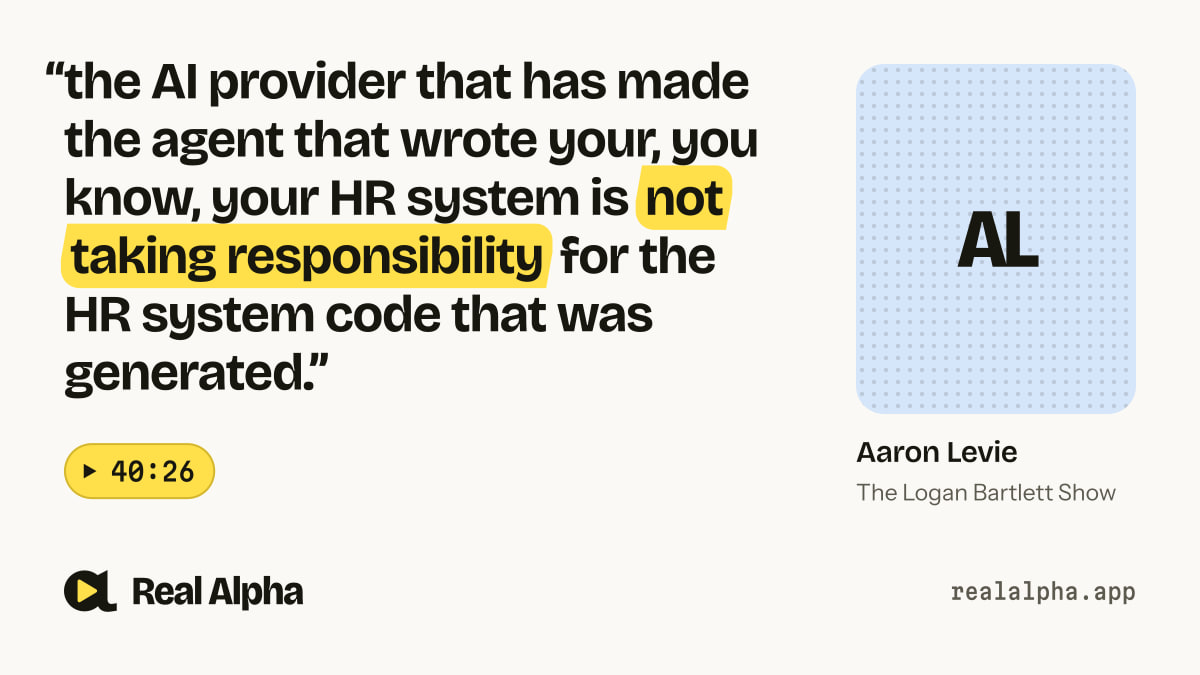
“the AI provider that has made the agent that wrote your, you know, your HR system is not taking responsibility for the HR system code that was generated.”
Takeaways
- Most companies don’t want to run their own HR or CRM systems.
- AI vendors don’t take responsibility for customer-built software.
- Agents may fit temporary, unstrategic tools better than core systems.
About this segment
Aaron Levie says Klarna’s software experiments don’t mean most companies will replace core systems. Customers still own the risks and accountability for software they build with agents.
Aaron Levie is cofounder and CEO of Box.

Logan Bartlett, Host · Managing director, Redpoint Ventures
Backs enterprise software companies like Ramp, Cribl, Cyera and Legora.
From “Box CEO on Enterprise AI Trends No One is Talking About Yet”, Mar 28, 2025. Watch the full episode
Answers “Is SaaS dead?” See all 36 answers
Answers “Are AI agents ready for real work?” See all 104 answers
Answers “Is vibe coding the future?” See all 8 answers
Thanks. We'll look at and fix what's off.
Transcript
Transcribed by machine (Whisper) from the episode’s audio, so a word may be off here and there.
- 38:57
Yeah, I mean, I found it very fascinating and I enjoyed that it was happening. And I mean, I enjoy that it's still theoretically happening. I think some of his updates were that, like, they didn't actually do as much on the customer support side or they have some more, you know, kind of premium agent, you know, human agents that they now have. But but so I thought it was great from a provocativeness standpoint.
- 39:20
I think we do need people testing the boundaries. um um i think it's the kind of thing which is it didn't cause me to rethink all of sass because because the the you know uh uh i don't remember the first time i heard this but maybe maybe it was like 15 years ago or something i was uh i was meeting with um an it you know leader at tesla and and they were like building i'm gonna make up 80 of the story but they were building their own ERP system. And I was like, holy crap, I cannot believe that you're doing this. And maybe this is the future. And then you quickly wake up that like, okay, no, this is sort of an Elon special where he needed to control end to end the whole thing. And they needed their own, they didn't want any of the off the shelf stuff. And the amount of fortitude and just sheer
- 40:14
entrepreneurialness you need to have to even want to attempt that is like kind of insane. And so I think the Clarn example is more in that category. Like it's just like if you go to the average company and you're like, do you want to be responsible for running your own HR system? Like the average enterprise. is not going to say yes to that. And no matter how agentic, you know, something is, it does mean that you're responsible for the thing. Like, like this, the AI provider that has made the agent that wrote your, you know, your HR system is not taking responsibility for the HR system code that was generated. So that means by definition, you, the customer are now responsible for whatever the thing is that it produced. It's not going to be the AI models. You know, Claude is not, Anthropic is not taking any responsibility for how your HR system works. And if it leaks data, and you get
- 41:04
sued by the EU, because there's some kind of, you know, data privacy thing, like, that's not Claude. Like, that's Workday. Workday will do that, not, not Anthropic. So I think you'd have to be like, you know, which parts of software are people so unhappy about that they would do themselves? Or which parts of software just like are so needed to be customized? Or which parts software are so unstrategic that you don't mind whipping up these like micro apps for like one off things. And so so you don't you're fine that it is built by this, you know, an agent that you can just deploy quickly and turn it off. And it's kind of, you know, it's a three month, you know, it needs to live in the world for only three months, those for the foreseeable future next two years, let's say, that would be the only thing I think could be disrupted. But I don't
- 41:49
think your HR system is going away. I don't think your CRM system is going away. I don't think that really changes. To your point about deflationary impact, I do think that there's a chance that you could see, you know, you could see a new crop of like, I'm going to just like, like YOLO it and build like the AI, you know, like, I'm going to build Oracle with AI agents and just like give it a shot. But that would still be a software company that emerges from that. And you're really using AI purely to just, you know, add engineering augmentation.
- 42:22
I don't think the customer wants to be responsible for that software at the end of the day. That was my conclusion as well, which I think is good for people investing in software companies. Yeah. Now, big asterisk, like in 10 years, do I want to be on the record as saying this? Let's see. But like, but like, just I just don't think companies want to be responsible for every problem in the world. Like you want like the Jeffrey Moore came up with this idea.
- 42:50
I think it was Jeffrey Moore that came up with it, but, but maybe he credited somebody else of core versus context. And, and like context is just like shit that like, like you just want done for you. You don't want, you don't want to worry about it. Core obviously being like, this is like existential to my business. And for most people, like, like their core business is not their HR system. And so thus you hire other people to do your HR system. And so that's why you don't really want, you know, you don't, you don't want your internal IT team being responsible for rebuilding something that you can get off the shelf, then just it's done for you.
- 43:21
That's the way I feel whenever technical founders want to reinvent sales comp. And it's just like, you're not, it's hard enough to differentiate on one vector.