The alpha, twice a week
That was 4 min.
Get the best new moments in your inbox every Wednesday and Saturday. It's free.
Check your inbox
We sent a link to your address. Click it to finish signing up. Not there in a minute? Look in spam.
or
The Logan Bartlett Show · 4 min · Mar 28, 2025
Enterprise AI demand is unlike early cloud adoption
Aaron Levie contrasts cloud’s years of resistance with customers now treating AI as inevitable.
The episode’s best minutes
Full analysis- 13:09AI agents can expand software into service budgets4 min
- 26:56Enterprise AI demand is unlike early cloud adoption4 min
- 38:45AI-generated software does not remove customer responsibility5 min
- 5 more moments in the full episode
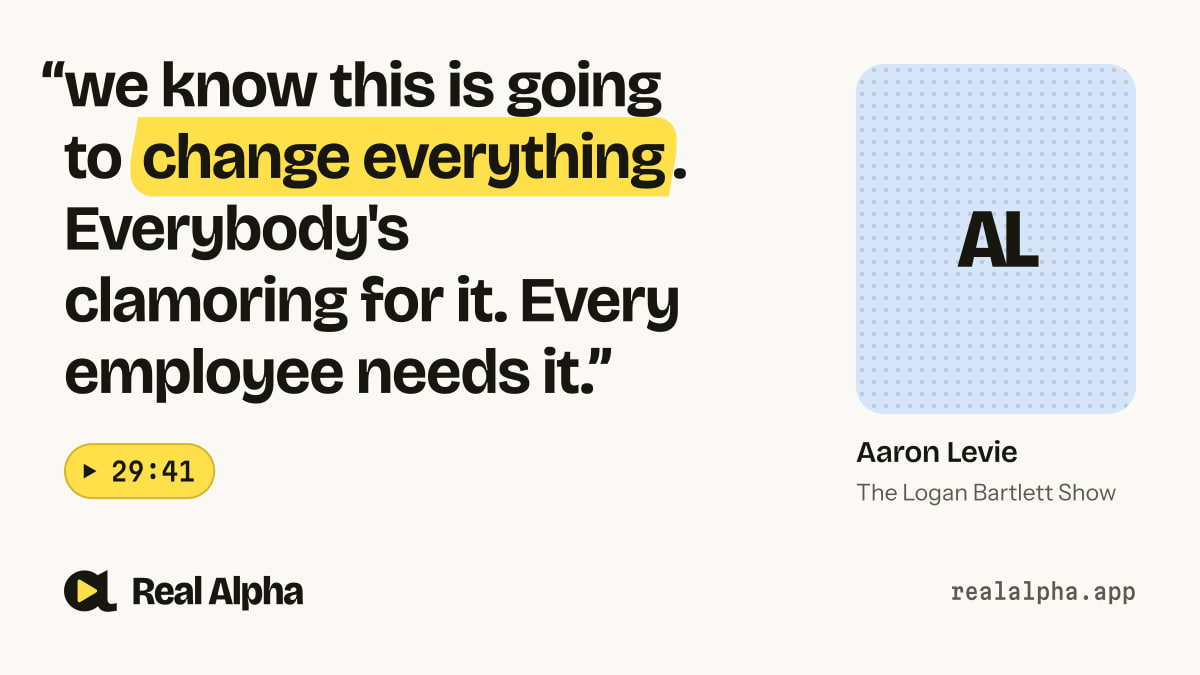
“we know this is going to change everything. Everybody's clamoring for it. Every employee needs it.”
Takeaways
- Early cloud meetings often met outright resistance.
- Enterprise customers now see AI as inevitable and urgent.
- Adoption still requires change management, governance and human oversight.
About this segment
Aaron Levie contrasts cloud’s years of resistance with customers now treating AI as inevitable. The main challenge has shifted from persuading them to working out implementation.
Aaron Levie is cofounder and CEO of Box.

Logan Bartlett, Host · Managing director, Redpoint Ventures
Backs enterprise software companies like Ramp, Cribl, Cyera and Legora.
From “Box CEO on Enterprise AI Trends No One is Talking About Yet”, Mar 28, 2025. Watch the full episode
Thanks. We'll look at and fix what's off.
Transcript
Transcribed by machine (Whisper) from the episode’s audio, so a word may be off here and there.
- 27:08
yeah so uh if i recall the anecdote properly it was i think i was just referencing that like in the peak of cloud adoption i i did this keynote on like the future of of you know running your bank or you know financial services and and it was it was mostly just the pitch cloud and and it was you know the the the i i find it very exciting uh but the audience didn't because it was because it was just like yep cool we get it man like the servers are not in our data center anymore they're in now a cloud data center like really like super cool and um uh and and so so that that that to me was kind of the it kind of captured the cloud transition you know at an industry level in a nutshell which was like it was it made your it made your it operations faster it meant you could store more data so you can make better decisions. It makes your employees more efficient because
- 28:05
they have better software, but it didn't radically transform like entire industries or sectors. And AI, you know, conversely has the opportunity to actually radically, you know, transform how you run your business, how you make decisions, you know, how you, you know, serve your customers, how you build products. And, you know, I think it's, I think it's always useful to learn, you know, figure out like what things will be similar to a prior technical.
- 28:30
technology transition, which things will be different. I think the thing that will be similar is that adopting AI versus cloud will take all the same change management. It'll take all the same meetings. It'll take all of the same privacy and policy and governance and compliance review people. It's going to be all of that. But I do notice and see one big distinction in the two waves, having kind of been at the similar timeframes for both, in the very early days of cloud, you would go into a meeting with a bank, a pharma, a government agency, and you'd say, you know, I'd love to talk to you about, you know, moving your data to the cloud.
- 29:10
And it was sort of like, like, not interested, shock, like, definitely not going to happen, not going to happen here. Maybe, maybe there'll be some small little workload that's like a dev test workload. Maybe some department or fringe group will use it. And so it was mostly like years and years of just like selling and selling and selling and trying to get you to understand what was so much better and all of this.
- 29:36
Conversely, and so we're only about two and a half years into Chachapiti, let's say. So that would easily describe two and a half years into cloud if I go back to the late 2000s, let's say. If I look at AI right now, that exact same meeting with a customer or set of peer customers is like, is like, we know this is going to change everything. Everybody's clamoring for it. Every employee needs it. The new generation coming into the workforce is asking for it. My boss is asking for it. The board is asking for it. I need to figure out a strategy. And, and like, it's not when it's, it's how, um, it's not, sorry, it's not if it's, it's when it's how it's like, what do we, what can we do? I need to do more yesterday. And so totally different universes. Um, and, And it is, so basically what that means is that you've bypassed all of the normal, like, resistance to this happening that normally, you know, happens with one of these big changes.
- 30:33
And now it's purely in the mode of, like, how do we make it happen? Which functions are going to use it? What is the impact to, you know, how do we make decisions when an AI generated the response? How much human in the loop do we need? So we've jumped all into just now that mode. five to seven years faster than we did with cloud. Now, that doesn't mean that the adoption will follow a different trajectory because again, it's really people, it's change management, it's systems, but the reluctance and emotional kind of consternation is very different this time.