The alpha, twice a week
That was 6 min.
Get the best new moments in your inbox every Wednesday and Saturday. It's free.
Check your inbox
We sent a link to your address. Click it to finish signing up. Not there in a minute? Look in spam.
or
Silicon Valley Girl · 6 min · Oct 13, 2026
AI is already supporting cancer detection and flood warnings
 James Manyika
 cites a UK breast cancer study involving over 180,000 women, tuberculosis diagnosis pilots, and flood forecasts reaching 150 countries.
In this episode
Full analysis- 0:45AI is changing jobs faster than it is eliminating them8 min
- 11:43AI productivity does not guarantee higher wages3 min
- 27:27AI is already supporting cancer detection and flood warnings6 min
- 44:18Safety work needs to keep pace with AI capabilities3 min
- 47:57AI risks include connected systems and unequal access4 min
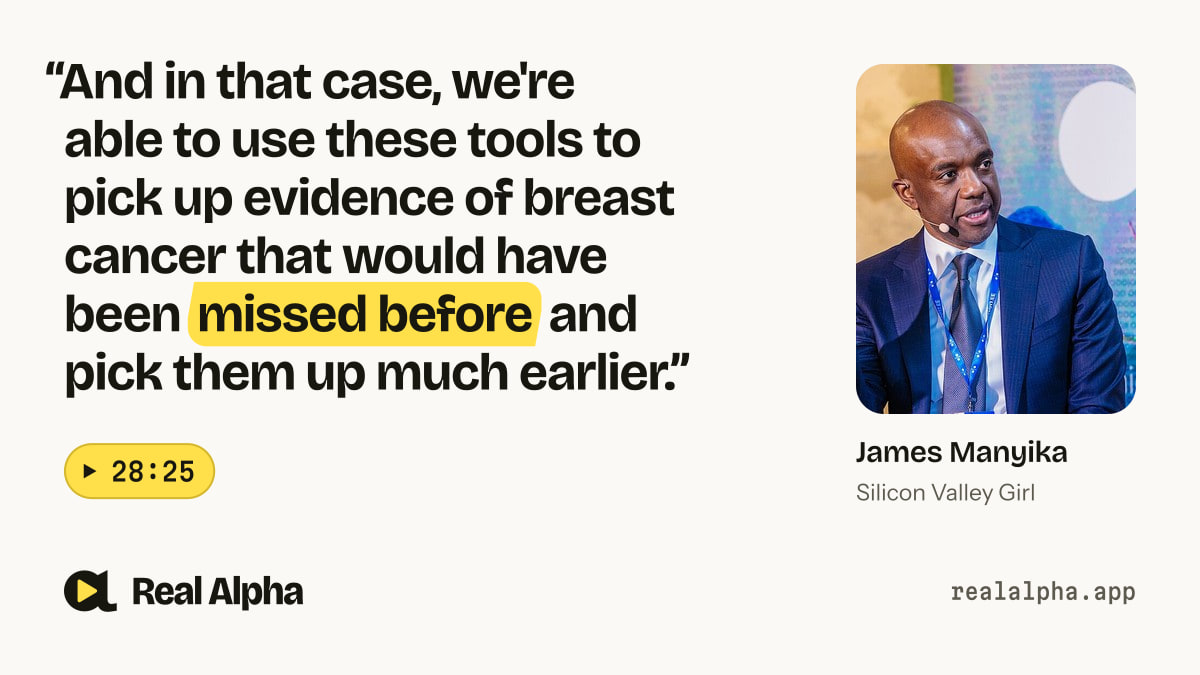
“And in that case, we're able to use these tools to pick up evidence of breast cancer that would have been missed before and pick them up much earlier.”
 James Manyikaat 28:25 · Silicon Valley Girl
Takeaways
- A UK study with over 180,000 women tested AI for breast cancer detection.
- TB diagnosis tools were tested in Zambia and India.
- Flood forecasts expanded to over 150 countries and 2 billion people.
About this segment
James Manyika cites a UK breast cancer study involving over 180,000 women, tuberculosis diagnosis pilots, and flood forecasts reaching 150 countries. These examples show AI's effects are already reaching patients and communities.

James Manyika is a Senior Vice President of Research, Labs, Technology, and Society at Google.
Leads Google and Alphabet’s efforts to responsibly shape ambitious innovations for the benefit of people and society.

Marina Mogilko, Host · Host, Silicon Valley Girl
Co-founded LinguaTrip and built Linguamarina, an English-learning YouTube channel with almost 9M subscribers.
From “Top Google Exec: AI Moves Fast, Jobs Move Slow. Use the Gap”, Oct 13, 2026. Watch the full episode
Thanks. We'll look at and fix what's off.
Transcript
Transcribed by machine (Whisper) from the episode’s audio, so a word may be off here and there.
- 27:39
So subscribe using the link in the description and you'll get the 30-day plan for free. When do you think we're going to see a scientific breakthrough that's going to affect everybody's lives? Because for now, there are some amazing breakthroughs when we're treating very rare diseases in babies who were just born, right? Right. But there hasn't been a massive effect on the population where we're like, oh my God, this is thanks to AI.
- 27:59
I think we're starting to see that. Now, the question is that people think of it as, oh, thanks to AI. So I'll give an example. In healthcare, for example, in health, we're now able to do so many diagnostics that we couldn't have done before. Either faster, earlier, and see and pick up diseases or evidence of illnesses that we couldn't have done before. Can you give an example? Yeah, so we just published early this year one of the largest studies ever done on breast cancer detection.
- 28:30
We did this with the NHS in the UK. I think it involved over 180,000 women. We're part of the year-long study. And in that case, we're able to use these tools to pick up evidence of breast cancer that would have been missed before and pick them up much earlier. By looking at the mammography results. Yeah, and using AI tools to observe those and evaluate those. We've done the same thing in the choral rectal cancer, in lung cancer, and also in tuberculosis.
- 28:58
I mean, tuberculosis is interesting because something like 30 to 40% of the people in the world, we have TB, go undiagnosed. And that's mostly because they live in communities where the infrastructure just isn't there to diagnose them. And so being able to use these tools in those places, we did a study that involved, we studied in Zambia and India. And we're able to show that, no, you can actually make accurate diagnosis for tuberculosis in those places.
- 29:26
Now, in all of these examples, will those people say thanks to AI? They'll just think, oh, I got a great diagnosis and they discovered I have this disease. So a lot of those effects are going to be a little indirect. It's the same thing with another area we're spending a lot of time on is trying to help communities be resilient. Imagine if people would not get surprised from natural events and natural disasters.
- 29:51
So we've been working down a list from floods to monsoons and cyclones and weather and even earthquakes. One of my favorite examples, just because it's at scale now, is in floods. So there's two kinds of floods you want to worry about in most cases, which are riverine floods and flash floods. And in those cases, it's always been known that if you could make a prediction six plus days in advance, the impact on people would be dramatically halved just because people can move out of the way and so forth.
- 30:28
And starting three years ago, we did a first experiment using our AI tools in India and it worked. And now we've expanded that to over 150 countries where more than in places where more than 2 billion people live. but again in those cases I think what those people will experience is they'll probably get an alert on their phone to get out of the way, there's a flood coming So not necessarily bridging it back to AI Yeah, but the connection back to AI may not be as direct I'll give another example recently in the Venezuela earthquake we've been experimenting with the idea of using Android systems with AI sensors but also AI systems to make predictions and in that case I think this was reported in the New York Times as well, we're able to send alerts to about 12 million people ahead of time.
- 31:18
In some cases, a few seconds, in some cases, a couple of minutes ahead of time. So we've been working our way down everything from wildfire predictions to monsoons, to cyclones, to hurricanes, where the next one of our models was actually used in Melissa in Jamaica. And we're able to send alerts. So those are examples where the ability to make these predictions are extraordinary. And the impact of people, this is not in the far future, it's right now.
- 31:50
What about the medical examples that you talked about? Are they available in the US as well? Are we using this technology in the US? So we're starting to. So for example, one of our tools called AMI, which is an assistive tool that we've tested with a variety of hospitals and clinics, Beth Deaconess Israel at Harvard and other places. We're now involved in a nationwide trial. It's an assistive tool for doctors.
- 32:14
Another AI-based tool we've developed for detecting what's called diabetic retinopathy, where you can look at the eye as a way to predict all kinds of diseases. We've actually applied that in more than 600,000 cases in India. And now we're working with a partner with a goal to scale that up to being able to do 6 million assessments. The tuberculosis example that I mentioned, now that we've demonstrated that it works with a year-long study, we now work with various providers in Africa and other places to actually start to deploy that and use that.
- 32:48
So a lot of these things are here and scaling. That's why these are such important examples. But often the attribution of those things to AI is often indirect or at least a step removed from the people who are experiencing those things. But there's still so much more to do, by the way. Don't get me wrong. But I think I worry that when we think about the AI, AI's contributions to science and health and all these areas, it's always positioned as in the far future.
- 33:15
Someday we will do X. And I say, no, no, no, no, no. We're already. We're starting to do that today. Of course, there's a lot more we will be able to do in the future. But don't, this isn't some future promise.