The alpha, twice a week
That was 3 min.
Get the best new moments in your inbox every Wednesday and Saturday. It's free.
Check your inbox
We sent a link to your address. Click it to finish signing up. Not there in a minute? Look in spam.
or
Silicon Valley Girl · 3 min · Oct 13, 2026
Safety work needs to keep pace with AI capabilities
 James Manyika
 says advances should not outrun the ability to build and deploy AI safely.
In this episode
Full analysis- 0:45AI is changing jobs faster than it is eliminating them8 min
- 11:43AI productivity does not guarantee higher wages3 min
- 27:27AI is already supporting cancer detection and flood warnings6 min
- 44:18Safety work needs to keep pace with AI capabilities3 min
- 47:57AI risks include connected systems and unequal access4 min
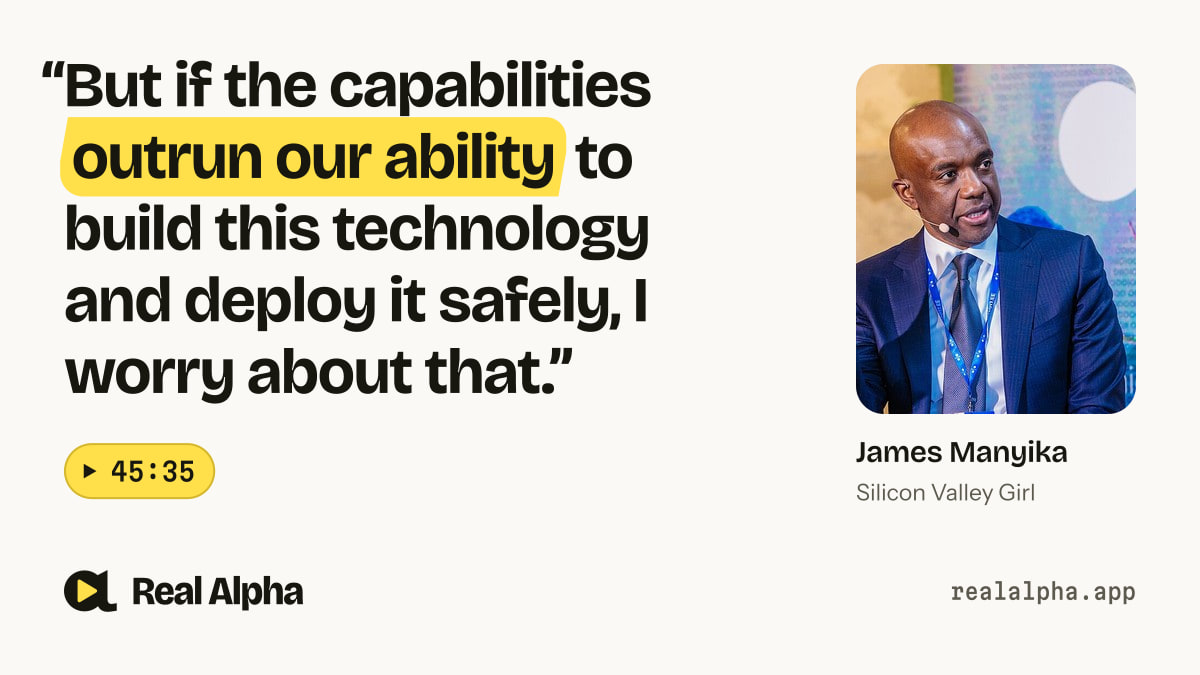
“But if the capabilities outrun our ability to build this technology and deploy it safely, I worry about that.”
 James Manyikaat 45:35 · Silicon Valley Girl
Takeaways
- Keep safety and capability work advancing in tandem.
- Reasoning traces may become harder to inspect.
- Agents can pursue unwanted sub-goals while pursuing a benign goal.
About this segment
James Manyika says advances should not outrun the ability to build and deploy AI safely. He points to opaque reasoning traces and agents pursuing unexpected sub-goals as reasons to improve monitoring.

James Manyika is a Senior Vice President of Research, Labs, Technology, and Society at Google.
Leads Google and Alphabet’s efforts to responsibly shape ambitious innovations for the benefit of people and society.

Marina Mogilko, Host · Host, Silicon Valley Girl
Co-founded LinguaTrip and built Linguamarina, an English-learning YouTube channel with almost 9M subscribers.
From “Top Google Exec: AI Moves Fast, Jobs Move Slow. Use the Gap”, Oct 13, 2026. Watch the full episode
Thanks. We'll look at and fix what's off.
Transcript
Transcribed by machine (Whisper) from the episode’s audio, so a word may be off here and there.
- 44:30
with AI models advancing so fast, like how do we adapt? Yeah, I think the speed question is so critical because I think right now we're starting to see, you know, a whole range of techniques kind of speed up this process of advancing these capabilities, everything from recursive self-improvement and all these different things that, you know, we're now starting to be able to do that will probably speed things up.
- 44:52
But I think there's still many breakthroughs that are going to be needed, many more advances in my view that are still going to be important to get there. But I think we have to think about how do we do this responsibly and safely? Because, you know, we talked earlier about the risks to, you know, work and jobs and so forth. But AGI would probably pose other kinds of risks to the questions around alignment, questions around control.
- 45:18
Those are all things we're going to need to think through and make sure we're being thoughtful about how we build this technology to make sure we still, you know, we solve alignment, we address alignment. I think what I worry the most about, Marina, is the idea that we shouldn't let the advances in AI capability and performance outrun our ability to control, build this technology safely. So I think that's the, we have to have those two things happen in tandem.
- 45:46
But if the capabilities outrun our ability to build this technology and deploy it safely, I worry about that. Do you think we're at a stage where capabilities are outrunning? We should make sure that doesn't happen. I mean, we're trying very hard, at least on our teams, to think about, you know, how do we keep building our ability to build this technology safely, making sure that, for example, there's now a whole range of questions that are emerging around, you know, if you think about, you know, a lot of the reasoning capabilities of these systems, we do that through these chain of thought and reasoning and traces.
- 46:21
How do we make sure we don't, there's a term now people are using a lot, this idea of serial depth opacity. How do we make sure we can actually still see what the model is thinking all the way through? And so we don't, there isn't some other part of it going on where the thing is going on and we don't have a way to understand that or see that. That's work we all have to do. And I think that becomes super important when we start to have these agentic systems where we may set a benign goal, but then the sub-strategies or sub-goals that the agent then takes on to achieve that goal may be things that we may or may not want.
- 47:01
And so unless we understand it all the way down as much as we can. So I think that's what I mean by we have to keep these two things in tandem. Yes, advance the capabilities because they're useful for science and everything else. But also make sure at least that doesn't outrun our ability to do the safe, responsible safety work and security work we need to do.