The alpha, twice a week
That was 4 min.
Get the best new moments in your inbox every Wednesday and Saturday. It's free.
Check your inbox
We sent a link to your address. Click it to finish signing up. Not there in a minute? Look in spam.
or
Sourcery · 4 min · Nov 13, 2026
AI is making industrial automation easier to deploy
 Christian Garrett
Using Applied Intuition and General Matter, Christian Garrett describes technology reaching vehicle electronics, factory controls and uranium enrichment.
In this episode
Full analysis- 1:18SpaceX is building a durable hyperscaler businessPro pick 4 min
- 28:14Dual-use conglomerates can build resilient defense capacity5 min
- 33:14Europe’s defense suppliers need scale and modernization6 min
- 8:25Starship can unlock businesses by lowering launch costs4 min
- 16:07137 backs AI companies with positions above the models3 min
- 22:47Power-law returns can justify premium prices for leaders5 min
- 42:31Co-founding Onodrim changed how Garrett helps founders7 min
- 49:11AI is making industrial automation easier to deploy4 min
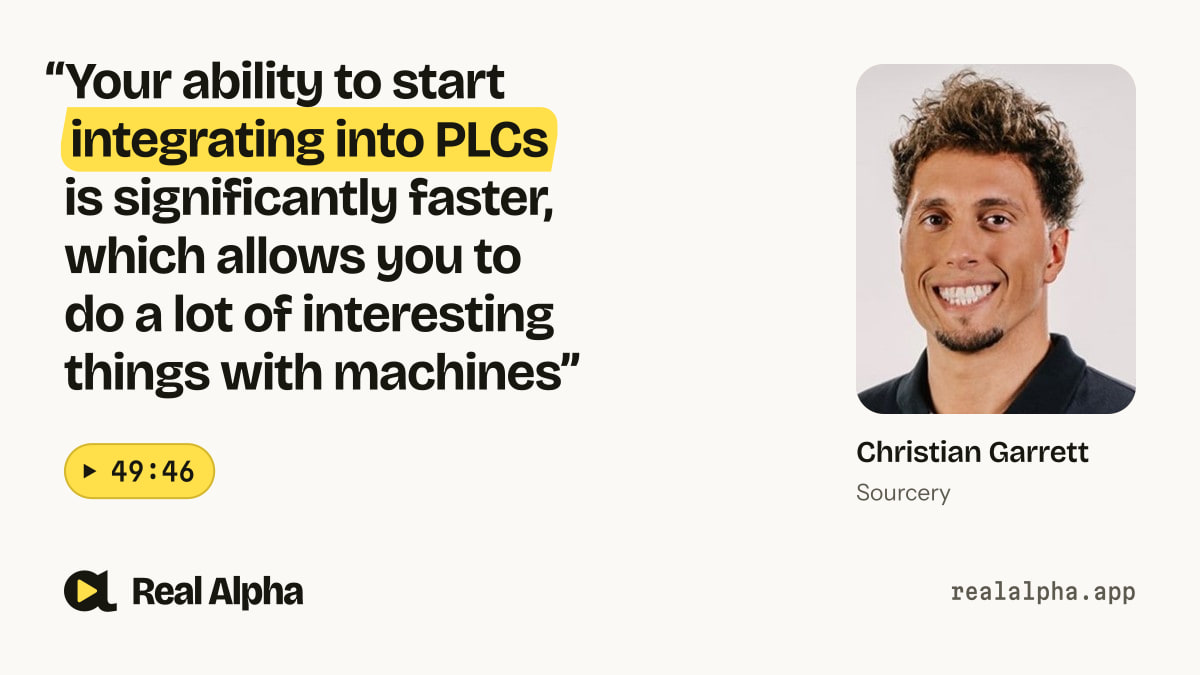
“Your ability to start integrating into PLCs is significantly faster, which allows you to do a lot of interesting things with machines”
 Christian Garrettat 49:46 · Sourcery
Takeaways
- AI can make PLC integration faster.
- Applied Intuition works on vehicle electronics as well as software.
- Sensors and modern tooling can update legacy industrial processes.
About this segment
Using Applied Intuition and General Matter, Christian Garrett describes technology reaching vehicle electronics, factory controls and uranium enrichment. Faster integration can improve industrial operations and cost structures.

Christian Garrett is a Partner at 137 Ventures and co-founder of Onodrim Industries.
Backed SpaceX for 16 years at 137 Ventures and co-founded Onodrim, a European defense and industrial platform.

Molly O'Shea, Host · Founder, Sourcery
Ex-Upfront Ventures investor; has interviewed Alex Karp and Palmer Luckey.
From “SpaceX, Palantir, Anduril & Onodrim | The Return of Conglomerates”, Nov 13, 2026. Watch the full episode
Thanks. We'll look at and fix what's off.
Transcript
Transcribed by machine (Whisper) from the episode’s audio, so a word may be off here and there.
- 49:17
also impacted my thesis on other areas, right? It's made me more excited about things that are being built here. Like I mentioned, Amca and Ballinor, really exciting companies. It's made me more excited about deploying technology in industrial manufacturing. You know, we've been close to it from, obviously, Palantir really pioneered this, deploying software into legacy manufacturing from shampoos to planes. But also companies like Hadrian and others, right, that started to adopt these things. And you just, you learn, you're like, man, there's low-hanging fruit, like automating paperwork. But then there's real incredible things that you can start to do now, particularly AI is improving. Your ability to start integrating into PLCs is significantly faster, which allows you to do a lot of interesting things with machines, go down the list of stuff.
- 49:59
And so it's made me a lot more bullish on how technology can be used in manufacturing and industrials. And I can go down a list of other things too, as well. That's kind of, I think, helped some of the conversations we have as investors now at 1-3-7. Yeah, I know we didn't get to talk about them, but applied intuition is also an incredible example of this. Yeah, 100%. They're a company that we've been investing in and really excited about, and that's solving hard problems and deploying technology into a legacy, but one of the most massive industries in the world, right? The automotive industry, but they've expanded across industries and kind of all things. Robots on wheels and vehicles, right? Across the OEMs.
- 50:34
Construction, mining, trucking. That's a business as well that, you know, actually we were just there at the offices the other day, and it's incredible to see a company that is, you know, not just deploying software and selling software to maybe engineers across these companies, particularly the automotive sector, but they're also, you know, touching the electronics of these vehicles, right, and simplifying all the processing units, right, and all the controllers and the wiring and, like, improve the cost structure of these vehicles, right, and then that allows you to then actually use technology more in the vehicles, right, and have a better experience for the from maintenance, right, or whether from your in-cabin experience or obviously deploying autonomy. And so it's been pretty incredible to see people not just take maybe the operating
- 51:18
playbook of venture, but also particularly fine technology in hard industries. And it continues to surprise me, you know, the limit of that. You know, you think the automotive industry is one, that's been successful. But, you know, if you look at General Matter, which is another company we're really excited about and have been investing in. And I mentioned, you know, Scott's actually the first person I met in venture a long time ago.
- 51:37
That company, I can go on for a bit, but similar thing, like they're once again, sort of re, they're bringing back an important critical capacity and re-enrichment, but they're also reinventing the playbook for how to do it, right? And applying technology in minor ways you wouldn't expect, even just applying sensors to things where there wasn't sensors, right? Because most of this capacity with state-owned actors that are still using coldware technology, now we can kind of rebuild some of that.
- 52:00
some of the latest tooling. And so, you know, that's another area where, like, it turns out even uranium enrichment, right, we can kind of reinvent. It makes you appreciate, however, and Scott actually is the one that said this, which is really good, but you realize how incredibly smart people were back in the 60s? I think about this all the time, and it's so simple. I was like, I don't know why I woke up this morning, and I couldn't sleep, and I was thinking about how violins were made, and I was like, why am I thinking about this? These people were definitely smarter than us they made violins without us and now they were oh well ai can generate new types of instruments i'm just thinking they were definitely smarter than us i mean they were doing stuff with hand and instrumentation i mean it's incredible um but we have new types of tools
- 52:40
and technology that i think can make us you know continue to drive not just the performance or unlock new capabilities but also how efficient these things are and so that's the trade-off but it's pretty incredible um that you know so many of these things work and it was done without the kind of modern tools that we have today. But yeah, I mean, that's another example of a company, right, that's actually using technology to improve one of the hardest, you know, types of processes in the world.
- 53:05
And I think there's no limit to this. How that plays out in margins, right, how that plays out in sort of business quality and outcome, right, is varied, right, just because you deploy software into a business doesn't necessarily make it a technology business, but it has real impact.