The alpha, twice a week
That was 4 min.
Get the best new moments in your inbox every Wednesday and Saturday. It's free.
Check your inbox
We sent a link to your address. Click it to finish signing up. Not there in a minute? Look in spam.
or
Sourcery · 4 min · Nov 13, 2026
Starship can unlock businesses by lowering launch costs
 Christian Garrett
 argues cheaper Starship launches can unlock orbital compute and businesses built on lower launch costs.
In this episode
Full analysis- 1:18SpaceX is building a durable hyperscaler businessPro pick 4 min
- 28:14Dual-use conglomerates can build resilient defense capacity5 min
- 33:14Europe’s defense suppliers need scale and modernization6 min
- 8:25Starship can unlock businesses by lowering launch costs4 min
- 16:07137 backs AI companies with positions above the models3 min
- 22:47Power-law returns can justify premium prices for leaders5 min
- 42:31Co-founding Onodrim changed how Garrett helps founders7 min
- 49:11AI is making industrial automation easier to deploy4 min
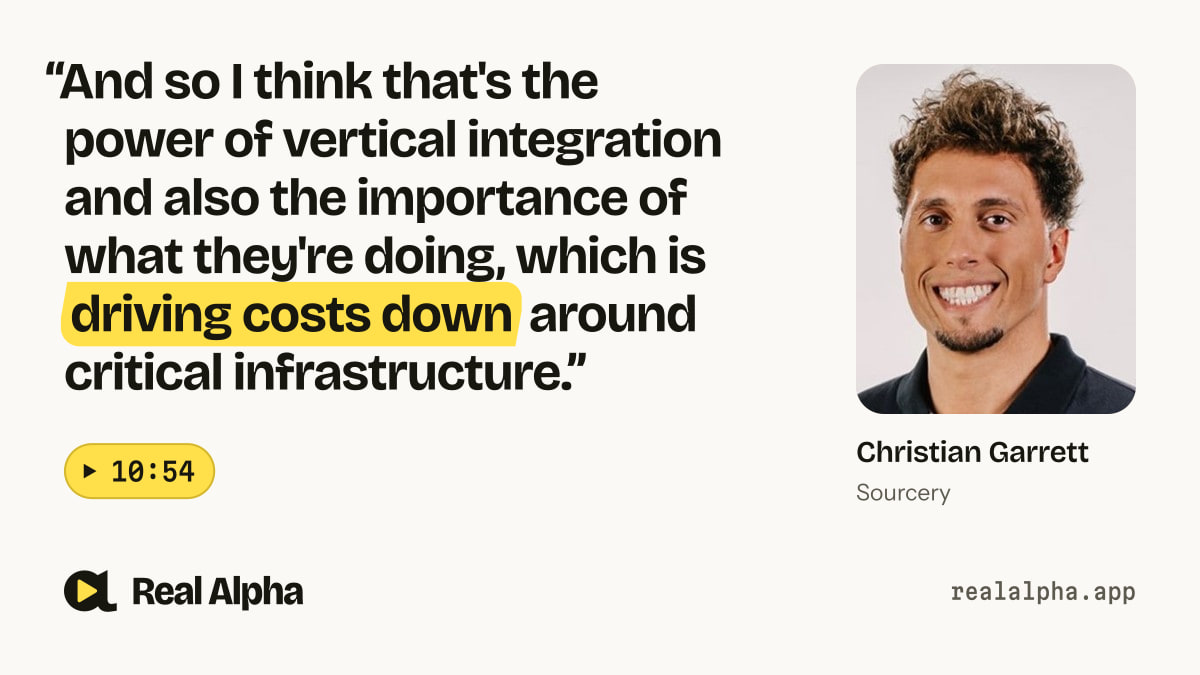
“And so I think that's the power of vertical integration and also the importance of what they're doing, which is driving costs down around critical infrastructure.”
 Christian Garrettat 10:54 · Sourcery
Takeaways
- Starship already offers a viable launch platform, even before full reusability.
- Lower launch costs can enable businesses that are hard to predict today.
- Reusability is the next major cost and cadence step.
About this segment
Christian Garrett argues cheaper Starship launches can unlock orbital compute and businesses built on lower launch costs. Full reusability is the next major step in reducing costs and increasing launch cadence.

Christian Garrett is a Partner at 137 Ventures and co-founder of Onodrim Industries.
Backed SpaceX for 16 years at 137 Ventures and co-founded Onodrim, a European defense and industrial platform.

Molly O'Shea, Host · Founder, Sourcery
Ex-Upfront Ventures investor; has interviewed Alex Karp and Palmer Luckey.
From “SpaceX, Palantir, Anduril & Onodrim | The Return of Conglomerates”, Nov 13, 2026. Watch the full episode
Thanks. We'll look at and fix what's off.
Transcript
Transcribed by machine (Whisper) from the episode’s audio, so a word may be off here and there.
- 8:31
walking through. We saw StarCloud 1 on the screen. We saw StarCloud 2 being developed. And we saw the early iterations of StarCloud 3, which will go on Starship. And so we were talking about what actually breaks the ability to switch over to compute in space, in orbit. And it's really the economics of Starship and what that leads to then of like unlocking an entire market of what is really constrained on Earth and terrestrial compute.
- 9:03
And so whether what they're doing with, you know, like TerraFab, Colossus, all these other projects they're doing, I'm curious how you're thinking about that capacity and like the hyperscaler side of things and when we'll start seeing the compute in space. They've delivered their timeline publicly that they're trying to launch some of the first orbital compute satellites, you know, within the back half of next year, I believe it is. They seem to be on track to delivering that. I think this is, once again, a project that is going to be successful. You can never accurately forecast timelines, right, or capacity or all these things, but they have a history of underwriting complex engineering projects at SpaceX. And when they have conviction on something, they deliver it. And so I think this will be no different. And you've
- 9:47
seen this. I mean, Google just obviously tested a version just recently deployed in orbit. Obviously you have companies like StarCloud being built out. This is clearly going to be a category and a sort of business that's going to be quite successful. And you see all the constraints on Earth around these things, particularly with power and everything else. And the clear solve is data centers in orbit. It's another example of benefiting SpaceX work on integration, but exactly as you said, which is a drive down in costs for infrastructure, allows people to build things on top. And for launch, we saw that even with Falcon 9, right, go down to the sort of exponential increase in the number of launches and how much capacity was delivered to space because of SpaceX driving costs down. We had companies that we've been investing in for a long time, like Varda,
- 10:27
right, which, you know, our friend Delian started along with Will Brewey, and they have built a successful business on top of the ability to have a lower cost of launch, which allows them, right, to deliver valuable capabilities and services to the pharmaceutical industry and to the defense industry. And I think Starship will not just drive launch costs down an order of magnitude, which probably then will lead to an equal rise in the number of companies that can be built.
- 10:52
And it's very hard to forecast these things because a lot of the business models that we're talking about today within SpaceX were not even thoughts just one, two, three, four, five years ago. And so I think that's the power of vertical integration and also the importance of what they're doing, which is driving costs down around critical infrastructure. And yes, that's in AI like we're seeing, but it's also clearly within what they've been doing for decades, which is around launch. And once again, early days as Starship continues to build out. The iteration of Starship that we see today is a fully functioning launch platform compared to everyone else, right? I think the goal for them is to get to full reusability, which is going to have that real impact on cost and launch cadence. But if you compare it to every other launch vehicle today,
- 11:34
they're completely viable, right? They can launch, they can deliver payload. Just because the entire thing isn't fully reusable doesn't really necessarily sort of hit the benchmark compared to the rest of the industry because everyone else is not. And so I think, you know, same thing. It's like, this is probably underpriced that like the next phase is just getting this thing to being fully reusable and then continue to open up launch capacity for the market. That takes time. Also, we're on the early iterations of Starship vehicles, right? They're going to continue to iterate, make them larger, make them more performance. I mean, this is...
- 12:00
Once again, not the, what we see today of the Starship kind of version is definitely not what it will look like, you know, five, ten years from now in capabilities and size and everything else. So, yeah, we remain very excited. We've been excited for almost two decades. We're not the only ones. I mean, Sean McGuire is so excited. He put a model out on Twitter, which is awesome. And I love Sean. It was the best financial model I've ever seen.
- 12:21
So great. I love Sean. So, I mean, that shows the, like, level of excitement people have that have been close to this company. And I think now in the public markets, more people can understand and start to learn this business more. And just, yeah, if you ask me today, it's still the company we are most excited about and the most important company in the world.