The alpha, twice a week
That was 7 min.
Get the best new moments in your inbox every Wednesday and Saturday. It's free.
Check your inbox
We sent a link to your address. Click it to finish signing up. Not there in a minute? Look in spam.
or
TBPN · 7 min · Mar 12, 2026
AI job losses will require major changes to education and policy
 Alex Karp
 argues AI-driven job losses will force changes to migration, education and vocational training.
The episode’s best minutes
Full analysis- 1:15:48AI job losses will require major changes to education and policy7 min
- 1:05:19Palantir combines software with deep deployment expertise4 min
- 45:33AI should expand work rather than just cut headcount3 min
- 5 more moments in the full episode
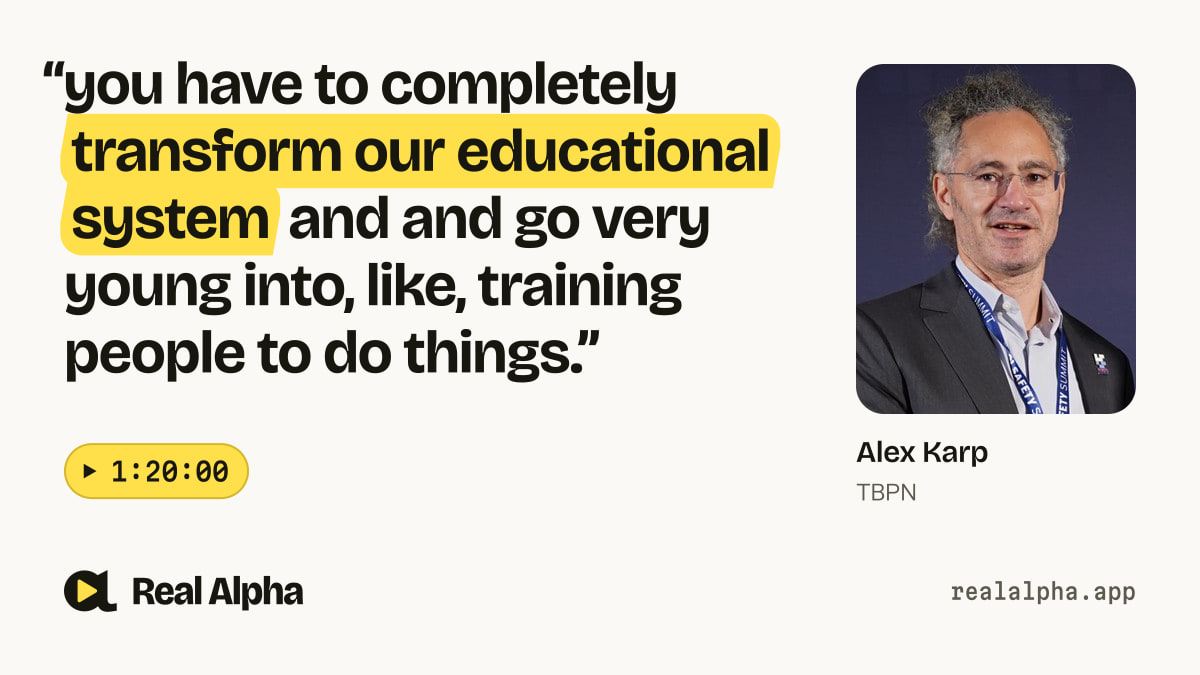
“you have to completely transform our educational system and and go very young into, like, training people to do things.”
 Alex Karpat 1:20:00 · TBPN
Takeaways
- AI transition needs explicit workforce and migration policy.
- Expand vocational pathways and assess skills beyond academic tests.
- Rebuild manufacturing while training people for technical roles.
About this segment
Alex Karp argues AI-driven job losses will force changes to migration, education and vocational training. He warns that ignoring the transition risks political backlash.

Alex Karp is cofounder and CEO of Palantir Technologies.
Co-founded Palantir with Peter Thiel and has run it as CEO, selling data and AI software to governments.

John Coogan, Host · Co-host, TBPN
Co-founded Soylent and Lucy; OpenAI bought his show TBPN in April 2026.

Jordi Hays, Host · Co-host, TBPN
Founded Branded Native; co-founded fintech Capital, which Rho bought.
From “🔴 Dr. Alex Karp LIVE on TBPN”, Mar 12, 2026. Watch the full episode
Answers “Which jobs will AI replace, and which are safe?” See all 241 answers
Thanks. We'll look at and fix what's off.
Transcript
From the transcript TBPN publishes with the episode.
- 1:15:53
on So so, I mean, it sounds like you're you're you're closer to Dario on, you know, potentially 50% of early stage white collar job loss. Like, you're you're you're aware that there's a risk at least Every one's probability. You're aware of it. Well, what do you see as the solution?
- 1:16:09
Well, first, we just have to I mean, well, I mean, the obvious thing is, okay. We can't have any migration here. Like, how are gonna create more job? Like, it's like you have to what the problem in fairness, not that people wanna be in the business of being fair to policy leaders, but that we are dealing with technologies that will determine the policy decisions. Mhmm. So you can't just pretend they're not happening. Mhmm. Like, step one is, like, we it's going to be hard and but possible to make this society work given that transforming it requires these technologies. Mhmm. All like, I really like the people here.
- 1:16:45
They're not here because they like me. Like, maybe they're here for my jokes. Yeah. High quality in some cases. But they it's like a long trip and we're here and I'm the only one who likes this weather. It's great weather. I brought it for you. It's but they're here because they've seen their business being transformed. Yeah. And this is happening in America more than it. So Yeah. We have to win those battles, but the costs are gonna be very high.
- 1:17:06
Mhmm. And so you have to work back from, okay, the costs are gonna be very high. We we can't put oil on the fire. It's like, you know, it's like, well, getting jobs for all Americans is gonna be hard and people maybe who become Americans. But it's like you have to have different policies around migration. Mhmm. You have to different policies around how we train people. Like, currently, if you're a young kid in high school and you're neurodivergent, they're literally track chaining into your chair and feeding you medication so you can have skills that are not valuable.
- 1:17:35
Yeah. Like, it's so it's like and and then we'll probably over time have to have, like, a discussion of, like, yeah, if you go into this career, you're not gonna have a job. Mhmm. Like, a really honest discussion about that. These are the places where you will likely have a job. Mhmm. And yeah. Help me What
- 1:17:52
you know, it it seems like we, as a country, will probably head down a more European path where it is becomes very, very difficult or near impossible to let people go. Do you think that's correct? So you mean in Germany, it's much harder to to lay someone off. I mean, I And that does impact I mean, that does impact the the growth of of companies. Mhmm. But I think many Germans would argue that's probably
- 1:18:21
You know, Germany's I mean, I won't I'll I'll answer your question. Germany's an interesting place. I did this thing in German where I basically told the truth, which you're not allowed to do in Germany. It's like, you know, it's kinda really bad situation and the economy sucks. The migration thing's a complete disaster, and the energy situation is like compounds everything. And I got thousands of people literally saying, thank god someone told the truth. And there are a lot of people like you guys, young people building things that feel hampered and and and are correct to feel hampered. I I think the American version, if we're not careful, is not gonna be the German version. I think it's gonna be hang the rich. I it's like, I think it's gonna be not protect everybody else.
- 1:19:04
You're gonna be like, oh, look. This is too dangerous, and we're gonna hang the rich, but not really help the poor. And in fairness to the German version, like, you know, German, like, health insurance, insurance, all that stuff, it works. Yeah. Like, I was I was poor in Germany for, like, a decade. Yeah. And, like, I had I had the best life on the planet. Like, it's like being poor in Germany is like being better than being rich here in some in some days.
- 1:19:27
So basically, policies that lift the floor, reeducation, training. You're so if you wanna do what we could do here Yeah. We the things we could adopt from Germany are Germany has three high schools. Yeah. Two are vocational. Sure. One is academic. Better education. Better programmatic Yeah. Vocational. A vocational it also has a bad like, a weird vibe here. Like, vocational training in Germany is very technical. Like, the people building the cars at BMW Mhmm.
- 1:19:54
Or even in the French version Airbus, like, very complicated jobs. They didn't go to college. True. They went to a very, very high end high school. Yeah. And they come out without any debt. Yeah. And that stuff is really valuable. Yeah. So if you wanna Amazing. You you have to completely transform our educational system and and go very young into, like, training people to do things. You also need to change our testing system Mhmm. Like, different forms of intelligence. All of our tests are built around things that are were valuable in the industrial revolution. Sure.
- 1:20:20
Sure. Sure. It's like, you wanna pull out all the dyslexics, all the neurodivergence. Everybody who can't sit or needs to build or wants to build have to go into a select a separate slot of, like, yeah. We should have gotten you before you got turned down at Coleman. And, like, said, this is like, that's a waste of your time.
- 1:20:34
You could be building something important. And What else goes would be a part of the good outcome? Rescaling.
- 1:20:41
The the the most important part of the good outcome is what we show our adversaries, you can't fuck with us. And we're the best we have the best military in the world. I hope I believe we're doing that right now. On the good outcome side, we yeah. We go around. And then on the commercial side, we go to all these high infrastructure, you know, hospitals, manufacturing, all these things, complicated infrastructure, and we AI enhanced all of them so the products are legitimately the best in world. And we rebuild manufacturing in this country. Like, a big problem for us, including on the battlefield, is our manufacturing just is not up to where we have to be. Yep. And that, by the way, requires rescaling scaling humans, and we're doing this all over the place.
- 1:21:20
I mean, the guy writing a lot of the scripts for the target these people, they're like high school, college grads, the people building batteries and all these things using our products. These are high school, college grads. There's a lot of opportunity there. But, you know, one of the things I told the Germans, and I would say to us is we I was like, you know, in Germany, you have to call it a crisis. Mhmm.
- 1:21:38
We do need, like this is a crisis moment. America is in tomorrow is not gonna look like it looked at all, or we're gonna have radicalism on right or left. Mhmm. The the the problem the danger is if we don't do these reforms, you are gonna get the pitchforks. Mhmm. Because that then the only solution people are gonna have is, well, you know, let's go after the unlikable rich people in tech, especially AI tech. And then but but then what can work is, yeah, close the borders, keep them closed, start doing huge vocational efforts, change how we test aptitude, like, so we have an accurate diagnostic of where you could be slotted, Be ruthless and, like, you know, it's it's like in in certain find out new ways to test and do ruthless testing and slotting. And then also go around to universities and just I mean, you know how when you, like, you wanna smoke a cigarette, it's like this this cigarette may be harmful to you. Maybe we should be putting that in universities. This university this this university is harmful for your investor.
- 1:22:33
You know, I'm libertarian. You wanna go to university debt may be harmful to your future financial health. For for you and your personal life. Explain to someone you gotta have a million dollars in debt. Yeah. Million dollars in debt. I mean, maybe if you're six nine and you you can get away with that, but the rest of us have to provide.