The alpha, twice a week
That was 3 min.
Get the best new moments in your inbox every Wednesday and Saturday. It's free.
Check your inbox
We sent a link to your address. Click it to finish signing up. Not there in a minute? Look in spam.
or
Big Technology Podcast · 3 min · Nov 17, 2026
AI reasoning works best when answers can be verified
 Gary Marcus
 explains how language models can generate ideas that symbolic tools like Lean check.
The episode’s best minutes
Full analysis- 6:43Anthropic’s growth depends on a market that may commoditize8 min
- 32:03Efficiency gains may not protect Anthropic’s marginsPro pick 2 min
- 46:41AI reasoning works best when answers can be verifiedPro pick 3 min
- 4 more moments in the full episode
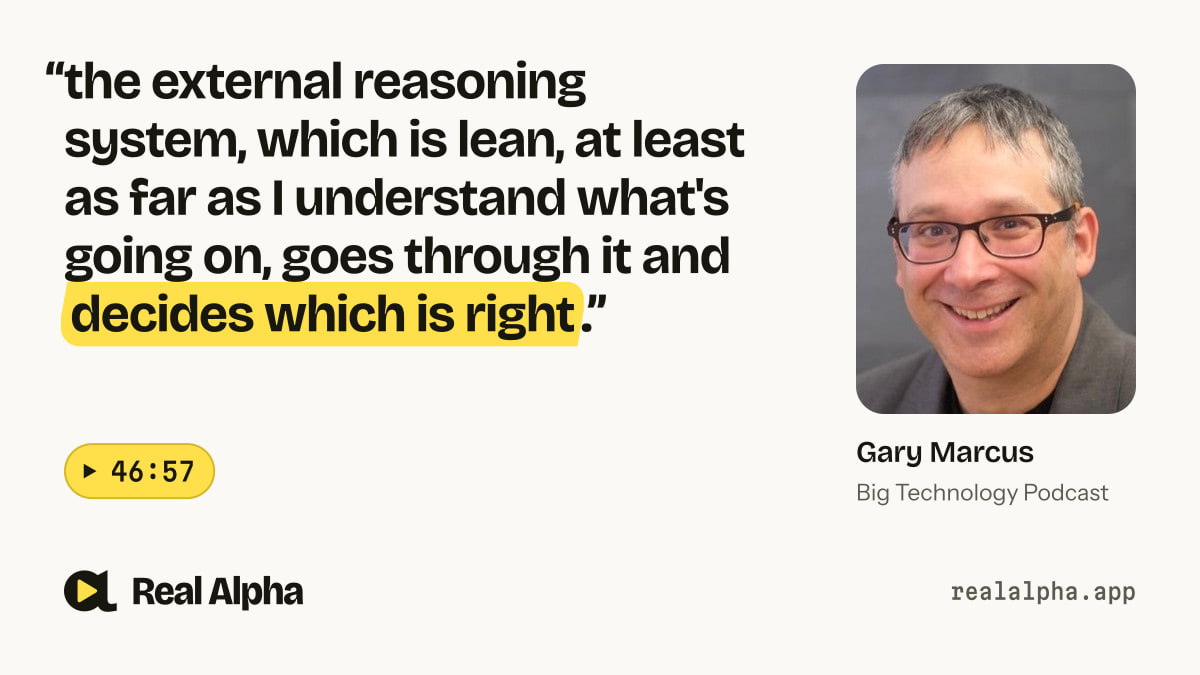
“the external reasoning system, which is lean, at least as far as I understand what's going on, goes through it and decides which is right.”
 Gary Marcusat 46:57 · Big Technology Podcast
Takeaways Pro pick
- A symbolic system can verify an LLM’s proposed answer.
- Math and code allow more reliable checks than open-ended tasks.
- Most real-world problems lack formal verification.
One of Pro's picks, open to you here. Try Pro free for 7 days
One of Pro's picks. The rest of the summary and the 3 takeaways are in Real Alpha Pro; the video, the quote and the transcript stay free.
Read it with Pro, 7 days freeAbout this segment
Gary Marcus explains how language models can generate ideas that symbolic tools like Lean check. The approach works in verifiable fields such as math and code, but not across most real-world problems.

Gary Marcus is a professor emeritus at NYU and author of Marcus on AI.
Founded Geometric Intelligence, acquired by Uber, and researches human language development and cognitive neuroscience.

Alex Kantrowitz, Host · Founder, Big Technology
Former BuzzFeed News senior tech reporter and author of Always Day One.
From “Why The Anthropic IPO Will Fail — With Gary Marcus”, Nov 17, 2026. Watch the full episode
Thanks. We'll look at and fix what's off.
Transcript
Transcribed by machine (Whisper) from the episode’s audio, so a word may be off here and there.
- 46:52
They're doing it with the stuff that I said would work. But is it the LLM, help me understand this, is it the LLM that attaches to that? that's because you know previously the rough way to think about it is um like a generate and filter the llm generates a bunch of possibilities and then the external reasoning system, which is lean, at least as far as I understand what's going on, goes through it and decides which is right. That is the whole essence of being a neurosymbolic system. Neural network generates, I mean, there are different ways to do neurosymbolic, but this is completely neurosymbolic solution. Neural network generates something, the LLM generates something, and then something else says, does this make sense? So you're doing external verification with something that is not an LLM and is, you know, it's a version of a symbolic AI idea that
- 47:38
goes back to the 1950s, right? Newell and Simon had general problem solver in the 1950s, which, by the way, actually solved some novel theorems. Nobody remembers that. But, you know, the notion that an AI system could solve a novel theorem goes back to long before neural networks were doing anything of substance. In the 1950s, Newell and Simon did this. So you have an upgraded version of what Newell and Simon did, pure symbolic, working together with the neural network. So it's a partnership, like I always said you need. So you would say, you might say, well, Gary, then why aren't you satisfied now, right? This is exactly why aren't you satisfied now?
- 48:14
And the reason is because the way that they're doing it is still kind of narrow AI, right? It is focused on a theorem proving symbolic system that does that and nothing else. And they're building a hybrid is really focused on that. The problem with AI for 70 years is that we know how to build narrow solutions to narrow problems. The classic version of that is like a chess computer could play chess, but it couldn't do anything else. You can do this particular trick where you have a whole bunch of axioms like you get in math, and you can verify them. You can do this trick to some extent in coding. So you can have verification of a set of benchmarks, or they're not really benchmarks, but I'm blanking on the word people typically use, but you have a bunch of tests to see whether, unit tests and so forth, to see whether the system performs as expected.
- 49:08
And so you can verify, not 100%, but you can do a lot towards verifying that your code works. And so that's why code works, and it's why the math stuff works. But if you want to, say, make a plan to invade Taiwan or to defend Taiwan or whatever, you can't do the formal verification techniques. And then this technique that is super cool in these very verifiable domains doesn't really work for you anymore. And that is really where AI is currently stuck.
- 49:37
I mean, you know, AI keeps evolving. it's been evolving for 70, 80 years. The place where we are right now is we know how to make this stuff work in domains that we can formally verify that the answer is correct, or at least come pretty close to that. And most of the world isn't like that. And that's where we still have work to do. For those who are, let's say, on Wall Street, and they've heard neurosymbolic