The alpha, twice a week
That was 8 min.
Get the best new moments in your inbox every Wednesday and Saturday. It's free.
Check your inbox
We sent a link to your address. Click it to finish signing up. Not there in a minute? Look in spam.
or
Big Technology Podcast · 8 min · Nov 17, 2026
Anthropic’s growth depends on a market that may commoditize
 Gary Marcus
 argues that token maxing and slowing growth undermine Anthropic’s projections, while competitors make models harder to differentiate.
The episode’s best minutes
Full analysis- 6:43Anthropic’s growth depends on a market that may commoditize8 min
- 32:03Efficiency gains may not protect Anthropic’s marginsPro pick 2 min
- 46:41AI reasoning works best when answers can be verifiedPro pick 3 min
- 4 more moments in the full episode
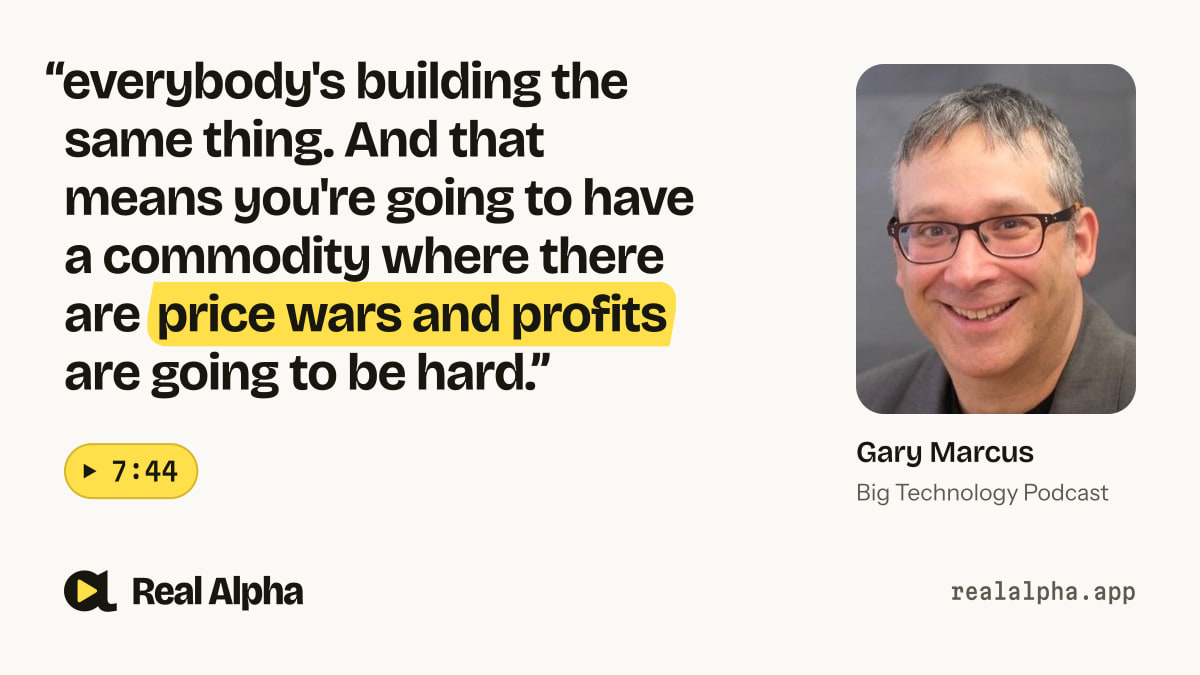
“everybody's building the same thing. And that means you're going to have a commodity where there are price wars and profits are going to be hard.”
 Gary Marcusat 7:44 · Big Technology Podcast
Takeaways
- Token maxing inflated demand but is already fading.
- Similar models invite price wars and squeeze profits.
- Slowing growth makes Anthropic’s future commitments harder to meet.
About this segment
Gary Marcus argues that token maxing and slowing growth undermine Anthropic’s projections, while competitors make models harder to differentiate. That matters because its huge future commitments require sustained growth.

Gary Marcus is a professor emeritus at NYU and author of Marcus on AI.
Founded Geometric Intelligence, acquired by Uber, and researches human language development and cognitive neuroscience.

Alex Kantrowitz, Host · Founder, Big Technology
Former BuzzFeed News senior tech reporter and author of Always Day One.
From “Why The Anthropic IPO Will Fail — With Gary Marcus”, Nov 17, 2026. Watch the full episode
Answers “How do AI companies make money?” See all 122 answers
Thanks. We'll look at and fix what's off.
Transcript
Transcribed by machine (Whisper) from the episode’s audio, so a word may be off here and there.
- 6:54
And what I said then was this depends on this fad of token maxine. This fad is not going to last. And so you have these projections. I always think of what I call the trillion pound baby fallacy, which comes from a tweet that I saw on Twitter that absolutely left. A guy had a picture of his baby and then his baby like a month later. And it was kind of a joke. He says, you know, my baby has doubled in weight in its first month of life or something like that.
- 7:20
And I've taken the liberty of making some projections. By the time he goes to college, he'll be a trillion pounds. And of course, the point is that you can have exponential growth for a while, but usually it tails off. And I said, look, anthropics growth was exponential like the trillion pound baby, but it ain't going to get to be. trillion pounds because there are going to be countervailing pressures. One of which I anticipated correctly, I said that token maxing would die. That was one of the reasons why revenue or growth has tailed off. Another that I didn't get precisely, but I had gotten the gist of a long time ago was in 2023. I said, everybody's building the same thing. And that means you're going to have a commodity where there are price wars and profits are going to be hard. What I
- 8:01
didn't quite get was how fast suddenly China would be there. But it was a symptom of what I always said was going to happen. Large language models and even enhanced large language models, if everybody else knows the tricks, are going to be a commodity. There's going to be price wars and it's going to be really hard to make profits. And sure enough, by the middle of this year, suddenly Anthropic was struggling to find a market niche at all because people were using the Chinese models. What it looks to me in the latest data that I've seen is that Anthropic took off like a bat out of hell for about a year. And then around July, things slowed down. It's not that there's no growth anymore. But these projections of them making 147% growth every quarter are just clearly wrong. And if they're clearly wrong, and they have $900 billion in
- 8:48
liabilities, the math doesn't math. Indeed. Let's go to your post. You said quarter two growth was 147%. It was up 147% compared to Q1. But Q3 wound up being a mere 47% in growth compared to Q2. The decline of token maxing and the rise of good quality, if not quite top tier competitors from China, began to take their toll. We're going to keep making the case here for why it might not work before we go to the rebuttals.
- 9:19
And then you're going to come back at me afterwards. But I do need to just say one thing when I was putting this together last night. It just strikes me that Anthropik grew. So in the middle of this token maxing era, they grew 147% in a quarter, which would just reflect, you know, basically tokens gone wild within companies, uncapped token spend, token leaderboards, all these things. There has been a discussion about them reining that in, about companies reining that in.
- 9:47
Yeah. But the quarter afterwards, so it didn't maintain the growth rate, okay? But it didn't shrink. Like the reigning in of token maxing led to the next quarter being a 47% increase in spend over the crazy quarter. Yep. Yeah. No, I mean, it didn't die completely. It's just. that he got $900 billion of obligation. I mean, another way to put it is it would be a good business if the liabilities weren't so high.
- 10:17
I mean, maybe that's sort of the story of all businesses that fail. But, you know, they are making a bunch of money. They do have a good product. But they're not making profits off of this. And the revenue is not growing fast enough to catch up with what they've committed to. Yep. All right. Diminishing returns, I think. We've talked about this on previous episodes. You bring it up again. Let me just set it up.
- 10:44
You write, the cost of making better AI and Anthropik's only real niche is models at the extreme top end, since they can readily be beat on price at the low end, is growing exponentially. So the cost of making these better models is growing extremely fast. Each new tiny improvement tends to cost far more than the last. and you you basically showed that uh that shared this tweet uh anthropic is gaining exponentially less uh capability per billion dollars spent over time yeah they should be terrified about this is an issue because this is always like for me it was like okay you know once you make the model smart enough and then you run another multi-billion dollar pre-train it's like the improvements might only be noticeable to you know the people who they really apply to like some Like a PhD might notice, but, you know, me, an average user, might not.
- 11:33
That's right. I mean, some of it's about what the user notices. Some of it's about what appears on the benchmarks. But the point is, if you have to spend a billion dollars to impress your users this year, $10 billion to impress your users next year, and $100 billion the year after, and that's kind of what it's looking like, you know, if Anthropic wants to say we did, you know, four points better on the benchmark, suddenly it's going to be $100 billion to them.
- 11:55
And then, you know, ultimately a trillion. at some point that is just not sustainable i mean also this might be um sort of a counter narrative to say or whatever but like the benchmarks are just like so many of the benchmarks have been saturated that doesn't really matter and that's going to go to your commoditization point which is just like the model the base models have just become smart enough that like really getting to the frontier on the benchmarks at a certain point it's like Like, you're not going to have a meaningful difference if you, like, increase the benchmark by a little bit over time.
- 12:28
Yeah, I mean, there's a separate issue of is the benchmark still valid, like, if you get close enough to the top. But we'll put that aside for the moment. It goes back to this issue of market niche, like who cares? So the way I think about it is there's three kinds of problems. There's the ones that you can solve with kind of any model nowadays, and so you don't need anthropic stuff because you can go on an open router and get it from someone else cheaper.
- 12:54
There are the very few problems where really the best thing is what you need, not even the second best. And I think problems like that do exist, and I think also people are still experimenting to see if any of those exist for them. And there are some that I think no current system can solve and that doesn't help them. So the only thing that really sustains their business right now are these fairly difficult problems that they're uniquely qualified to solve. And that's itself a moving target, right? Because the open weight models get better and better. And so you can think it's like this little slice from this big graph and that little slice is like moving. Maybe it's moving up a little but the bottom of it is catching up and it you know again like you're making this bet if you buy this IPO that they're going to make that little slice work that the
- 13:45
revenue on that is going to grow that somehow they're going to be able to serve up that slice at a profitable level like it's not impossible I am not so pessimistic as to say there is zero chance that this will ever work but I'm pessimistic enough to say that so many things have to come together and some are already not coming together right the revenue growth that really was sustaining that notion of evaluation is already tailing off and so like they're probably not going to get the perfect storm and if they don't get that perfect storm then i think that they either go bankrupt or get acquired at a discount yeah the way that i i describe what you're what you're hitting at is basically like if you're if you're a hiring manager and you could hire you know a sixth