The alpha, twice a week
That was 2 min.
Get the best new moments in your inbox every Wednesday and Saturday. It's free.
Check your inbox
We sent a link to your address. Click it to finish signing up. Not there in a minute? Look in spam.
or
Big Technology Podcast · 2 min · Nov 17, 2026
Efficiency gains may not protect Anthropic’s margins
 Gary Marcus
 says cheaper compute helps, but competitors can adopt the same efficiencies and drive prices down.
The episode’s best minutes
Full analysis- 6:43Anthropic’s growth depends on a market that may commoditize8 min
- 32:03Efficiency gains may not protect Anthropic’s marginsPro pick 2 min
- 46:41AI reasoning works best when answers can be verifiedPro pick 3 min
- 4 more moments in the full episode
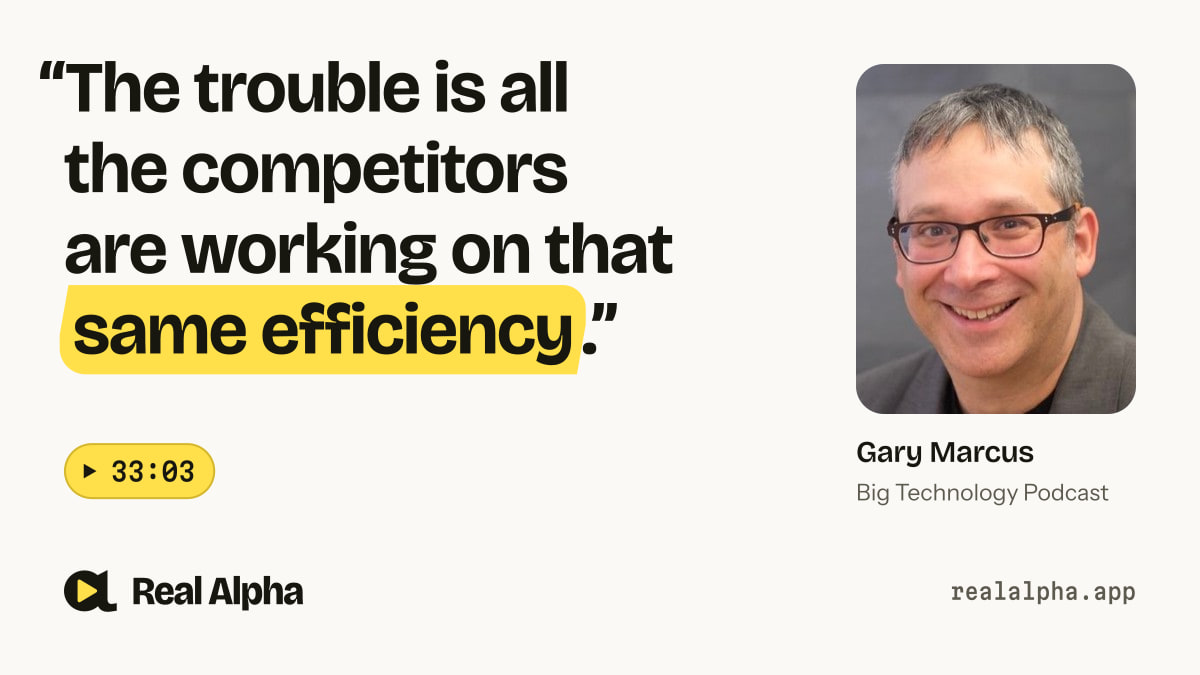
“The trouble is all the competitors are working on that same efficiency.”
 Gary Marcusat 33:03 · Big Technology Podcast
Takeaways Pro pick
- Serving models more efficiently can lower costs.
- Competitors are pursuing the same efficiency gains.
- Falling prices can erase the benefit of lower costs.
One of Pro's picks, open to you here. Try Pro free for 7 days
One of Pro's picks. The rest of the summary and the 3 takeaways are in Real Alpha Pro; the video, the quote and the transcript stay free.
Read it with Pro, 7 days freeAbout this segment
Gary Marcus says cheaper compute helps, but competitors can adopt the same efficiencies and drive prices down. Lower costs only matter if they fall faster than the prices customers pay.

Gary Marcus is a professor emeritus at NYU and author of Marcus on AI.
Founded Geometric Intelligence, acquired by Uber, and researches human language development and cognitive neuroscience.

Alex Kantrowitz, Host · Founder, Big Technology
Former BuzzFeed News senior tech reporter and author of Always Day One.
From “Why The Anthropic IPO Will Fail — With Gary Marcus”, Nov 17, 2026. Watch the full episode
Answers “How do AI companies make money?” See all 122 answers
Thanks. We'll look at and fix what's off.
Transcript
Transcribed by machine (Whisper) from the episode’s audio, so a word may be off here and there.
- 32:14
i'm sure you've seen about compute efficiency that in q1 2025 for every dollar uh they spent building compute they made 40 cents uh in q3 2026 for every dollar of compute they invested they would make a dollar 72. so that would be the argument that that if you're looking at anthropic their argument for why they're going to be profitable they're making it work per dollar of compute invested. And that also suggests that they won't go bankrupt.
- 32:41
I mean, I think the best hope that any of these companies have is that there will be efficiencies eked out. And that's a reasonable expectation. The way I think about it is there's a lot left to do, in my view, to get to AGI. Some of it is science. We need whole new ideas around world models and things like that. And some of it's just efficiencies with things we already know how to build. That's more like engineering. And that is happening, which means that the cost to serve a given model is going down. It has gone down steadily. It will continue to go down.
- 33:11
And that is their best hope. The trouble is all the competitors are working on that same efficiency. Like the DeepSeek moment was about DeepSeek finding a cool new way to serve models more efficiently. And so everybody's trying to do that. And that means that the prices that they can charge go down, right? Because the competitors are doing it. If there's a way that they can make this work i think it does rely on on eking out those efficiencies but because the competitors are doing the same thing it's going to be hard to sustain the price and prices have gone down what by a factor of a hundred or a thousand over the last crazy um and and so you know it's like if you were selling lemonade you know last year you could sell it for three dollars but you ain't selling it for three dollars anymore because everybody else figured out how to make it cheaply
- 33:55
so it's great that you're now making it for you know 40 cents but now you can only charge a dollar or worse. Now you're charging, you can charge a dollar, but it's costing you $1.10. It's really more what it's like. And so, yes, you are selling for less. It costs less, but you need those things to intersect in the right way such that you actually make a profit. When everybody else has the same idea, it's hard. Let me give you my best argument in Anthropik's favor on this