The alpha, twice a week
That was 3 min.
Get the best new moments in your inbox every Wednesday and Saturday. It's free.
Check your inbox
We sent a link to your address. Click it to finish signing up. Not there in a minute? Look in spam.
or
No Priors · 3 min · Sep 3, 2026
AI speeds up chip verification more than chip design
 Rene Haas
 says AI is already used daily by 80–90% of Arm engineers, especially for verification and debugging.
The episode’s best minutes
Full analysis- 7:18AI speeds up chip verification more than chip design3 min
- 12:02Chip supply constraints may last three to five years3 min
- 34:26CPUs orchestrate AI workloads alongside acceleratorsPro pick 2 min
- 4 more moments in the full episode
“The largest amount of time is in the verification, the validation, the debug, the documentation, et cetera, et cetera. AI is really good at that.”
 Rene Haasat 8:12 · No Priors
Takeaways
- Verification and debugging take more time than architecture or RTL generation.
- 80–90% of Arm engineers use AI daily.
- Well-documented IP is easier to test and train AI on.
About this segment
Rene Haas says AI is already used daily by 80–90% of Arm engineers, especially for verification and debugging. He explains why Arm’s documentation and test benches could also make its IP more useful for AI tools.

Rene Haas is CEO of Arm and SoftBank Group International.
Arm's CEO since 2022, after seven years at NVIDIA. Since April 2026 he has also led SoftBank Group International.


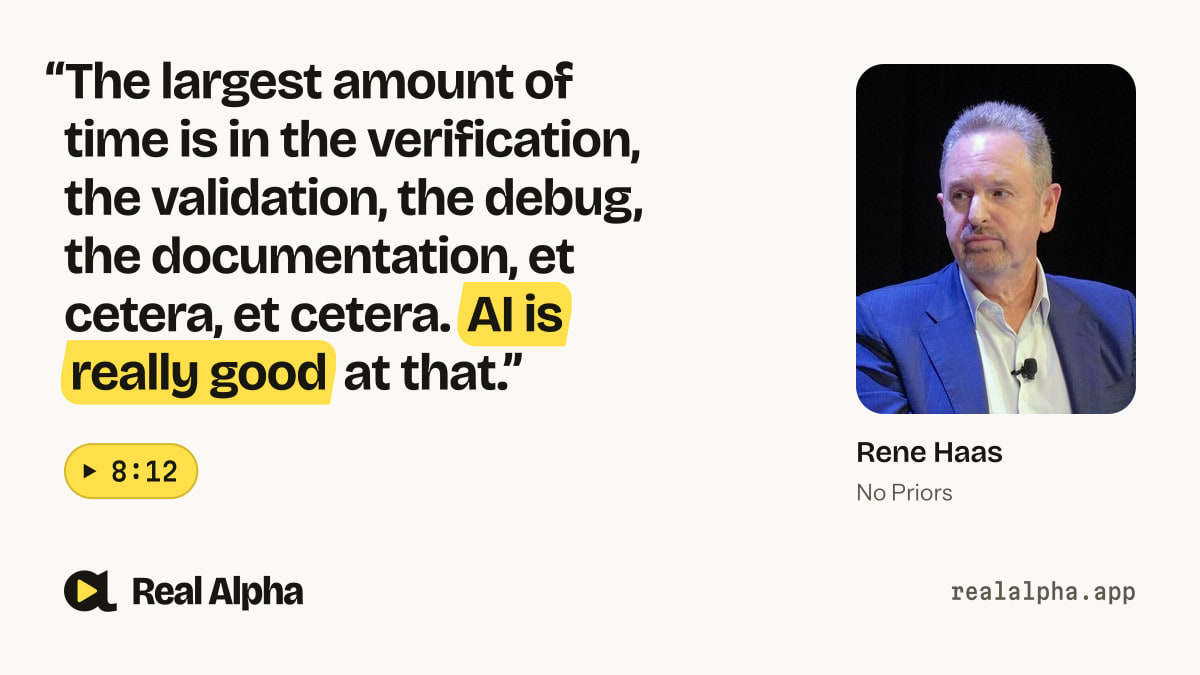
From “Redefining Chip Architecture with Arm CEO Rene Haas”, Sep 3, 2026. Watch the full episode
Thanks. We'll look at and fix what's off.
Transcript
Transcribed by machine (Whisper) from the episode’s audio, so a word may be off here and there.
- 7:22
Personally, I'm a huge believer in AI as a utility that's going to help productivity for every single industry. is going to be the great leveler in terms of companies that get started super quickly. And for industries, whether it's healthcare, infrastructure, robotics, every industry is going to use artificial intelligence as a utility and stop. So since I'm such a believer in this, of course, we use it very heavily, you know, inside of ARM.
- 7:52
On the non-engineering side, we're using it all over the place. But on the engineering side, we've seen huge, huge benefit. it, you mentioned verification. Chip design can take anywhere from 24 to 36 months, depending on the complexity of the chip, et cetera, et cetera. The actual design of the architecture, the RTL generation, if you will, the mapping of the architecture is not the largest amount of time. The largest amount of time is in the verification, the validation, the debug, the documentation, et cetera, et cetera. AI is really good at that. And I would say we We probably have 80 to 90 percent of engineers today in SightArm who use it on a daily basis.
- 8:31
And if we were to shut it off, my analogy I give to people, it's like being in the 1990s, you've got Internet and you're now saying, you know, only Internet between the hours of two and four. After that, go to the library that we have down the hall that's got all the books that you can go up and look all this information up. People are to be anarchy. So the genie's out of the bottle. Right. There's and there's no there's no stopping that.
- 8:53
Now, there's certain things that the tools are still not that mature of. One of them is really around RTL generation and then physical design and implementation in best of class. And that's simply because the models, you know, they're trained on what's available publicly. And a lot of the information is quite proprietary. That being said, there's massive opportunity between the ecosystems and everyone in the industry to make that better.
- 9:20
It's only going to get better. Have you been fine-tuning models to try and address that gap, given the proprietary information that you want? We've been working with model makers around that, absolutely. And I think that's a big, big opportunity. And one of the things that I'm proud of at ARM is given our business, our core IP business, we probably have the richest IP portfolio, both in terms of not only the IP, and this is the killer, the documentation, the test benches, you know, how you build the IP.
- 9:47
You know, I've worked for chip companies in the past that have said, hey, why don't we license this IP that we've got? Because it's really, really valuable. And then you get into, oh, wait a minute, there's no documentation. There's no explanation on how you... No one's ever going to be able to use this. It's unusable. It's untestable, right? And if it's unusable and untestable, it's actually untrainable.
- 10:05
And if it's untrainable, it's not usable for AI. I think we have some built-in advantages based on our business model that'll allow us to really be able to take advantage of the tools as they get better. It's really exciting. How much do you think, if you were to extrapolate out,