The alpha, twice a week
That was 3 min.
Get the best new moments in your inbox every Wednesday and Saturday. It's free.
Check your inbox
We sent a link to your address. Click it to finish signing up. Not there in a minute? Look in spam.
or
No Priors · 3 min · Sep 3, 2026
Chip supply constraints may last three to five years
 Rene Haas
 says chip startups need more than a good design: they need access to capital, wafers, memory and packaging.
The episode’s best minutes
Full analysis- 7:18AI speeds up chip verification more than chip design3 min
- 12:02Chip supply constraints may last three to five years3 min
- 34:26CPUs orchestrate AI workloads alongside acceleratorsPro pick 2 min
- 4 more moments in the full episode
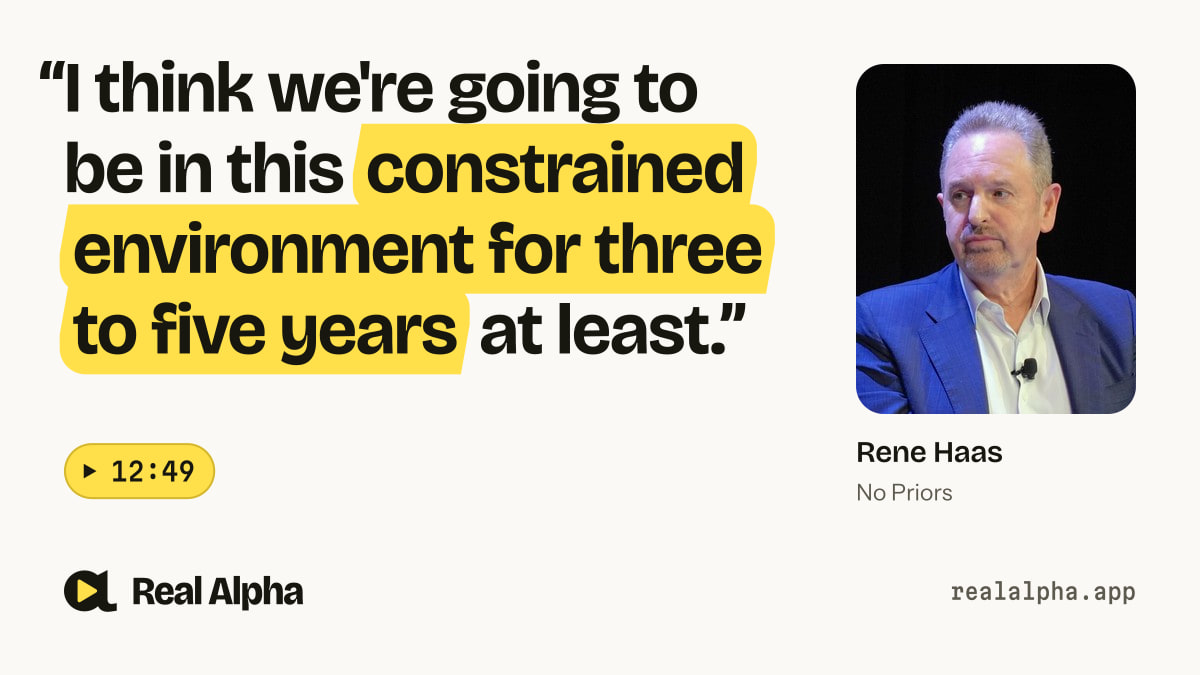
“I think we're going to be in this constrained environment for three to five years at least.”
 Rene Haasat 12:49 · No Priors
Takeaways
- Access to wafers, memory and packaging is a major hurdle for startups.
- Haas expects constrained chip supply to persist for three to five years.
- Data-center construction could become the next bottleneck.
About this segment
Rene Haas says chip startups need more than a good design: they need access to capital, wafers, memory and packaging. He sees data-center construction becoming a bottleneck, even as AI demand remains far from oversupplied.

Rene Haas is CEO of Arm and SoftBank Group International.
Arm's CEO since 2022, after seven years at NVIDIA. Since April 2026 he has also led SoftBank Group International.


From “Redefining Chip Architecture with Arm CEO Rene Haas”, Sep 3, 2026. Watch the full episode
Answers “What will AI look like in the next few years?” See all 395 answers
Answers “Is there still a GPU shortage?” See all 95 answers
Thanks. We'll look at and fix what's off.
Transcript
Transcribed by machine (Whisper) from the episode’s audio, so a word may be off here and there.
- 12:06
it's understanding the supply chain impacts, how all of it gets built and put into ultimate end products. I think that's going to become a much more important muscle as we go forward, because it's one thing today, I said it another way, there's a lot of really great young companies today doing AI chips, well-known companies getting tons of funding, innovative designs, et cetera, et cetera. selling into an industry where the capital requirements are just massive and the relationships with memory vendors is incredibly critical or the relationship with substrate vendors.
- 12:39
So companies are going to have to be more access to a three nanometer line, a six nanometer line, advanced packaging line. All of it. Yeah, all of that. And I think that is that's not going to stop in 12 months. It's not going to stop in 24 months. I think we're going to be in this constrained environment for three to five years at least. So long as the transformer is the unit of energy relative to how you generate AI training and AI inference by design, it is very compute intensive, very memory intensive. So if you think about that, that's going to drive a lot of demand on having supply chain acumen, which then goes back to people who've got great ideas on ship design, they're going to have to have need a lot of other things just to be able to get access to capital, wafers, everything you just talked about. We've just had a cascading series of things that
- 13:29
have been the bottleneck to more compute for the AI industry. So, you know, two years ago or so, I think it was like packaging and packaging related items. And then eventually now people want to talk about how it's memory and things like that, that are in some sense limiting to certain systems being built at sufficient scale. Do you have a view of what is the next sort of bottleneck that's coming? I think building out the data centers is going to be a bottleneck.
- 13:50
And when I say building out, if you look at all the projects that are being done today, not a lot of them are ahead of schedule and needing less labor than they thought. And then when you layer on top of that, a lot of buzz that's coming from different parts of the country in the United States here relative to slowing down data center development or putting restrictions around it. I think that infrastructure buildout could be a headwind just relative to everything going on, which may be, you know, end quote, okay, because if infrastructure buildout was not a headwind, I think capacity for wafers, capacity for memory, that probably would be a headwind. So I think you're going to see a number of different governors, if you will, not governors of states, but different things that are going to throttle the growth of this, which just expounding
- 14:43
for a second. I've been on a bunch of panels and I get a lot of questions about AI bubble and when's it going to stop? And there's setting aside the valuation bubbles, which is a stock market index component. The bubble in terms of, are we over oversupply? Demand, not even close. And I think, again, that's because the demand is insatial. It's just given the way these models work. And infrastructure build out, access to wafers, access to memory, all of that's combining.