The alpha, twice a week
That was 2 min.
Get the best new moments in your inbox every Wednesday and Saturday. It's free.
Check your inbox
We sent a link to your address. Click it to finish signing up. Not there in a minute? Look in spam.
or
No Priors · 2 min · Sep 3, 2026
CPUs orchestrate AI workloads alongside accelerators
 Rene Haas
 argues that CPUs remain essential as AI shifts from training toward inference, where systems must route tokens and coordinate work.
The episode’s best minutes
Full analysis- 7:18AI speeds up chip verification more than chip design3 min
- 12:02Chip supply constraints may last three to five years3 min
- 34:26CPUs orchestrate AI workloads alongside acceleratorsPro pick 2 min
- 4 more moments in the full episode
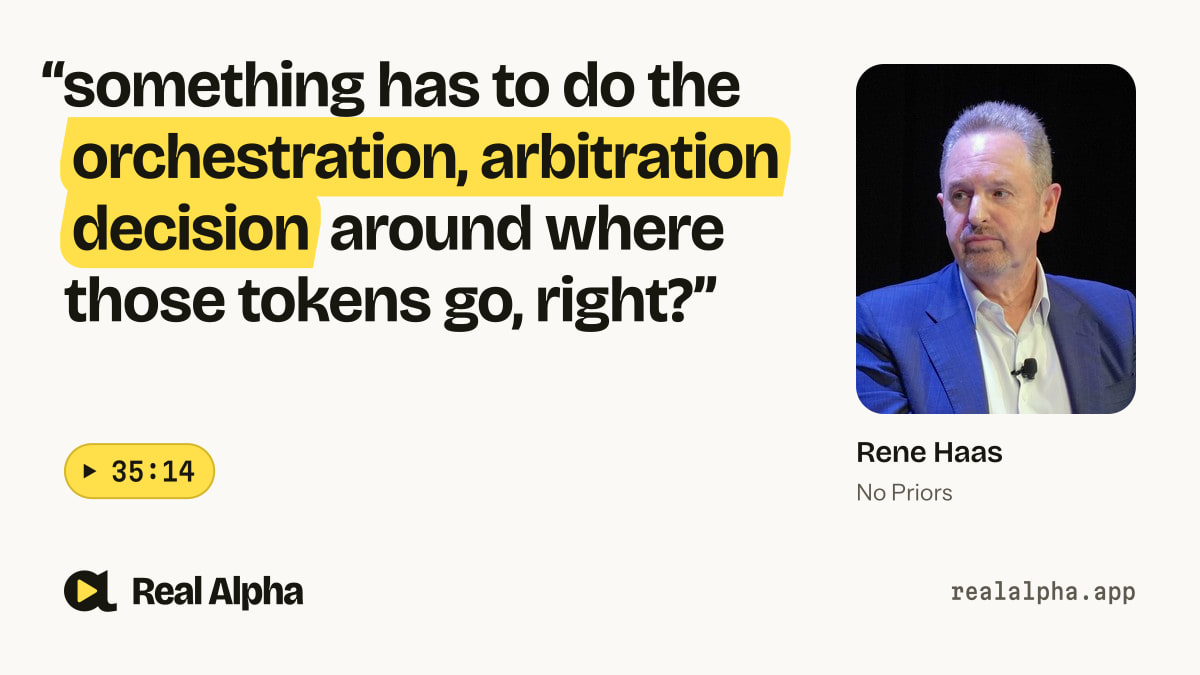
“something has to do the orchestration, arbitration decision around where those tokens go, right?”
 Rene Haasat 35:14 · No Priors
Takeaways Pro pick
- Accelerators generate tokens; CPUs help route and coordinate them.
- AI systems still need CPUs, accelerators and memory together.
- Edge devices need power-efficient local processing.
One of Pro's picks, open to you here. Try Pro free for 7 days
One of Pro's picks. The rest of the summary and the 3 takeaways are in Real Alpha Pro; the video, the quote and the transcript stay free.
Read it with Pro, 7 days freeAbout this segment
Rene Haas argues that CPUs remain essential as AI shifts from training toward inference, where systems must route tokens and coordinate work. He sees that role continuing in data centers and smaller edge devices.

Rene Haas is CEO of Arm and SoftBank Group International.
Arm's CEO since 2022, after seven years at NVIDIA. Since April 2026 he has also led SoftBank Group International.


From “Redefining Chip Architecture with Arm CEO Rene Haas”, Sep 3, 2026. Watch the full episode
Thanks. We'll look at and fix what's off.
Transcript
Transcribed by machine (Whisper) from the episode’s audio, so a word may be off here and there.
- 34:30
When ChatGPT had the explosion thing and everything was all about the accelerators, I think there was so much focus on no matter what the question is, the answer is the accelerator. There's no computing problem that's ever been invented that doesn't utilize and can't utilize the microprocessor. It is the heart of everything. All roads lead through it, around it, past it, et cetera. So you look at fundamental system design and you have to have CPUs.
- 34:55
They just don't kind of go away. They were a little bit forgotten as this accelerated. The thing kind of took off, but what then became very obvious was as more and more of the data was moving away from training, training is obviously very important to recursive learning, reinforcement learning, to inference, the use of the tokens, the use of the information. Well, of course, in a system problem, something has to do the orchestration, arbitration decision around where those tokens go, right?
- 35:23
If the token factory just generates all these tokens, it's like literally, where are the trucks that are going to take the tokens away and give them to the users? That's what CPUs do. So until something's invented that says the CPU has gone away and we're now doing it through some other mechanism, which has yet been defined or invented, the CPU is going to be doing just fine. And there's going to be a lot of demand for it, a ton of demand, in addition to the accelerators that generate the tokens.
- 35:48
But the way to think about it is it's a system, Which again, going back to, you know, memory. Well, of course memory is needed because in a computer von Neumann architecture or computing architecture, you have a CPU, you have some accelerator, whether it's a floating point, a GPU accelerator, and memory. System design hasn't changed. I think some of the focus kind of moved around, but for ARM, and by the way, that applies whether I'm talking about a data center, it applies when I'm talking about an automobile, a robot, a phone, wearables.
- 36:18
And in fact, as you get to the smaller footprints where more and more AI is going to take place, that's going to be a sweet spot for ARM because the CPU is table stakes anyway. You have to have it to do all the things that are required in the edge device. But now we have an opportunity with our instructions at architecture to do a lot of things where you just can't put a 50 watt GPU on your head, right?
- 36:41
You're going to have to do that AI processing somewhere locally. So it's a great place.