The alpha, twice a week
That was 4 min.
Get the best new moments in your inbox every Wednesday and Saturday. It's free.
Check your inbox
We sent a link to your address. Click it to finish signing up. Not there in a minute? Look in spam.
or
The Ezra Klein Show · 4 min · Oct 20, 2026
America's postwar alliance grew stronger by enriching its allies
 Chrystia Freeland
 says the U.S. built postwar alliances by investing in allies and treating their prosperity as a shared gain.
In this episode
Full analysis- 7:25Canada can target tariffs where they hurt U.S. voters8 min
- 22:00Appeasement taught Trump that coercion was workingPro pick 7 min
- 50:27Russian oligarchs misjudged how much they could control Putin7 min
- 39:51China uses trade pressure to enforce its political red lines4 min
- 1:09:19Allies can gain leverage by retaliating together5 min
- 33:16America's postwar alliance grew stronger by enriching its allies4 min
- 4:47Merkel handled Trump by staying cool and direct3 min
- 47:57U.S. democratic backsliding can weaken elections abroad3 min
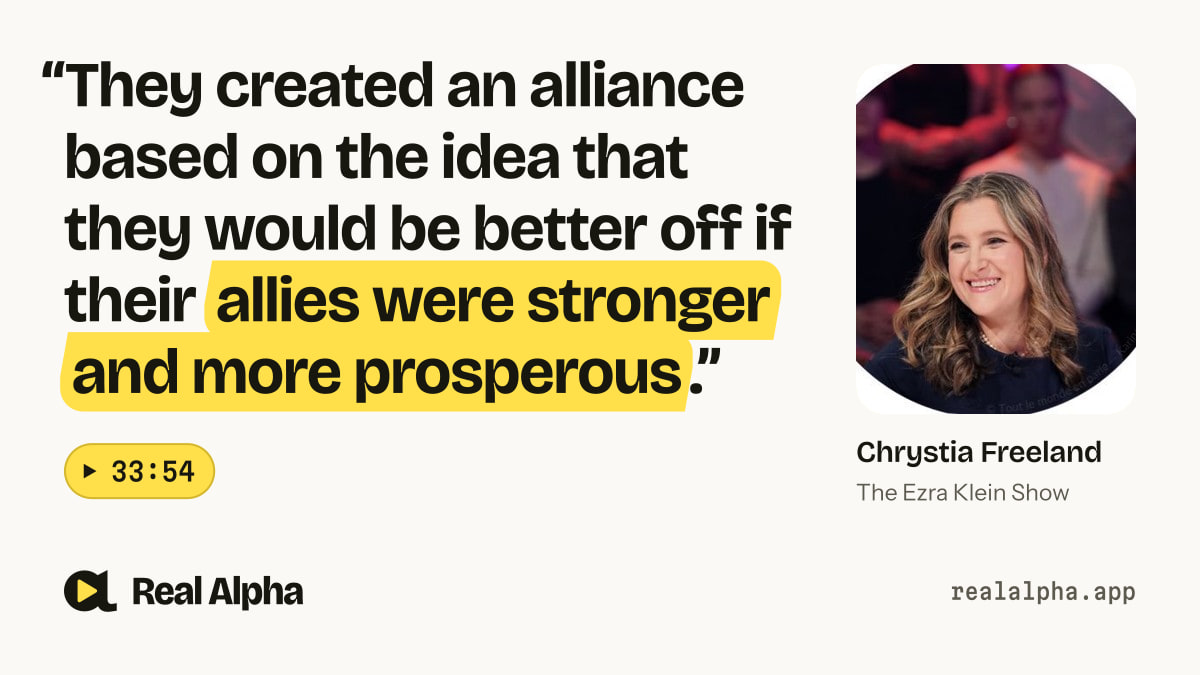
“They created an alliance based on the idea that they would be better off if their allies were stronger and more prosperous.”
 Chrystia Freelandat 33:54 · The Ezra Klein Show
Takeaways
- The U.S. helped rebuild Germany and Japan after World War II.
- Shared prosperity made allies stronger and helped the U.S.
- Coercion encourages countries to find alternatives to U.S. systems.
About this segment
Chrystia Freeland says the U.S. built postwar alliances by investing in allies and treating their prosperity as a shared gain. She argues coercion now pushes countries to reduce dependence on America.

Chrystia Freeland is a former Canadian deputy prime minister, finance minister and foreign affairs minister.
Reported in Ukraine, managed Thomson Reuters and served as Canada's deputy prime minister and finance minister.

Ezra Klein, Host · Host, The Ezra Klein Show
From “Trumpism Is Backfiring | The Ezra Klein Show”, Oct 20, 2026. Watch the full episode
Thanks. We'll look at and fix what's off.
Transcript
Transcribed by machine (Whisper) from the episode’s audio, so a word may be off here and there.
- 33:28
That's the other side of that dealmaking strategy that you force people to begin treating you as a threat, which means figuring out how to create defenses against you. And in the long run, this is classic IR theory figuring out how to weaken and undermine you. 100% correct. I mean, I think that the Trump administration is unintentionally revealed. the genius of the post-war American establishment. And, you know, it's actually remarkable what they did. They created an alliance based on the idea that they would be better off if their allies were stronger and more prosperous. They actually invested in the post-war reconstruction of Germany and Japan. They actually, you know, America was in this position of unmatched dominance after the Second World War. And it decided to build an alliance. And, you know, from the position of
- 34:36
a country that was not America, very easy to bitch about that alliance. And by the way, when you guys are not in the room, we always have, right? And these were never truly equal partnerships. America was always first among equals. But America did actually listen to its allies. America was governed by this general idea that this is a win-win partnership, that we will get rich together, that the prosperity of one country within the group of allies, far from being a threat, is actually going to help us, and that we have an interest in each other's security. And like, wow, such a great idea. And a great idea for America. Like, that is what made America different from the Soviet Union. The Soviet Union certainly did not have partners.
- 35:37
It only had vassals. Same with China. That's how America was a distinctive superpower. And when Tim Snyder talks about superpower suicide, what he means is America voluntarily wrecking that. And I think you're totally right. Like, part of why this incredibly ill-conceived approach seems to have been pursued is no one thought about the next step. No one thought about, okay, if we do that, what are our counterparties going to do? And the counterparties are doing two things. One is try to become as not dependent on America as possible, disentangle those ties as much as they can, particularly in the military space, but also economically.
- 36:37
And that's bad for America materially. You know, countries are going to think really hard before they buy another F-35 controlled by the Pentagon. Why would you want a jet that Americans control? Europe and Canada are obsessed with having an alternative to Starlink. And so is Ukraine. And so is Ukraine. And like rightly so, you know. So become less dependent. So American companies get less money. They have fewer clients.
- 37:04
But then also America has less leverage.