The alpha, twice a week
That was 4 min.
Get the best new moments in your inbox every Wednesday and Saturday. It's free.
Check your inbox
We sent a link to your address. Click it to finish signing up. Not there in a minute? Look in spam.
or
The Ezra Klein Show · 4 min · Oct 20, 2026
China uses trade pressure to enforce its political red lines
 Chrystia Freeland
 challenges China's claim to be a benign rules-based partner, citing pressure on Norway, Lithuania and Canada.
In this episode
Full analysis- 7:25Canada can target tariffs where they hurt U.S. voters8 min
- 22:00Appeasement taught Trump that coercion was workingPro pick 7 min
- 50:27Russian oligarchs misjudged how much they could control Putin7 min
- 39:51China uses trade pressure to enforce its political red lines4 min
- 1:09:19Allies can gain leverage by retaliating together5 min
- 33:16America's postwar alliance grew stronger by enriching its allies4 min
- 4:47Merkel handled Trump by staying cool and direct3 min
- 47:57U.S. democratic backsliding can weaken elections abroad3 min
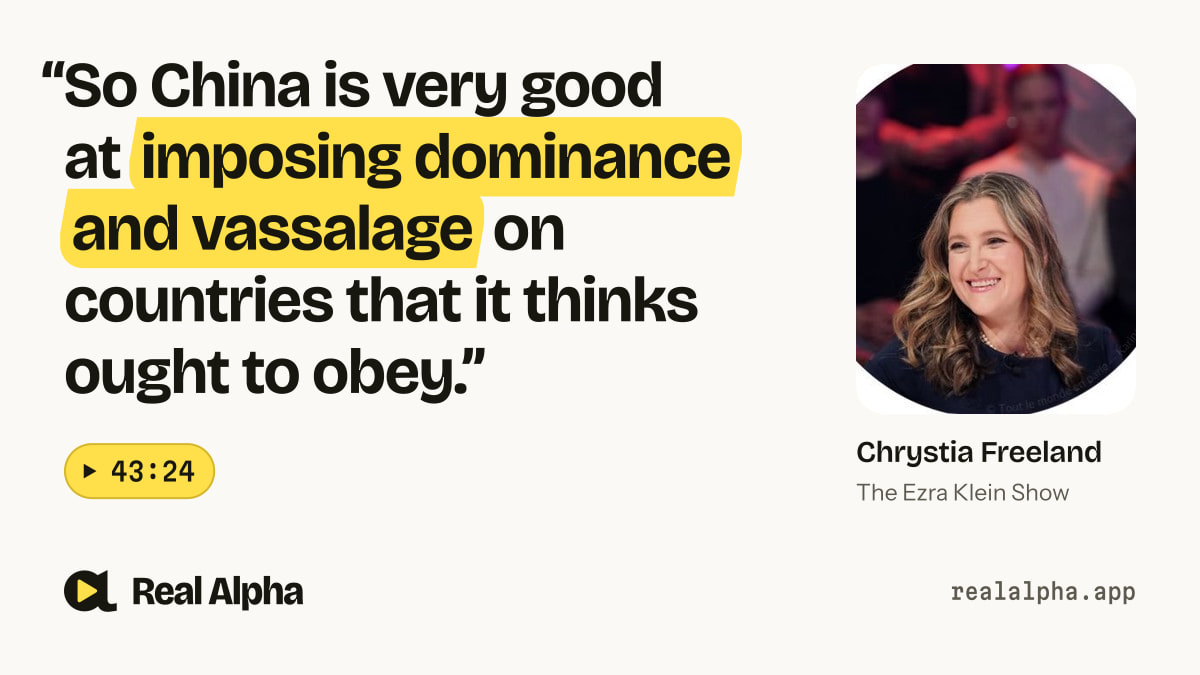
“So China is very good at imposing dominance and vassalage on countries that it thinks ought to obey.”
 Chrystia Freelandat 43:24 · The Ezra Klein Show
Takeaways
- China punished Norway over a Nobel Prize for a Chinese writer.
- Lithuania faced economic pressure for its relationship with Taiwan.
- Canada's arrest of a Huawei executive led to two Canadians being detained.
About this segment
Chrystia Freeland challenges China's claim to be a benign rules-based partner, citing pressure on Norway, Lithuania and Canada. The examples show how Beijing uses market access to enforce political demands.

Chrystia Freeland is a former Canadian deputy prime minister, finance minister and foreign affairs minister.
Reported in Ukraine, managed Thomson Reuters and served as Canada's deputy prime minister and finance minister.

Ezra Klein, Host · Host, The Ezra Klein Show
From “Trumpism Is Backfiring | The Ezra Klein Show”, Oct 20, 2026. Watch the full episode
Thanks. We'll look at and fix what's off.
Transcript
Transcribed by machine (Whisper) from the episode’s audio, so a word may be off here and there.
- 40:03
hundred percent correct the only thing that i would take issue with a little bit is i would say Let's not fall for the Chinese propaganda, right? The Chinese line is, okay, you might not like us, you might think it's bad that we oppress Uyghurs and Tibetans and that we crushed liberties in Hong Kong, but don't pay attention to that. Like, don't be like a Namby Pamby liberal. You can trust us as an international player because we play by the rules.
- 40:37
We are not a power that seeks to expand. We're not a power that seeks to dominate. We actually believe in the rules-based international order. So kind of, you know, I might be beating up my wife and kids at home, but, you know, when I'm outside in the world, I'm a trustworthy partner. And a partner who, and this is critical in what China is saying right now, a partner who is supportive of the rules-based international order and multilateralism.
- 41:08
And I don't think that's quite true. And where I think it's not true is, first of all, in trade, China broke the global trading system through intentional overcapacity and through intentional and pretty vicious building of supply chain dominance. prominence. And that's one of the things that got Trump elected. Not the only thing, but one of the things. And that's an area where I think he has a point. And then the second thing is, I think we should be careful about believing the Chinese assertions that, you know, they don't want to change us. That they want, you know, the world just to come.
- 41:55
kind of have rules-based multilateralism. China definitely wants to change Taiwan. And China passed a law that gives it extraterritorial authority, as deemed by itself, over political forces outside China that China deems to be acting against China's ethnic unity. And, you know, Final thing I would say is China has been pretty Stephen Miller-esque. The strong do what they will and the weak suffer what they must in its foreign policy.
- 42:39
The iron law of power. Right, exactly. The only difference is China has done it effectively. So when Norway granted a Nobel Prize to a Chinese writer, okay, I'm like, that's not something the Norwegian government is the boss of. But China punished Norway. And China punished Norway by banning salmon exports. And Norway had to grovel and kowtow to get them reinstated. When Lithuania wanted to have a relationship with Taiwan, China imposed economic punishment on Lithuania. When Canada honored our extradition treaty with the United States and arrested, but like under pretty nice house arrest in a $5 million Vancouver mansion, the CFO of Huawei, two Canadians were illegally arrested and detained in conditions that experts said amounted to torture.
- 43:37
So China is very good at imposing dominance and vassalage on countries that it thinks ought to obey. It's funny. I don't think – I agree with you.