The alpha, twice a week
That was 2 min.
Get the best new moments in your inbox every Wednesday and Saturday. It's free.
Check your inbox
We sent a link to your address. Click it to finish signing up. Not there in a minute? Look in spam.
or
Sourcery · 2 min · Dec 22, 2025
Anduril's product-first model rewards speed over billable work
 Palmer Luckey
 says Anduril funded Fury itself and flew it 556 days after signing with the Air Force.
In this episode
Full analysis- 4:28Anduril treats failed tests as part of product development3 min
- 14:18Visible-spectrum invisibility is easy but often not usefulPro pick 4 min
- 32:03Design weapons for factories the country already has3 min
- 2:00Anduril's product-first model rewards speed over billable work2 min
- 11:41Spacecraft would be too fragile to armor in combat3 min
- 17:53Luckey's UAP theory favors the distant past over the future4 min
- 22:06Seabed Sentry filters ocean detections into useful alerts3 min
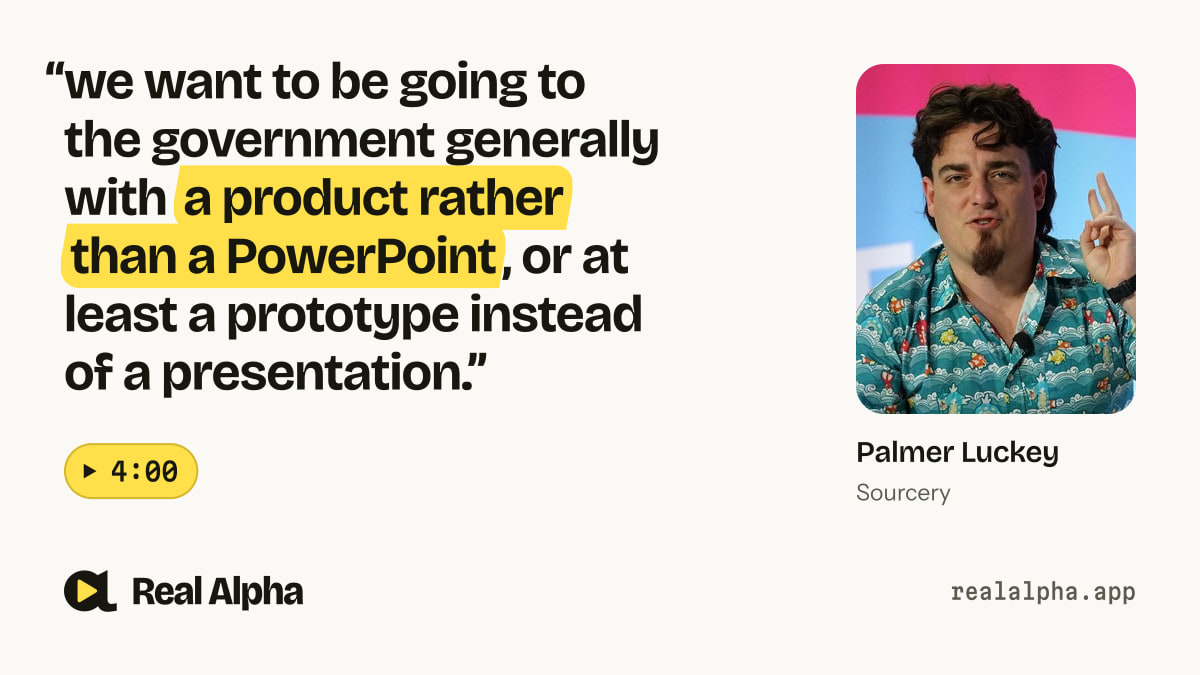
“we want to be going to the government generally with a product rather than a PowerPoint, or at least a prototype instead of a presentation.”
 Palmer Luckeyat 4:00 · Sourcery
Takeaways
- Fury flew 556 days after Anduril signed its Air Force contract.
- Anduril competed with Boeing, Northrop Grumman and Lockheed Martin.
- Self-funding ties returns to speed and products that work.
About this segment
Palmer Luckey says Anduril funded Fury itself and flew it 556 days after signing with the Air Force. Selling a product, he says, rewards speed and working systems over prolonged contract work.

Palmer Luckey is cofounder of Anduril.
Co-founded Anduril, which builds autonomous defense systems, and designed the Oculus Rift that revived VR.

Molly O'Shea, Host · Founder, Sourcery
Ex-Upfront Ventures investor; has interviewed Alex Karp and Palmer Luckey.
From “Palmer Luckey on UFOs, Anduril, Invisibility Tech, & Moon Wars”, Dec 22, 2025. Watch the full episode
Thanks. We'll look at and fix what's off.
Transcript
Transcribed by machine (Whisper) from the episode’s audio, so a word may be off here and there.
- 2:06
But of the things that are in this showroom, one of the things we're most proud of lately is Fury, also known as the FQ-44. This is the first autonomous fighter that the United States Air Force has ever procured. We recently just flew it for the first time. We went from signing a contract with the Air Force to first flight in 556 days, which is, as far as I know, the fastest new fighter development program since the end of the Korean War.
- 2:33
The really exciting thing about this program is we were competing against a lot of the big guys. So we were competing against Boeing, Northrop Grumman, Lockheed Martin, and in the end, Andrel beat all of them, which was really gratifying to go from starting this company to going toe-to-toe with the guys who are legends of the fighter community and actually get selected to build something, build something to fly.
- 2:57
So it's an AI-powered fighter jet that flies alongside manned fighters. So imagine if I had an F-35 pilot, he might fly with two or three or four or five of these alongside with him, extending his weapons webs forward, his sensors forward, and allowing them to engage in risks that you would never want a person to do. You know, there's a lot of ways to win a fight and live to see another day. There's a lot of ways to win a fight and sacrifice pawns on the board.
- 3:26
And autonomy means that you can do that without the ethical problems of, you know, just throwing away human lives. And what do you think this costs you compared to what the government would cost them? I think that we're, in general, much more efficient than the government. We've done a pretty good job. We like to think of our approach as being a defense product company, not a defense contractor. That is, we're not getting paid to engage in contracted work where they say, go and do this many hours of work to build exactly this thing.
- 3:58
Instead, we're investing our own money. in building what we think the right products are, and then we sell them to the government. So we want to be going to the government generally with a product rather than a PowerPoint, or at least a prototype instead of a presentation. And that's gone really, really well for us. It leads to way better incentive structures. We make more money when we move faster rather than more money when we move more slowly.