The alpha, twice a week
That was 3 min.
Get the best new moments in your inbox every Wednesday and Saturday. It's free.
Check your inbox
We sent a link to your address. Click it to finish signing up. Not there in a minute? Look in spam.
or
Sourcery · 3 min · Dec 22, 2025
Seabed Sentry filters ocean detections into useful alerts
 Palmer Luckey
 describes fiber-optic microphones and software that can locate submarines, ships and divers.
In this episode
Full analysis- 4:28Anduril treats failed tests as part of product development3 min
- 14:18Visible-spectrum invisibility is easy but often not usefulPro pick 4 min
- 32:03Design weapons for factories the country already has3 min
- 2:00Anduril's product-first model rewards speed over billable work2 min
- 11:41Spacecraft would be too fragile to armor in combat3 min
- 17:53Luckey's UAP theory favors the distant past over the future4 min
- 22:06Seabed Sentry filters ocean detections into useful alerts3 min
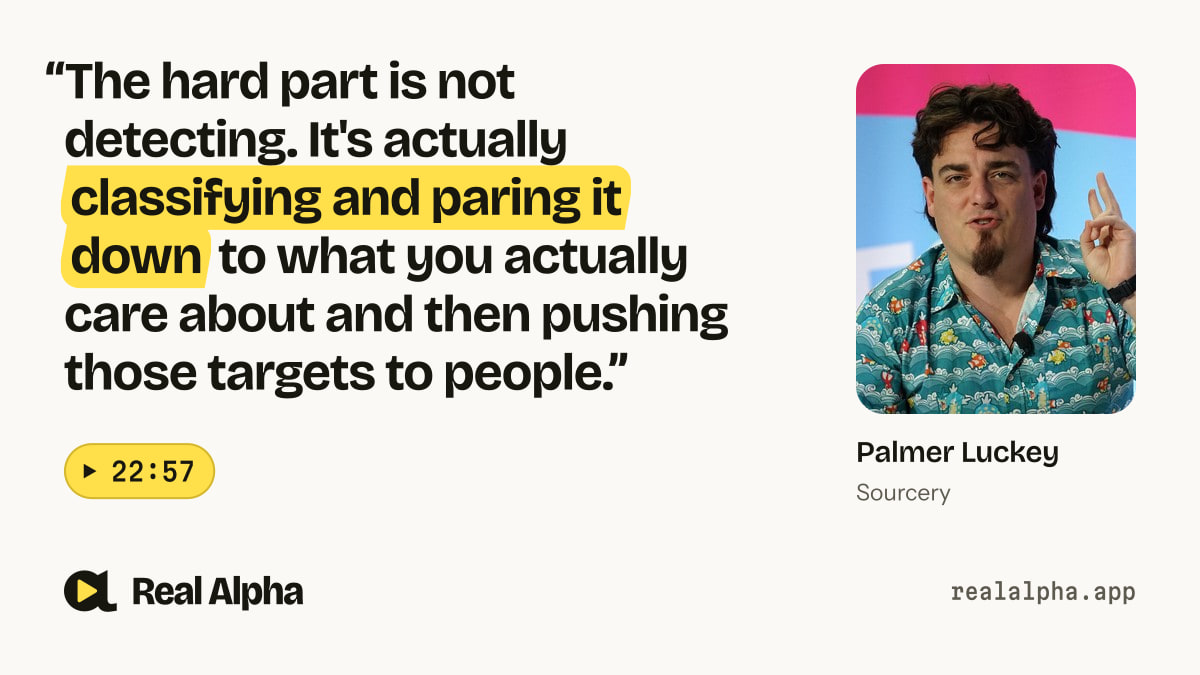
“The hard part is not detecting. It's actually classifying and paring it down to what you actually care about and then pushing those targets to people.”
 Palmer Luckeyat 22:57 · Sourcery
Takeaways
- Fiber-optic microphone arrays pick up distant underwater signatures.
- Processing can locate submarines, boats, divers and whales.
- Filtering helps operators focus on relevant detections.
About this segment
Palmer Luckey describes fiber-optic microphones and software that can locate submarines, ships and divers. The system's key task is filtering detections into alerts operators need.

Palmer Luckey is cofounder of Anduril.
Co-founded Anduril, which builds autonomous defense systems, and designed the Oculus Rift that revived VR.

Molly O'Shea, Host · Founder, Sourcery
Ex-Upfront Ventures investor; has interviewed Alex Karp and Palmer Luckey.
From “Palmer Luckey on UFOs, Anduril, Invisibility Tech, & Moon Wars”, Dec 22, 2025. Watch the full episode
Thanks. We'll look at and fix what's off.
Transcript
Transcribed by machine (Whisper) from the episode’s audio, so a word may be off here and there.
- 22:12
as completely independent parallel tracks yeah so this is one of our products that i think doesn't get nearly enough attention. It's our seabed sentry. For context, Anduril's best-selling product has been our sentry tower. So we sell them to the military, like Air Force, Navy, Marine Corps, a bunch of foreign customers. The Brits have a bunch of them. And Border Patrol has a bunch of them. We're covering about 35% of the U.S. southern border now. It's basically an autonomous tower that scans 360 degrees, detects all the people, vehicles, animals, drones, whatever, within a few miles.
- 22:52
And then most importantly, after detecting everything, reasons about what you might care about and what you would not, and then strips out all of the data you don't need. The hard part is not detecting. It's actually classifying and paring it down to what you actually care about and then pushing those targets to people. So giving you basically perfect situational awareness of what's going on in the area.
- 23:13
The Seabed Sentry is an extension of what we've done with the land-based Anderall Sentry Tower products. It's something that allows you to know where everything is under and on the surface of the ocean. We use a few different ways of doing this, but the primary way is this extending fiber optic microphone array. It's an extraordinarily sensitive microphone that can allow you to hear things that are very, very, very far away.
- 23:43
And then it runs it through processing that is more sophisticated than any human sonar operator could ever be. And it is able to figure out by working with other systems where all these signatures are. So I can know where all the whales are. I can know where all the submarines are. I know where all of them are. boats are. I know where all the divers are. And of course the hard problem again becomes not just detecting things, but filtering out all the things you don't care about. I probably don't need to know where all the whales are. I probably don't need to know where all the fish are. Probably don't need to know where all the swimmers are. But I might want to know if there's divers in a harbor where there shouldn't be any people. I might want to know about ships that are not showing up on radar, but I can find their acoustic signature. I might want to know about submarines that I can't
- 24:26
find for my space-based sensors or my air-based sensors or my ground-based or my, you know, sea-based sensors. But with this, I can see them. It's really just trying to make the world transparent to military. You know, we want to know where everything is. We don't want anyone