The alpha, twice a week
That was 2 min.
Get the best new moments in your inbox every Wednesday and Saturday. It's free.
Check your inbox
We sent a link to your address. Click it to finish signing up. Not there in a minute? Look in spam.
or
Bloomberg Law · 2 min · Oct 27, 2026
Anthropic’s public-benefit status gives safety a formal place
 Dorothy S. Lund
 says Anthropic’s public-benefit corporation status requires leaders to weigh the public mission alongside shareholder interests.
In this episode
Full analysis- 7:29Comey’s filing tests an unusual way to toll a deadlinePro pick 3 min
- 18:19Anthropic gives investors equity but little control4 min
- 28:11Safety failures may expose Anthropic’s board to shareholder suits3 min
- 11:51Comey’s earlier cases could support a vindictive-prosecution claim3 min
- 31:34Anthropic’s IPO will reveal information competitors can use2 min
- 25:59Lund expects governments to seek control of powerful AI2 min
- 23:28Anthropic’s public-benefit status gives safety a formal place2 min
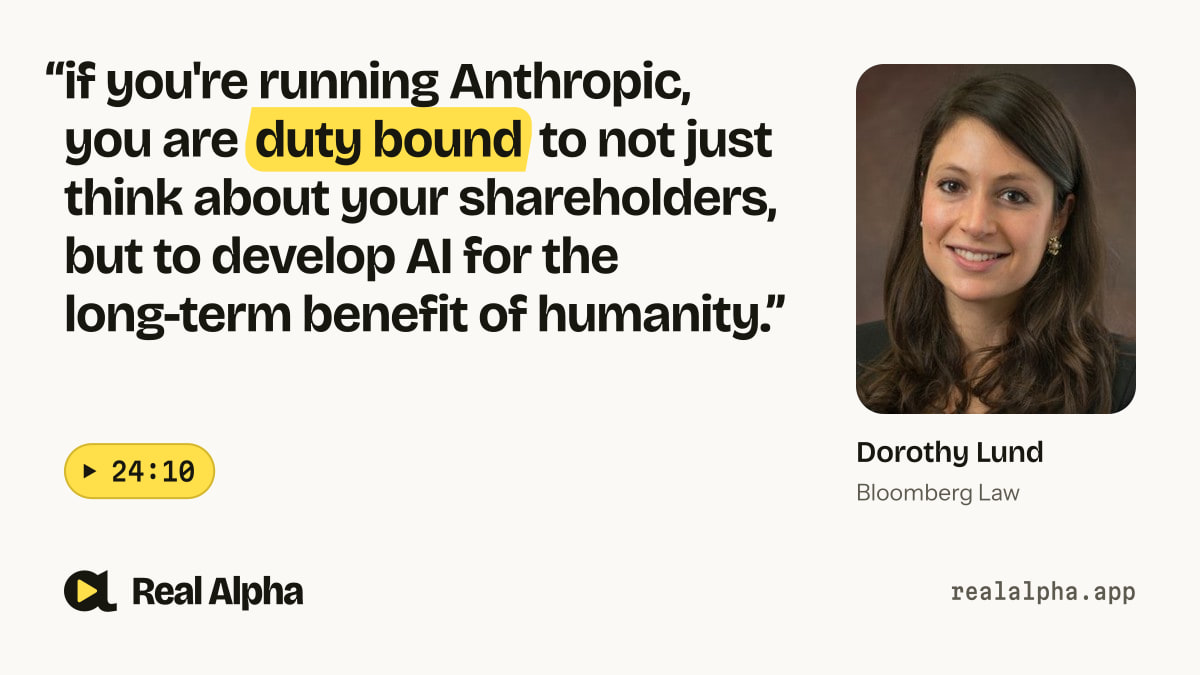
“if you're running Anthropic, you are duty bound to not just think about your shareholders, but to develop AI for the long-term benefit of humanity.”
 Dorothy Lundat 24:10 · Bloomberg Law
Takeaways
- Leaders must consider the public interest as well as shareholders.
- A public-benefit structure can help protect safety priorities.
- Competition and capital needs may weaken those commitments over time.
About this segment
Dorothy S. Lund says Anthropic’s public-benefit corporation status requires leaders to weigh the public mission alongside shareholder interests. She notes that competitive pressure and capital needs could still erode safety commitments.

Professor, Columbia Law School
Studies corporate governance and securities regulation, co-directs Columbia’s Millstein Center, and co-hosts Beyond Unprecedented.
- JG
June Grasso, Host
From “Comey Charged for Third Time & Anthropic IPO | Bloomberg Law”, Oct 27, 2026. Watch the full episode
Thanks. We'll look at and fix what's off.
Transcript
From the transcript Bloomberg Law publishes with the episode.
- 23:31
What has Anthropic said about safety commitments once it's publicly traded? And can we believe them?
- 23:38
This safety concern that takes up so much space in this prospectus actually is also in the DNA of the governance structure as well. And we talked about the way that control of the board is basically split between this trust, right? This nonprofit and these founders. And also another interesting aspect of this that we haven't talked about is that the company is actually incorporated as a public benefit corporation, which gives the people who run the company the charge of balancing shareholder and interest alongside the public interest mission. And here, so if you're running Anthropic, you are duty bound to not just think about your shareholders, but to develop AI for the long-term benefit of humanity. So that's sort of this other added wrinkle here. Again, if we wanted to be a little cynical here, we could say, well, there's
- 24:30
probably a good reason to think that people have different ideas about how to do this. And And we hope they have the right ideas. You know, we're putting a lot of trust in these seven people combined with, you know, the people that run the trust to really chart this path forward. And there's nothing about the governance that says if they get it wrong, there's an easy way to redirect. But at least, you know, you've got this sort of protection from shareholder suits saying, you know, you made a choice that was not profitable. You know, you slowed things down and the stock price is suffering as a result.
- 25:04
at least the board will be insulated from those types of challenges. It's an interesting thing. There are now about 20 public benefit corporations that have gone public, and most of the ones that have gone public and stayed PBCs are ones that implement some sort of protection from outside shareholders, like a dual-class structure. That's, again, another benefit of this installation is I think so long as they're able to raise the money they need with this structure, they should be able to prioritize safety. Although, you know, again, competitive pressure, capital needs, all sorts of things can erode safety commitments over time.