The alpha, twice a week
That was 2 min.
Get the best new moments in your inbox every Wednesday and Saturday. It's free.
Check your inbox
We sent a link to your address. Click it to finish signing up. Not there in a minute? Look in spam.
or
Bloomberg Law · 2 min · Oct 27, 2026
Lund expects governments to seek control of powerful AI
 Dorothy S. Lund
 predicts regulation and says nationalization is possible if AI becomes as powerful as expected.
In this episode
Full analysis- 7:29Comey’s filing tests an unusual way to toll a deadlinePro pick 3 min
- 18:19Anthropic gives investors equity but little control4 min
- 28:11Safety failures may expose Anthropic’s board to shareholder suits3 min
- 11:51Comey’s earlier cases could support a vindictive-prosecution claim3 min
- 31:34Anthropic’s IPO will reveal information competitors can use2 min
- 25:59Lund expects governments to seek control of powerful AI2 min
- 23:28Anthropic’s public-benefit status gives safety a formal place2 min
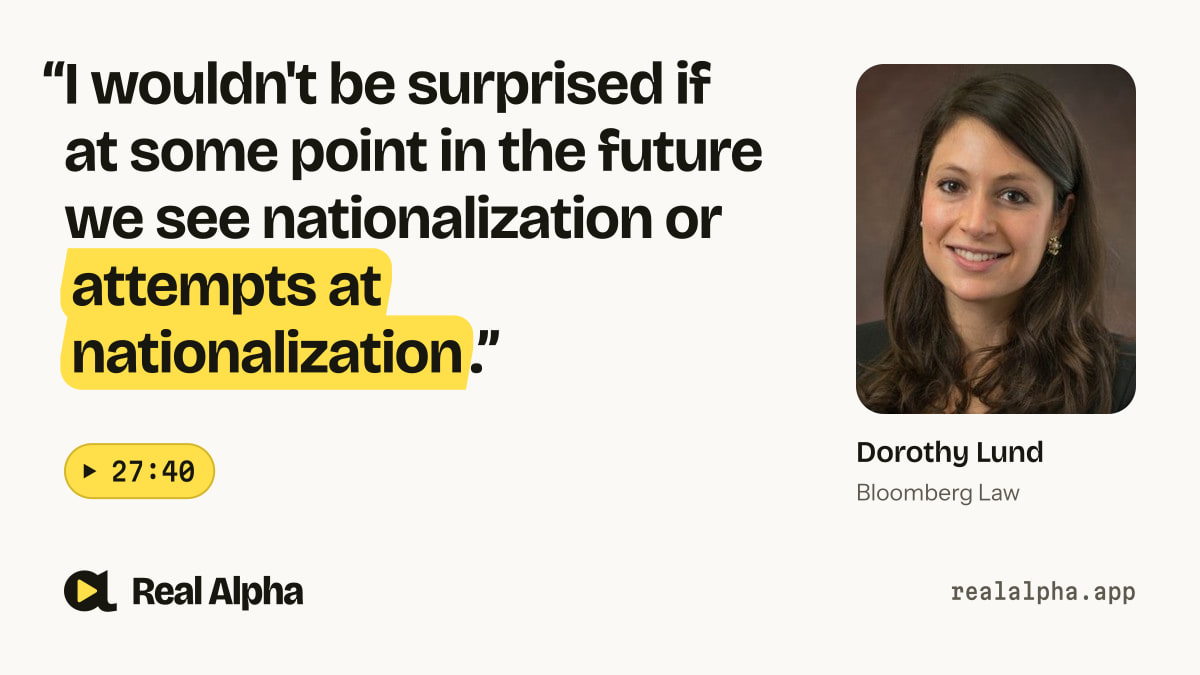
“I wouldn't be surprised if at some point in the future we see nationalization or attempts at nationalization.”
 Dorothy Lundat 27:40 · Bloomberg Law
Takeaways
- She expects regulation if self-regulation falls short.
- She sees nationalization as a possible future response.
- She points to the Manhattan Project as a precedent for government-led development.
About this segment
Dorothy S. Lund predicts regulation and says nationalization is possible if AI becomes as powerful as expected. She compares the prospect to the Manhattan Project, which was developed under government authority.

Professor, Columbia Law School
Studies corporate governance and securities regulation, co-directs Columbia’s Millstein Center, and co-hosts Beyond Unprecedented.
- JG
June Grasso, Host
From “Comey Charged for Third Time & Anthropic IPO | Bloomberg Law”, Oct 27, 2026. Watch the full episode
Thanks. We'll look at and fix what's off.
Transcript
From the transcript Bloomberg Law publishes with the episode.
- 26:02
talking to Columbia Law School professor Dorothy Lund about Anthropic's upcoming IPO. I mean, do you think that there is a high possibility of government interference or control in the future? I'm not saying the Trump administration, but let's say Democratic administrations going forward.
- 26:23
Yeah, I absolutely do. You know, I think they themselves have said, things to this degree that, you know, there's a real risk of government regulation and even all the way to nationalization. I mean, if this ends up being as powerful as everyone expects it to be rivaling, you know, governments and what, what this technology can do, you know, every government is going to want to have an interest in and having some way to, to control it. I know regulation at this moment in time is, has not been, um, a priority of the Trump administration. And, you know, you've got a lot of these AI leaders saying we can regulate ourselves and it'll be interesting. One of the other interesting aspects of this being a public company, it's not just that you and I can invest, but it's that now they're going to have to show us a lot
- 27:09
more about what they're doing. And I think we'll get some sense of like, Oh yeah, how exactly are you regulating? How are you slowing things down? What steps are you taking? Um, because this is all going to have to be disclosed. Right. Um, So I think that's actually a benefit of these companies going public. But assuming self-regulation isn't up to the task or assuming we get a new administration that's more interested in regulating this technology, I think we will see regulation.
- 27:42
And again, I wouldn't be surprised if at some point in the future we see nationalization or attempts at nationalization. If you look back to other really impactful technologies in human history. Think about like the Manhattan Project, right? We didn't have private companies developing these technologies, right? These were all done under the overhead of government authority. And so to the extent that we are talking about really powerful technology, I wouldn't be shocked to see us move in that direction.