The alpha, twice a week
That was 3 min.
Get the best new moments in your inbox every Wednesday and Saturday. It's free.
Check your inbox
We sent a link to your address. Click it to finish signing up. Not there in a minute? Look in spam.
or
Founders · 3 min · Nov 1, 2026
AppLovin beat better-funded ad rivals by prioritizing technology
 Rafael Vivas
Funded rivals had bigger sales teams, but AppLovin prioritized its ad-serving technology.
In this episode
Full analysis- 30:14Lion Studios grew from a broken partnership into a $250 million businessPro pick 3 min
- 20:54AppLovin leaders stay hands-on to keep work focusedPro pick 3 min
- 44:01A falling stock price drew Vivas back to AppLovin3 min
- 16:07AppLovin beat better-funded ad rivals by prioritizing technology3 min
- 38:32He left Lion once the business could succeed without him6 min
- 1:00:47Mark Rosner taught Vivas that every contract detail matters4 min
- 48:11AppLovin automates and removes work before hiring3 min
- 34:00Lion Studios found high-output game teams outside the US2 min
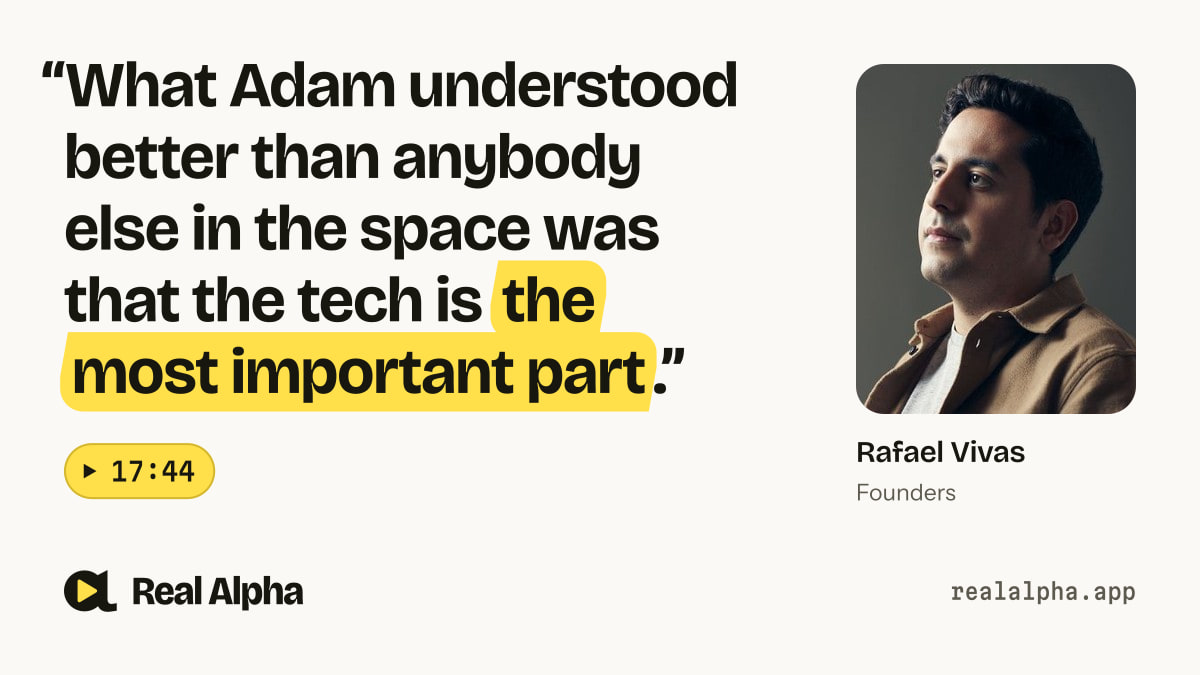
“What Adam understood better than anybody else in the space was that the tech is the most important part.”
 Rafael Vivasat 17:44 · Founders
Takeaways
- Competitors emphasized sales while AppLovin focused on its algorithms.
- Rules and regression learning shaped which ads the platform served.
- Higher monetization gave Vivas a clear pitch to publishers.
About this segment
Funded rivals had bigger sales teams, but AppLovin prioritized its ad-serving technology. Its rules and regression learning helped it monetize some traffic at twice competitors’ rates.

Rafael Vivas is a founding team member of AppLovin and cofounder of Lion Studios.
Co-founded Lion Studios, which generated over $250 million in revenue in two years, after joining AppLovin's founding team.

David Senra, Host · Host, Founders
Has read an entrepreneur's biography every week for Founders since 2016.
From “High School Dropout to Multi-Billionaire: The Relentless Drive of Rafael Vivas”, Nov 1, 2026. Watch the full episode
Thanks. We'll look at and fix what's off.
Transcript
Transcribed by machine (Whisper) from the episode’s audio, so a word may be off here and there.
- 16:13
So, there was actually plenty of other companies in the space that were very well funded. And, you know, they were backed by the top tier VCs at the time. So, Benchmark, Sequoia, and so on. Some of them were very, very successful already. It felt like the market actually at the time was very mature. It was like, how are these, you know, at the time, it was like this one kid doing sales and a few people in Palo Alto were going to succeed against these behemoths that already had a, at that time, it looked like a lot of the market.
- 16:38
And also, when Adam went to go try and raise this money, we were already profitable. It's funny because he was giving them a deal on a silver platter, revenue traction, companies growing like crazy month over month, very profitable, you know, world-class margins compared to everyone else in the space, and he still got turned down. Why do you think that is? I think what it came down to was that we have a very untraditional story and background.
- 17:03
A lot of people that, you know, had raised money before, you know, they were doing these mobile game app platforms. They were game publishers or they were part of these big corporate companies. And so on paper, you know, they worked at Facebook or they worked at Google. They were on the AdMob team, which was one of the biggest ad platforms at the time. You know, they worked for all these businesses.
- 17:22
So on paper, they looked great versus us. We were performance marketers who, we always ran arbitrage businesses. ever run an ad network that had kind of seen its way to a very profitable exit. So I think that's really what it was. How do you start, like you guys are a smaller team, no funding, you're such a bootstrap, competing against already established players that have more money and have more people.
- 17:46
So how do you guys start building a company? How do you start winning? What Adam understood better than anybody else in the space was that the tech is the most important part. Everyone else focused on sales, right? So they had hundreds of advertisers and they had, you know, these premium publishers, but their algorithms were shit. A lot of these algorithms were people just like manually optimizing things in the background.
- 18:08
Now, we didn't have like a state-of-the-art machine learning model. That's not what existed back then. But we had rules in place and we did regression learning around, you know, kind of deciding what to serve. And that in itself allowed us to out-compete our competitors, even though we didn't have as much demand and even though our publishers at that time weren't as high quality as some of the other ad platforms.
- 18:29
And so when we would go and we'd actually see our monetization, let's say we'd go head to head with another ad platform. And a lot of times we would monetize at, you know, double the clip of somebody else. So the conversation of when I would run into, when I'd walk into a room where I'd reach out to a publisher was, I guarantee you more money than you're making elsewhere. It was a no brainer, right?
- 18:47
A lot of people, they believed it was too good to be true, actually. So they make us put it in writing. We had no issue doing that. I would really say it was like Adam's vision and going all in on the tech is what allows us to succeed. Okay. We were talking before we started recording. You're like, I think our brand is like too soft and it doesn't represent like the insane performance culture that we have inside the company.
- 19:07
Okay.