The alpha, twice a week
That was 3 min.
Get the best new moments in your inbox every Wednesday and Saturday. It's free.
Check your inbox
We sent a link to your address. Click it to finish signing up. Not there in a minute? Look in spam.
or
Dwarkesh Podcast · 3 min · Nov 13, 2026
Automated researchers could accelerate progress in three ways
 Dwarkesh Patel
 argues that AI researchers would work faster, match top human talent, and scale across parallel tasks.
The episode’s best minutes
Full analysis- 11:07Automated researchers could accelerate progress in three waysPro pick 3 min
- 17:17Verifiable training could build general-purpose learnersPro pick 6 min
- 39:47More automated researchers could make experiment compute go furtherPro pick 4 min
- 5 more moments in the full episode
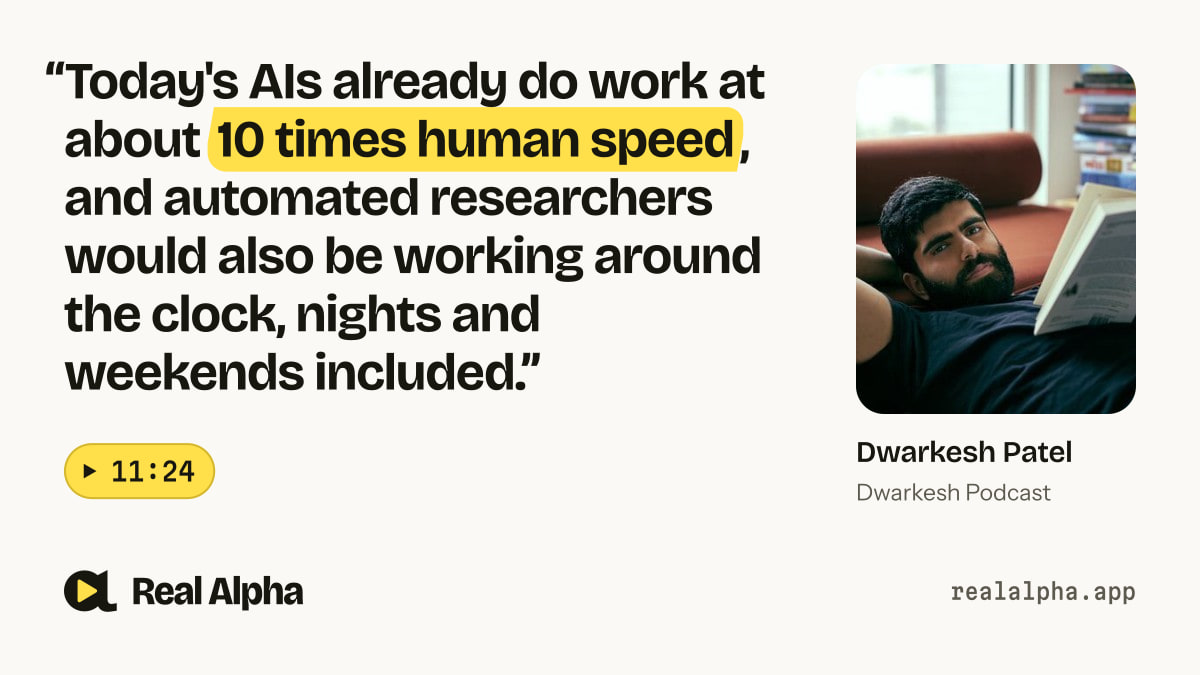
“Today's AIs already do work at about 10 times human speed, and automated researchers would also be working around the clock, nights and weekends included.”
 Dwarkesh Patelat 11:24 · Dwarkesh Podcast
Takeaways Pro pick
- AI agents can work around the clock at roughly 10 times human speed.
- A small group of top researchers drives much of frontier-lab progress.
- Verifiable, modular work lets many agents test approaches in parallel.
One of Pro's picks, open to you here. Try Pro free for 7 days
One of Pro's picks. The rest of the summary and the 3 takeaways are in Real Alpha Pro; the video, the quote and the transcript stay free.
Read it with Pro, 7 days freeAbout this segment
Dwarkesh Patel argues that AI researchers would work faster, match top human talent, and scale across parallel tasks. Together, these advantages could make AI progress several times faster.

Dwarkesh Patel, Host
Host, Dwarkesh Podcast
Co-wrote The Scaling Era, an oral history of AI; named to TIME100 AI.
From “Recursive self-improvement has started”, Nov 13, 2026. Watch the full episode
Thanks. We'll look at and fix what's off.
Transcript
From the transcript Dwarkesh Podcast publishes with the episode.
- 11:14
Once AI is as good as the best humans at AI research, algorithmic progress will get a lot faster for three important reasons. One, the AIs will be much faster. Two, each of them will be very smart. And three, there will be a lot more of them. Let's start with faster first. Today's AIs already do work at about 10 times human speed, and automated researchers would also be working around the clock, nights and weekends included. As a result, each individual automated researcher will be cramming roughly 50 times more work Every calendar week than a human researcher can do.
- 11:46
Of course, that doesn't mean AI progress will immediately accelerate 50x. Those automated researchers would still be bottlenecked by compute for experiments which aren't running any faster so there There would be diminishing returns but even with extremely steep diminishing returns this alone would make algorithmic progress proceed many times faster than it And this is before we come for the fact that in the scenario I'm talking about, every automated researcher will be at least as good at AI research and engineering as the very best humans today.
- 12:19
My sense is that around 80% of the algorithmic progress at a given frontier lab is driven by its 50 top researchers. It's not for nothing that Zuckerberg was willing to pay hundreds of millions of dollars to acquire the best talent in the industry. And so you get another big speedup in algorithmic progress from the fact that every single engineer and researcher in this automated company will be at the level of the very best humans in today's frontier AI labs.
- 12:44
And finally, there will be a lot more automated researchers. Now, throwing more workers at a problem isn't always helpful. For example, a swarm of agents probably isn't going to be able to write a great novel much faster than a single agent could. But other tasks lend themselves much more to parallelization. For example, look at this animation that I'm overlaying, which shows a bunch of different clods working together to formalize Fermat's last theorem.
- 13:08
This feat had thousands of modular subtasks, each of which could be completed independently and where each agent could locally check whether their work had succeeded. AI research is closer to formalizing a theorem than it is to writing a novel because there's a lot There's a lot of independent modular work to do, and there are verifiable proxies for progress. That means a swarm of agents can try out a thousand different approaches and see which one performs best, and they can do this independently for each different part of the pipeline.
- 13:36
AI companies are already made up of dozens of different teams working independently on different parts of model development. One team, for example, improves how the pre-training data is filtered. Another designs a particular kind of synthetic RL environment. Another writes a better attention kernel, and so on. In domains like this, where different streams of work can be done and checked independently, dumping in lots of persistent hill-climbing agents tends to speed up progress a lot.
- 14:02
Again, there will be steeply diminishing returns just from adding more parallel researchers. Anyone who's ever worked in the team before knows that having 100,000 collaborators doesn't mean that you'll go 100,000 times faster, probably not even 100 times faster. But given the nature of AI research, it's implausible that you wouldn't be going at least a couple times faster from having orders of magnitude more automated labor.