The alpha, twice a week
That was 6 min.
Get the best new moments in your inbox every Wednesday and Saturday. It's free.
Check your inbox
We sent a link to your address. Click it to finish signing up. Not there in a minute? Look in spam.
or
Dwarkesh Podcast · 6 min · Nov 13, 2026
Verifiable training could build general-purpose learners
 Dwarkesh Patel
 argues that practice in simulated environments and historical prediction tasks could build skills that transfer to unfamiliar domains.
The episode’s best minutes
Full analysis- 11:07Automated researchers could accelerate progress in three waysPro pick 3 min
- 17:17Verifiable training could build general-purpose learnersPro pick 6 min
- 39:47More automated researchers could make experiment compute go furtherPro pick 4 min
- 5 more moments in the full episode
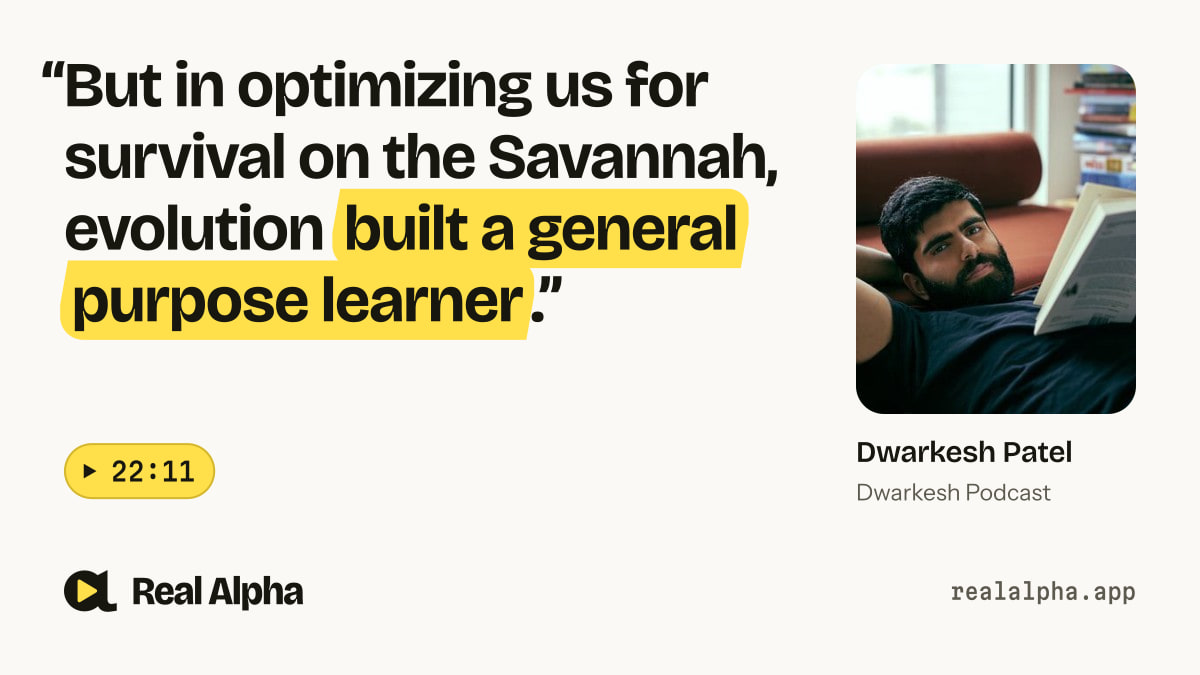
“But in optimizing us for survival on the Savannah, evolution built a general purpose learner.”
 Dwarkesh Patelat 22:11 · Dwarkesh Podcast
Takeaways Pro pick
- Complex expertise combines domain knowledge with general problem-solving skills.
- Simulated worlds could train agents on long, messy, collaborative tasks.
- Evolution produced abilities beyond the narrow tasks that selected for them.
One of Pro's picks, open to you here. Try Pro free for 7 days
One of Pro's picks. The rest of the summary and the 3 takeaways are in Real Alpha Pro; the video, the quote and the transcript stay free.
Read it with Pro, 7 days freeAbout this segment
Dwarkesh Patel argues that practice in simulated environments and historical prediction tasks could build skills that transfer to unfamiliar domains. Evolution offers a precedent for learning beyond the tasks that shaped it.

Dwarkesh Patel, Host
Host, Dwarkesh Podcast
Co-wrote The Scaling Era, an oral history of AI; named to TIME100 AI.
From “Recursive self-improvement has started”, Nov 13, 2026. Watch the full episode
Thanks. We'll look at and fix what's off.
Transcript
From the transcript Dwarkesh Podcast publishes with the episode.
- 17:24
Now, at this point, you might say, how will even superintelligence, which is trained in a data center, beat human experts in domains where the basis of that human expertise is years and years of real world experience? The way we're currently making AI smarter is by RL -ing them on tasks that are easy to automatically grade from within a data center. For example, did the million new lines of code that the AI wrote pass to pass all the unit tests? Did the AI to get really good at building a business from scratch?
- 17:54
How about winning court cases, or having a profitable day of trading in the markets, or helping a candidate win an election? The rollout here requires interacting with the real world, and you can't recreate it from just within the data center. So how will superintelligence get good at this kind of stuff? Well, let me be clear. I don't think we can just bake the answer to every real world problem into the waste.
- 18:20
Rather, my claim is that scaling up RL training will give AIs the abilities necessary to ramp up quickly in new contexts, even in hard-to-verify domains like the ones mentioned above. Getting really good at any complex task requires two things. One is domain-specific knowledge, and the other is a more general set of skills, the kind of capabilities that capable humans have. Like being able to seek out relevant information, make a plan, push forward on that plan through mistakes and obstacles, keep track of what you've learned, and collaborate with other people.
- 18:54
During RSI, automated engineers will build tens of thousands of times more environments than we have currently. And these will be Far larger and longer running and higher quality and more open -ended and covering a much wider range than today's in The AIs will learn to make their way through unfathomable amounts of virtual worlds that are each, to today's video games, what a Bugatti is to a horse and buggy.
- 19:19
These games will be far more difficult and messy and sprawling and realistic than anything that has ever been made for human entertainment. They will require AIs to cooperate or compete with teams of other AIs over long periods of time. For example, an AI might be dropped into a simulated economy of millions of other AIs and told to co -found a successful company. And it's not like the AI will be stuck just thinking about the ideal corporate structure.
- 19:43
It'll go through an evolutionary process that involves centuries of corporate competition to figure out the optimal organizational techniques. The AIs will also train themselves on endless backtests of everything in the history of science and tech and politics and culture. Every discovery, invention, war, election, and quarterly earning that has ever happened. For example, here's one prediction training task.
- 20:07
Can the AI figure out general relativity given a training corpus that includes no information beyond 1700, which is far earlier than any human was on track to discover GR? Another task might be, given every single newspaper article until 1962, can AI predict how the Cuban Missile Crisis is going to unfold? And it's not just the training data that these automated researchers will be improving. They will also radically improve the basic learning algorithms themselves through breakthroughs in online learning and sample efficiency, both of which have verifiable proxies, as I'll discuss later.
- 20:39
In the same way that humans are much more efficient and effective at learning from data than current LLMs are, Future AIs could be far beyond humans at their learning efficiency. Now, why do I think we'll see lots of transfer from verifiable tasks to these more general skills? Well, one reason is that even at one ten thousandth or a millionth of The scale of RL training that will be happening during the intelligence explosion, we're already seeing lots of generalization.
- 21:08
If you point clot code or codex at a project that it's never seen before, it knows how to orient itself and figure out how everything fits together and then tackle an ambitious assignment. Of course, it's hard to measure how much models have improved at tasks that are not easily verifiable because if we could, those tasks would be verifiable. But you can just go talk to a new model and compare it to an old one.
- 21:27
In my experience, AIs have gotten much better at things that have very little to do with code or math. For example, helping me research the abstract questions I needed to answer while writing this essay. The other big piece of evidence for transfer is human evolution. Our general purpose mental architecture was developed by evolution. And evolution is an optimization process with a really crude verifier.
- 21:50
Did your genes pass on or not? In the ancestral environment, the tasks which influenced that outcome were things like hunting and fending off predators and keeping your standing in your tribe. These are our tiny subset of the kinds of tasks that humans are able to tackle today. Evolution did not specifically optimize us to be able to write a Pulitzer Prize winning biography, or make advanced semiconductors, or lead nations of millions of people, or come up with a new branch of mathematics.
- 22:17
But in optimizing us for survival on the Savannah, evolution built a general purpose learner. And in training these AIs, we're running a similar process, except we're doing so deliberately with tasks that are much more closely related to the ones that are needed for success in today's world. And unlike evolution, AI companies are trying to improve transfer during training. For example, by making sure that performance improves on difficult tasks that were held out of trading.
- 22:44
If even dumb, blind evolution can get this much transfer out of building a mind that is effective at propagating itself in the savannah then the deliberate effort that AI companies are putting into building a flexible and general intelligence that can rapidly ramp up in new contexts should advance much further.