The alpha, twice a week
That was 4 min.
Get the best new moments in your inbox every Wednesday and Saturday. It's free.
Check your inbox
We sent a link to your address. Click it to finish signing up. Not there in a minute? Look in spam.
or
Dwarkesh Podcast · 4 min · Nov 13, 2026
More automated researchers could make experiment compute go further
 Dwarkesh Patel
 argues that future AI teams can use compute more efficiently through many small experiments and better methods for extrapolating from them.
The episode’s best minutes
Full analysis- 11:07Automated researchers could accelerate progress in three waysPro pick 3 min
- 17:17Verifiable training could build general-purpose learnersPro pick 6 min
- 39:47More automated researchers could make experiment compute go furtherPro pick 4 min
- 5 more moments in the full episode
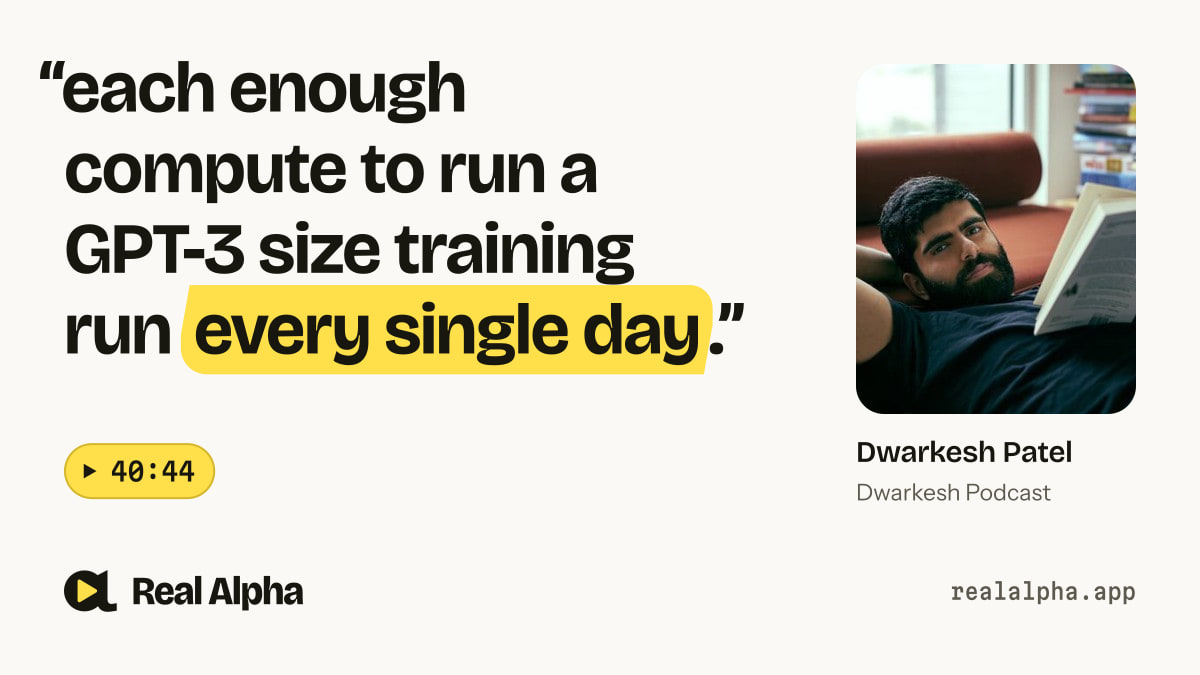
“each enough compute to run a GPT-3 size training run every single day.”
 Dwarkesh Patelat 40:44 · Dwarkesh Podcast
Takeaways Pro pick
- Frontier-lab compute has been growing more than fourfold each year.
- Agents can trade more labor for smaller, more informative experiments.
- Better scaling methods can make small runs predict larger ones.
One of Pro's picks, open to you here. Try Pro free for 7 days
One of Pro's picks. The rest of the summary and the 3 takeaways are in Real Alpha Pro; the video, the quote and the transcript stay free.
Read it with Pro, 7 days freeAbout this segment
Dwarkesh Patel argues that future AI teams can use compute more efficiently through many small experiments and better methods for extrapolating from them. He estimates that thousands of agents could each get substantial training-run capacity.

Dwarkesh Patel, Host
Host, Dwarkesh Podcast
Co-wrote The Scaling Era, an oral history of AI; named to TIME100 AI.
From “Recursive self-improvement has started”, Nov 13, 2026. Watch the full episode
Thanks. We'll look at and fix what's off.
Transcript
From the transcript Dwarkesh Podcast publishes with the episode.
- 39:54
I want to talk about the idea that AI progress will be bottlenecked by experiments. So earlier, I made this extended analogy between the current acceleration in mathematics and what we should expect to happen in AI research. But there is one big difference between AI research and mathematics. In In math, you can simply reason your way with pen and paper to new discoveries, whereas in AI research, you need to run actual experiments to validate your ideas, and these to compute and time.
- 40:24
And as the number of automated researchers grows, each gets access to a smaller and smaller slice of the total experiment compute pie. My answer to this is that each agent will still get access to a ton of compute, basically. Frontier Labs have been more than quadrupling their compute every single year. And if this trend continues, then by the end of 2027, OpenAI could almost give 10,000 agents, so the amount that were involved in solving the Millennium Prize problem, each enough compute to run a GPT-3 size training run every single day.
- 40:55
Keep in mind that the final model, trained in the original Transformer paper in 2017, took three days on eight P100s, which would cost about 50 bucks if you went to rent it today, or about one ten-thousandth of the training compute of GPT-3. If the top human AI researchers, like Norm Shazir and Elia Satskiver, had enough experiment compute to train a GPT-3 size model every single day, they might make slower progress than they currently do, but it would be extremely surprising to me if they failed to make meaningful progress altogether and just sat down and started complaining about how small their cluster was.
- 41:31
Now, how productive do you think an AI lab would be if it had 10,000 great researchers, each with this much compute and each thinking 10 times as fast? You wouldn't want to write a check to this Neolab? The nature of research and experimentation at the labs today reflects that researcher time is extremely scarce relative to compute. Top AI researchers individually get paid hundreds of millions of dollars a year.
- 41:54
So the way labs use compute today tells us very little about how efficiently they could use it if compute, rather than researcher time, was the key bottleneck. There are two main ways in which the RSI agent swarm will use experiment compute much more efficiently than researchers today use it. First, immediately they can trade labor for compute. To save valuable researcher time, experiments today are, and should be, very wasteful with compute.
- 42:19
So instead of painstakingly setting up and carefully monitoring tons of small-scale pre-training experiments, A human researcher today might instead kick off a couple of huge multi-agent RL runs in parallel. But if you're bottlenecked by experiment compute, you can just do more of the former. And when those automated researchers are doing an RL run, they could read every single rollout transfer And immediately pause and rebuild the whole environment if some task is broken.
- 42:44
They could be doing crazy amounts of small -scale ablations of their models to make them oh And when a team of agents decides to combine their compute together in order to do a much bigger run, they could spend many subjective decades designing the most informative pooled experiment. And once it's done running, they could spend further subjective decades comprehensively analyzing it before designing a new experiment.
- 43:07
The other big way that this huge agent swarm could remain productive despite the fact that each individual copy will have access to less compute Is that these automated researchers could come up with a better science for learning from small scale experiments. Scaling laws themselves are a good example of this. The GPT-4 paper says that they were able to predict the model's final loss using models trained with 10,000 x less compute.
- 43:31
One of the things that the smarter and faster automated company could be doing is trying to discover more scaling phenomenon like MuP, which lets researchers anticipate the optimal hyperparameters for a larger run from 100x smaller model. How many more similar discoveries like this are there? I remember chatting to an AI researcher who thought that learning from extremely small neural networks could be incredibly informative.
- 43:54
He put it this way, the gods above must work from the same principles as the ants below.