The alpha, twice a week
That was 5 min.
Get the best new moments in your inbox every Wednesday and Saturday. It's free.
Check your inbox
We sent a link to your address. Click it to finish signing up. Not there in a minute? Look in spam.
or
Training Data · 5 min · Nov 18, 2026
Avoiding a known issue makes the CEO part of the problem
 Dev Ittycheria
 says unresolved issues lower the standard and make the CEO part of the problem.
In this episode
Full analysis- 14:49A CEO’s job is strategy, people, and the conditions to succeedPro pick 3 min
- 33:15A strong CRO builds a sales playbook for the businessPro pick 8 min
- 41:18AI makes speed, unit economics, and talent more important3 min
- 9:26Avoiding a known issue makes the CEO part of the problem5 min
- 17:36A CEO must develop people, not just hire them4 min
- 24:22Math Olympiad filters can miss founders with useful judgment4 min
- 30:08Growth can hide an underbuilt demand-generation engine3 min
- 6:06Vulnerability helps leaders surface problems sooner3 min
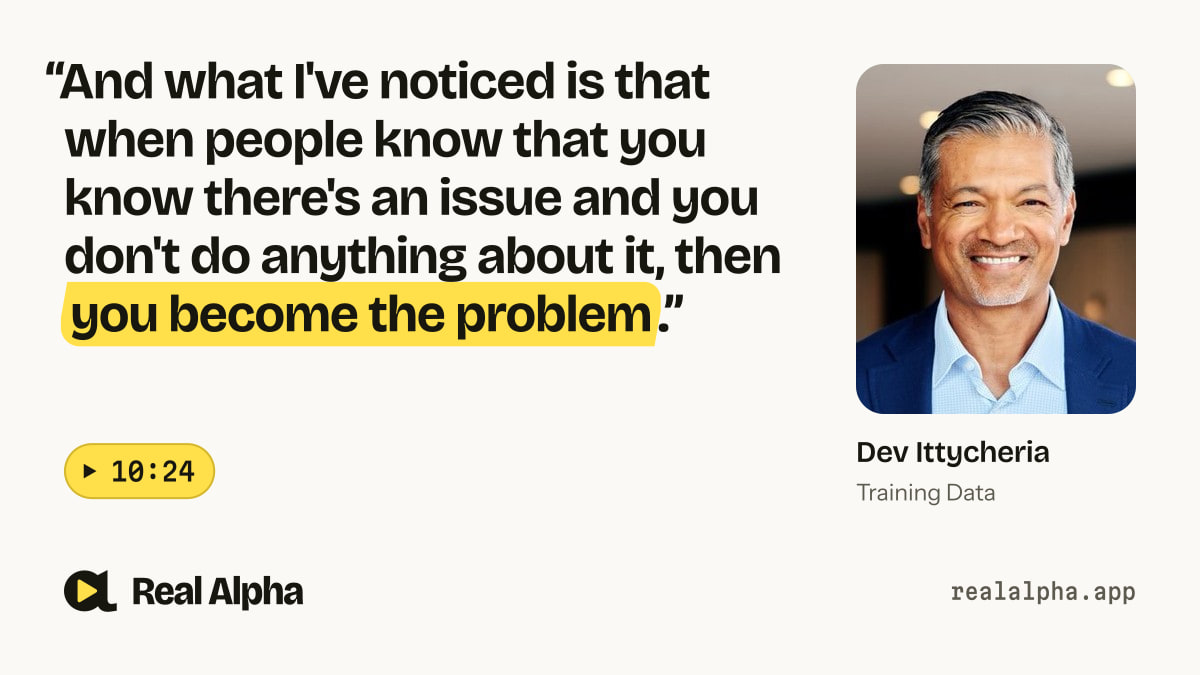
“And what I've noticed is that when people know that you know there's an issue and you don't do anything about it, then you become the problem.”
 Dev Ittycheriaat 10:24 · Training Data
Takeaways
- Avoiding an issue signals a lower standard.
- Kindness can require direct feedback.
- Good news travels up; bad news must be sought.
About this segment
Dev Ittycheria says unresolved issues lower the standard and make the CEO part of the problem. He argues leaders need to confront problems and actively seek bad news.

Dev Ittycheria is CEO of MongoDB.
Led MongoDB through 11 years of exceptional growth, helping establish it as an intelligent data platform for AI.

Sonya Huang, Host · Partner, Sequoia Capital
Works with OpenAI and Anthropic; co-wrote Sequoia's essay on generative AI.

Pat Grady, Host · Co-steward, Sequoia Capital
Joined Sequoia in 2007; backed Snowflake, Zoom, ServiceNow and OpenAI.
From “The Boomerang CEO(s): With MongoDB’s Dev Ittycheria”, Nov 18, 2026. Watch the full episode
Thanks. We'll look at and fix what's off.
Transcript
Transcribed by machine (Whisper) from the episode’s audio, so a word may be off here and there.
- 9:32
are quite introverted and are conflict-averse, just grew up that way. What coaching would you give me? My advice would be that you have to work on that, whether it's through your own introspection or get a coach. But the job of a CEO is in some ways to be confrontational, Not in a nasty or kind of unconstructive way, but you have to confront issues, right? You have to confront why. you know a person is not delivering on their commitments you have to confront an issue around why is this product you know not having the success it has in the field you have to contract the go-to-market team on why certain people are not you know meeting the expectations etc and um and that's your job and and in some ways if you don't do that and you avoid issues those issues just festers not like it's it's not like that issue is going to disappear
- 10:27
and then it takes way too long. And what I've noticed is that when people know that you know there's an issue and you don't do anything about it, then you become the problem. That issue or that person or that thing is not only the problem, you're the problem because you're basically saying there's a new standard and that standard is a lot lower than what they thought it was. The conflict aversion thing is interesting inside of my co-founder and my dynamics. My co-founder is the world's most conflict averse, Homo sapien. And I'm actually a little conflict averse.
- 10:55
Um, and so it sort of forces me into a box of, I need to be the one that sort of is that person that isn't afraid to create conflict and have those hard conversations. And I felt like I was always the person talking about the elephant that's sitting right in the middle of the table that everyone's ignoring. Right. But, but you obviously trained yourself to do that, right? Otherwise you wouldn't have been able to build a business.
- 11:15
You, I think I improved on it over time. It certainly wasn't natural. Um, yeah. Well, I think in some ways it's, you know, we humans are wired to be social animals. 3,000 years ago, if we didn't get along with people in the village, they'd take you out in the back and club you to death, right? So by definition, it is very antithetical to who you are. I mean, some people have no problem being conflict averse. And I think one of the things is that I think there's also a deep desire for people to be liked.
- 11:39
That's one of my bugs, actually. As a human, I think it's good. As a CEO, I think it's a huge bug. Yes. Being liked is okay. But if it stops you from being able to have hard conversations, then you're not doing that person any service. And you're basically conflating polite versus being kind. And to be kind, you actually have to give that person good feedback on where they're not measuring up. I just had a conversation with someone over Slack to one of my execs where I was very disappointed that didn't take ownership of an issue that we discussed yesterday. And I made the point saying, if I care more about this issue than you do, then we have a problem because this in your domain and you should be all over this issue and the person admitted it that's it's a yes i'm you're absolutely right i'm going to fix it which is great to hear but i needed to have
- 12:24
that discussion with that person okay related to this i was PubTest starting in 2006, you know, you get criticism as a CEO through certain channels. I think of a public company today like Mongo or HubSpot. The criticism just comes through everywhere. You see it on Glassdoor, you see it on Blind, you see it on X for Sure, you see it from Wall Street on their analyst reports, you see it on LinkedIn, people complaining about your product. Were you born thick-skinned to deal with all that, or is that hard for you?
- 12:56
Oh, it's definitely hard, right? You just have to learn to just develop thick skin over time. And especially if you have imposter syndrome, right? Like in all of us in some way, shape, or do, when someone says your product sucks or you're making the wrong- You've heard it all. I've heard it all. Now, what's interesting is outside the company, people are very comfortable bad-mouthing. In fact, I think there's an asymmetry of bad news to good news, like blind or glass door.
- 13:21
Anyone who's upset about something is going to post. Where someone is happy is going to not really do anything. where inside a company, I think leaders have an asymmetry of good information, right? Because what happens is that good news will find me anywhere. We closed that deal. We hired that rockstar engineer. The product launched with great success. But bad news, you have to go searching for. And the key as a leader is not only do you have to go searching for it, but you have to make it comfortable for people to tell you bad news. Because again, humans are wired not to tell the true. So you've got to minimize the gap between what people feel and what they say.