The alpha, twice a week
That was 4 min.
Get the best new moments in your inbox every Wednesday and Saturday. It's free.
Check your inbox
We sent a link to your address. Click it to finish signing up. Not there in a minute? Look in spam.
or
The TWIML AI Podcast · 4 min · Nov 24, 2026
Benchmarks should score the reasoning behind answers
 Thore Graepel
Answer-only tests can miss unsupported assumptions, skipped steps, or a correct guess.
In this episode
Full analysis- 6:58Search let AlphaGo find a move its policy network rejected3 min
- 15:19Choose the next step by how much uncertainty it can reduce4 min
- 23:05Separate stored knowledge from the reasoning processPro pick 8 min
- 43:20Evidence assessment is the system's highest-risk step4 min
- 59:14Benchmarks should score the reasoning behind answers4 min
- 37:57Knowledge and reasoning can scale along separate axes5 min
- 31:17Narrow LLM calls can make evidence checks more reliable4 min
- 35:10Decision models can supply cheap, calibrated priors3 min
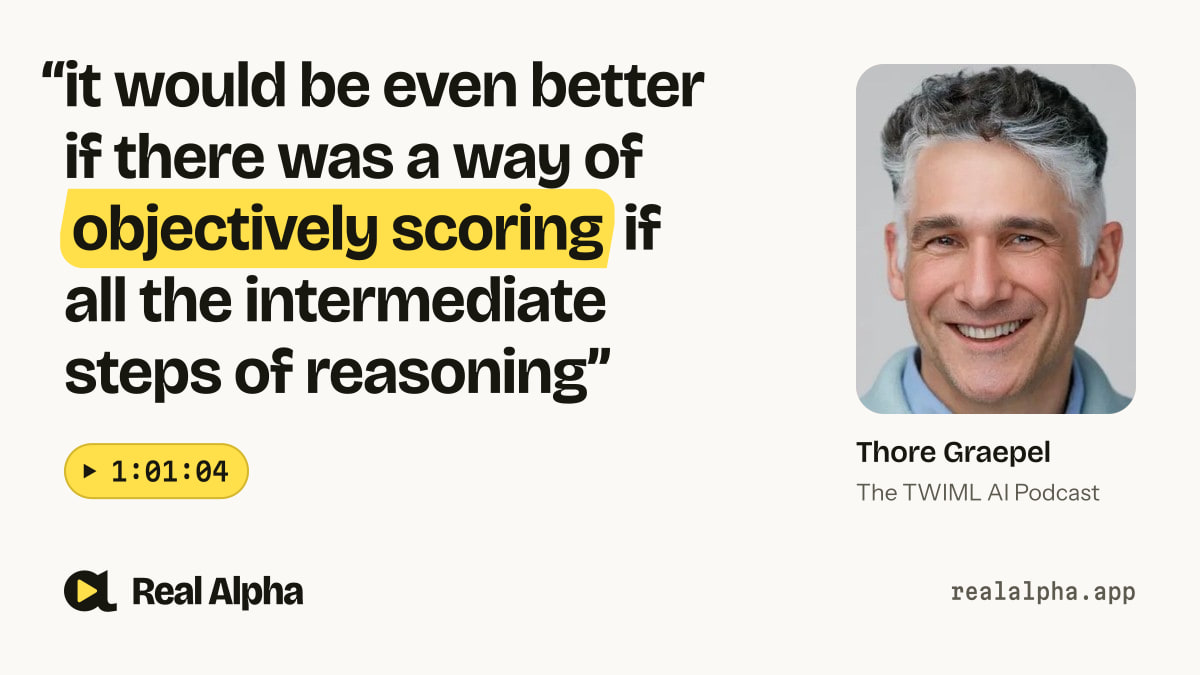
“it would be even better if there was a way of objectively scoring if all the intermediate steps of reasoning”
 Thore Graepelat 1:01:04 · The TWIML AI Podcast
Takeaways
- Correct multiple-choice answers do not prove sound reasoning.
- Score whether intermediate steps support the result.
- Check for skipped steps and unjustified assumptions.
About this segment
Answer-only tests can miss unsupported assumptions, skipped steps, or a correct guess. Thore Graepel wants benchmarks to assess whether each step supports the conclusion, especially for critical uses.

Thore Graepel is CEO and co-founder of Metis Reasoning and Chair of Machine Learning at UCL.
Co-created AlphaGo and now leads Metis Reasoning’s effort to build more reliable, evidence-grounded AI reasoning systems.

Sam Charrington, Host · Host, The TWIML AI Podcast
From “AlphaGo Researcher: LLMs Won’t Get Us to Reliable Reasoning. Here’s What Will.”, Nov 24, 2026. Watch the full episode
Thanks. We'll look at and fix what's off.
Transcript
Transcribed by machine (Whisper) from the episode’s audio, so a word may be off here and there.
- 59:16
How do you think benchmarks change to better kind of accommodate or recognize what you're doing? Like, are they different? Are they the same? Yeah, that's a great question. And I think you're pointing to something interesting, which is that how we define our benchmarks in a way gives us the direction in which we move our research. And so it's really important to define the right benchmarks about the things that actually matter to us in order to then drive the research in that direction.
- 59:49
And so there are a lot of reasoning benchmarks. For example, GPQA Diamond is one of those. you know, PhD level, technical or science questions. And we can evaluate our system on these questions. You know, we need all the tools installed that are necessary to answer the questions. And that is certainly very valuable to do that. It's great that we have them. But what is being measured is perhaps not exactly what needs to be measured.
- 1:00:29
So you can come to an answer and often a correct answer on a multiple choice test without actually presenting the full reasoning trace. And so I think it would be good to expand these benchmarks such that they not only check the answer, which might also be in the training set, by the way, for the frontier models. That's always a bit murky territory, I think. But what actually matters for a lot of applications is that you can see how the system arrived at that.
- 1:01:02
And so I think these benchmarks are a good starting point, but it would be even better if there was a way of objectively scoring if all the intermediate steps of reasoning, the reasoning strategy, if that was consistent and actually leads to the result or if there are steps that are being skipped and assumptions that come in that are unjustified and so on. And so I think it's a very good idea to think about how to extend those benchmarks and what is being measured in them in order to pin down exactly if a system does rigorous reasoning or is more or less guessing at the answer at finding post hoc explanations of why it arrived at the answer.
- 1:01:48
Which is, yeah, to that last point, a very different approach from what you would apply in an LLM scenario because those reasoning traces can be anything and are not, you know, they're post hoc, right? They're not causal to the answer in any way necessarily. It's actually quite entertaining to look at them, right? I mean, I always, you know, sometimes, have you seen the ones where the LLM gets really panicky?
- 1:02:14
where it says, oh my God, the user is asking me to do this and I don't have the answer yet. I mean, what shall I do and things like that. And of course, also the frontier model providers are now obscuring the reasoning traces or the chain of thought traces and encoding them because they want to avoid distillation from them. And so, yeah, that is exactly the reason why we think that that isn't proper reasoning, because you cannot rely on the trace.
- 1:02:51
In some sense, the reasoning is more than the outcome of the reasoning. Reasoning is also the argument that leads to the result. And really, the output is that full package that you need in most critical applications.