The alpha, twice a week
That was 4 min.
Get the best new moments in your inbox every Wednesday and Saturday. It's free.
Check your inbox
We sent a link to your address. Click it to finish signing up. Not there in a minute? Look in spam.
or
The TWIML AI Podcast · 4 min · Nov 24, 2026
Narrow LLM calls can make evidence checks more reliable
 Thore Graepel
 argues that harnesses patch a deeper gap: systems need an explicit record of known, false, and unresolved claims.
In this episode
Full analysis- 6:58Search let AlphaGo find a move its policy network rejected3 min
- 15:19Choose the next step by how much uncertainty it can reduce4 min
- 23:05Separate stored knowledge from the reasoning processPro pick 8 min
- 43:20Evidence assessment is the system's highest-risk step4 min
- 59:14Benchmarks should score the reasoning behind answers4 min
- 37:57Knowledge and reasoning can scale along separate axes5 min
- 31:17Narrow LLM calls can make evidence checks more reliable4 min
- 35:10Decision models can supply cheap, calibrated priors3 min
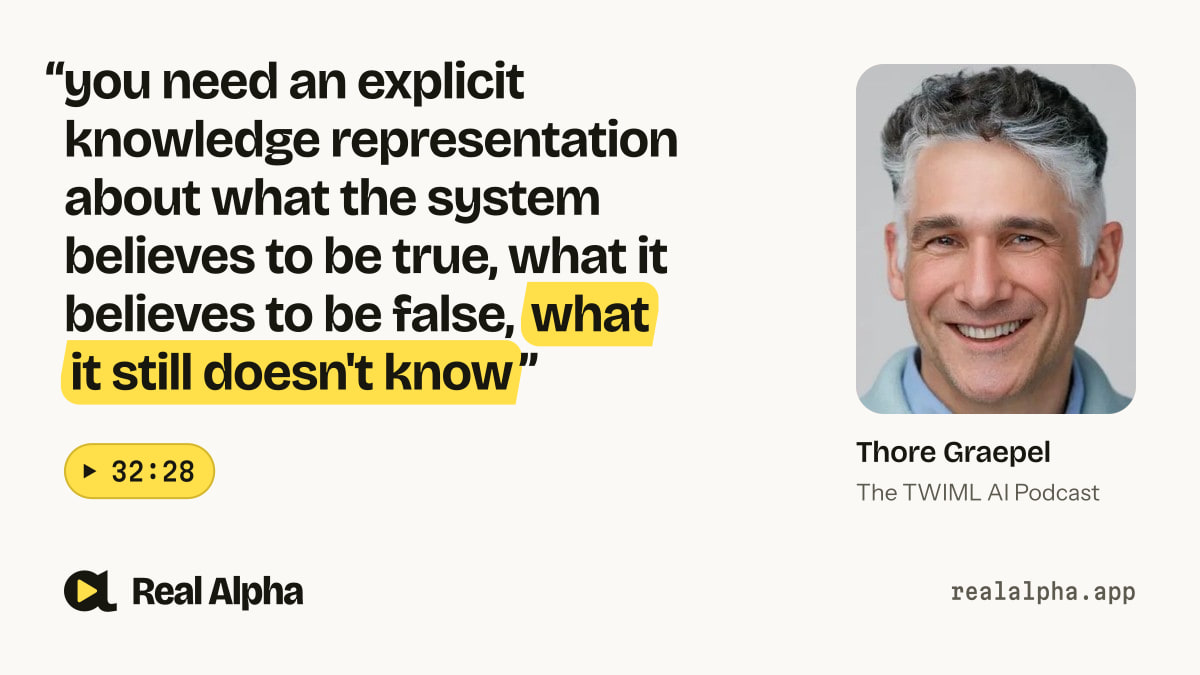
“you need an explicit knowledge representation about what the system believes to be true, what it believes to be false, what it still doesn't know”
 Thore Graepelat 32:28 · The TWIML AI Podcast
Takeaways
- Store true, false, and unresolved claims explicitly.
- Use LLMs to interpret evidence, not to own reasoning.
- Small, scoped calls can support edge or trusted-model use.
About this segment
Thore Graepel argues that harnesses patch a deeper gap: systems need an explicit record of known, false, and unresolved claims. Small, scoped model calls can then interpret evidence without carrying the whole reasoning burden.

Thore Graepel is CEO and co-founder of Metis Reasoning and Chair of Machine Learning at UCL.
Co-created AlphaGo and now leads Metis Reasoning’s effort to build more reliable, evidence-grounded AI reasoning systems.

Sam Charrington, Host · Host, The TWIML AI Podcast
From “AlphaGo Researcher: LLMs Won’t Get Us to Reliable Reasoning. Here’s What Will.”, Nov 24, 2026. Watch the full episode
Thanks. We'll look at and fix what's off.
Transcript
Transcribed by machine (Whisper) from the episode’s audio, so a word may be off here and there.
- 31:20
Like you start with the question, kind of ask a bunch of questions about the question. You generate more text in this case. You ask, OK, what information might I need to further research this? You got you get that information and then you stick this all into a context and you kind of let the LLM do its thing and like predict the answer. And so clearly that's missing like the fundamental probabilistic mechanism that you're proposing.
- 31:48
But it does better than just one shot and what's the capital of France. One of the questions that comes from like that thought process is, you know, you're generating all these claims. Like, what does that look like? Where do you put them? And do you have the same retrieval issues that we see on the RAG side and trying to get the right information into the context? I think a lot of people who develop harnesses are really patching up the same fundamental weakness of LLMs.
- 32:18
I was describing a harness, right? Exactly. That we're seeing. But we believe that you need to do this even more at the root, so to speak. You know, you need an explicit knowledge representation about what the system believes to be true, what it believes to be false, what it still doesn't know, so to speak. And that needs to be at the heart of the system. And then you use the large language models really only to interface with the world and to interpret the evidence that comes from the world and perhaps to make suggestions for hypotheses.
- 33:00
But you break down the reasoning process into these very small calls to language models or to other neural operators in the case of robotics to small visual language models, for example. And in that way, you don't need to rely on these systems to do any reasoning. And that's how you avoid hallucinations because the calls that such a system makes to these neural operators are so small and well-scoped that there's hardly any way the system could hallucinate.
- 33:37
For example, in the case of the capital of France, there might be a Wikipedia page that gives the information that you need. The hypothesis is Paris is the capital of France. And now you're not asking the system, what's the capital of France? You're asking it, does this text snippet from Wikipedia support the statement that Paris is the capital of France? So it becomes a very well-scoped, small theory.
- 34:03
And that also changes the computational profile of the whole method. Because now you don't need a trillion parameter model to do all the kind of processing to get the answer in complex reasoning problems. You decompose the problem and you only need a very small language model to do the semantic interpretations for you. And that is a very attractive profile. Well, for example, if you want to operate on the edge, you know, so you want to run something on your phone or under your desk and things like that.
- 34:41
And it also has interesting sovereignty implications because suppose you don't have access to those frontier models, yet you want frontier level reasoning. You know, you can use a smaller base model that you trust and then you can have this reasoning process on top of it.