The alpha, twice a week
That was 2 min.
Get the best new moments in your inbox every Wednesday and Saturday. It's free.
Check your inbox
We sent a link to your address. Click it to finish signing up. Not there in a minute? Look in spam.
or
MTS · 2 min · Oct 23, 2026
Boom plans to make single-crystal blades in a digital foundry
 Blake Scholl
 says turbine blades are a supply bottleneck, so Boom plans to cast them itself.
The episode’s best minutes
Full analysis- 2:56Boom uses vertical integration to speed up engineering4 min
- 7:52Modular turbines could ease data center power constraintsPro pick 6 min
- 23:38Boom plans to make single-crystal blades in a digital foundryPro pick 2 min
- 3 more moments in the full episode
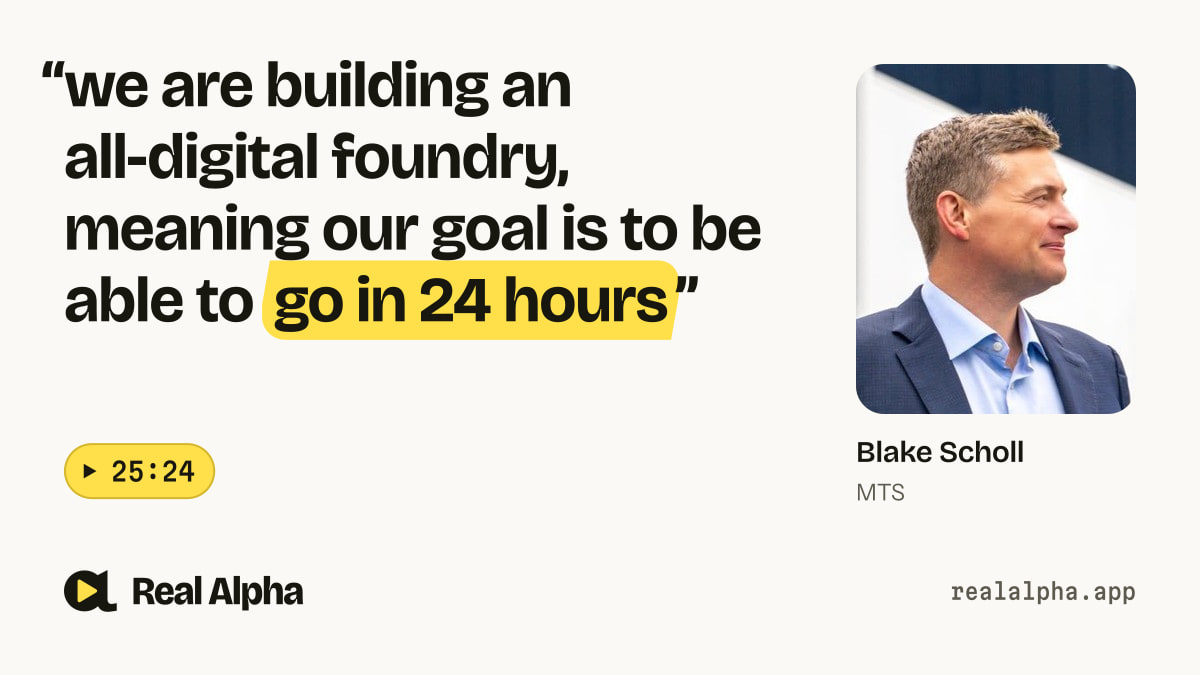
“we are building an all-digital foundry, meaning our goal is to be able to go in 24 hours”
 Blake Schollat 25:24 · MTS
Takeaways Pro pick
- The blades spin at 10,000 RPM in roughly 3,000-degree heat.
- Only a few companies can make single-crystal blades.
- Boom aims to build an all-digital foundry for faster iteration.
One of Pro's picks, open to you here. Try Pro free for 7 days
One of Pro's picks. The rest of the summary and the 3 takeaways are in Real Alpha Pro; the video, the quote and the transcript stay free.
Read it with Pro, 7 days freeAbout this segment
Blake Scholl says turbine blades are a supply bottleneck, so Boom plans to cast them itself. Its goal is to move from blade design to a single-crystal casting in 24 hours.

Blake Scholl is founder and CEO of Boom Supersonic.
Founded Boom Supersonic and led XB-1, the first independently developed jet to break the sound barrier.

Theo Jaffee, Host · Co-founder & host, MTS
One of the first members of a16z's new media team; earlier hosted the Emergent Ventures-backed Theo Jaffee Podcast.

Sophia Dew, Host · Host, MTS
From “Traditional Aerospace Supply Chains Are Cooked | Blake Scholl”, Oct 23, 2026. Watch the full episode
Thanks. We'll look at and fix what's off.
Transcript
Transcribed by machine (Whisper) from the episode’s audio, so a word may be off here and there.
- 23:46
but we haven't talked about yet, is where do the parts come from? And I talked about some of the, like, I'll call it high-tech parts, the, like, blists, these, like, disks that got blades that are machined into them that are made of nickel super alloy. This is, like... the second hardest stuff. But the hardest stuff are actually the turbine blades that spin at 10,000 RPM in an environment that is about 3,000 degrees, hotter than Starship on re-entry.
- 24:13
They have to be actively cooled or they will melt. And actually, Elon talked about this a couple of days ago on the SpaceX earning call because those blades are actually the bottleneck in all of turbines. and turbines are the bottleneck in all of energy. And the energy is the bottleneck in superintelligence. So it's all about these blades. And I always keep getting asked, like, where is Boom gonna get its single crystal blades?
- 24:41
Because these blades, if I describe this in a way, you might think like it's impossible, but it's actually been done before. You basically take this molten metal and it solidifies, it freezes in such a way that the atoms all line up in one perfect grid. Like we're talking like, you know, billions and trillions of atoms, like all in one perfect grid. Like it's not obvious this is possible, but it has been done.
- 25:08
But there are like only a couple of companies on the planet that can do this and they're supply constrained and they're certainly not going to like hand their manufacturing capacity to a startup. And so our other announcement today is we're going to be doing that ourselves. So you can't see it on camera, but from where I'm standing, I can see our first vacuum induction furnace. And this is some of the most advanced industrial equipment in the world.
- 25:30
And we are building an all-digital foundry, meaning our goal is to be able to go in 24 hours from a turbine blade design to the world's most advanced single crystal casting. And I don't think there's anywhere you can actually do that today. But that's going to enable iteration. That's going to enable scaling. Man, so many things coming up in the pipeline. Well, Blake, really wanted to thank you for joining us on MTS.